Owl: Who Runs the World? New Network Analysis…

03 Economy, 07 Other Atrocities, 09 Justice, 11 Society, Civil Society, Commerce, Commercial Intelligence, Corruption, Earth Intelligence, Government, IO Deeds of War, Military, Money, Banks & Concentrated Wealth, Power Behind-the-Scenes/Special Interests
Who? Who?

Who Runs the World ? – Network Analysis Reveals ‘Super Entity’ of Global Corporate

Richard Ricciardi

Planet Save, August 28, 2011

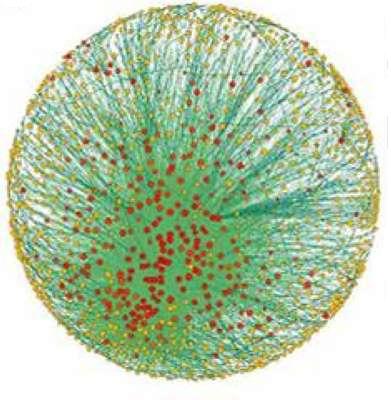
In the first such analysis ever conducted, Swiss economic researchers have conducted a global network analysis of the most powerful transnational corporations (TNCs). Their results have revealed a core of 787 firms with control of 80% of this network, and a “super entity” comprised of 147 corporations that have a controlling interest in 40% of the network’s TNCs.
Read more…

Click on Image to Enlarge

Phi Beta Iota:  It is not the first time this has been done, original work was done in the 1970's on inter-locking boards of directors, and complex forms of relationship analysis were pioneered by Samuel Milgram among others.  It is the first time it has been done in digital form with large amounts of data.  It is not, however, ”
the final answer.”  For that one must understand deep secrecy, over-lapping proxies, the role of clandestine and covert entities, the cross-over among religious organizations, criminal organizations, and government entitites nominally responsible for justice but more often than not actively engaged in crimes against the public interest.  Certainly worth a close read, but the banks are fronts, not the high table.

See Also:

+ Reference: Invisible Empire New World Order DVD + RECAP
+ The Secret Government: The Constitution in Crisis (part 1 of 9)
+ Invisible Government (part 1 of 4, John Pilger)
+ War on Democracy (1 of 10, John Pilger)
+ The American Ruling Class
Paul Fernhout: Global Groundswell Mad as Hell

Civil Society, Cultural Intelligence, Government
Paul Fernhout

Global Groundswell: Mad as Hell

Eric Best,

Truthout, 9 September 2011

EXTRACT:

These are just a few examples of grassroots reactions around the world to governments that appear out of touch with or indifferent to the lives of the people – and the people are not standing for it anymore. They are standing up. And in so doing, they are able to leverage the Internet to discover important truths, publicize their efforts, reveal the tyranny or venality of the opposition and draw those of like mind into efforts of resistance and change.

. . . . . .

It also suggests a world in which rapid collaboration can occur around an idea faster than at any time in history. And this will make for volatile politics. This should be contemplated by regimes that have lasted this long without attending to the fundamental needs of people – jobs, education, health, opportunity. Where the governments are failing to “do it all” – and it seems increasingly that all governments are – people are rising up with unprecedented power to do more – if not all – for themselves.

. . . . . .

It is not too much to imagine this will involve the United States, where many are now fed up with its intransigent if not incompetent government.

Read full article.

See Also:

Graphic: Preconditions of Revolution in the USA Today

Paradigms of Failure

Legitimate Grievances (US Internal)

Legitimate Grievances (Anti-US Global)

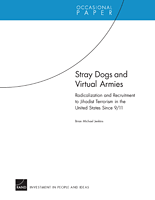
Reference: Stray Dogs and Virtual Armies – Radicalization and Recruitment to Jihadist Terrorism in the United States Since 9/11

03 Economy, 04 Education, 11 Society, Civil Society, Corruption, Cultural Intelligence

Since September 11, 2001, so-called “homegrown terrorists,” working alone or with others, have planned and in some cases implemented terrorist activities, contributed financial or other material support to others' terrorist activities, or become radicalized in the United States and then traveled to other countries to conduct terrorist activities directed against those countries or against the United States. This paper examines the cases of homegrown terrorism from 9/11 through 2010, highlights lessons learned from those cases that suggest actions for the future, and includes a chronology of numbers and case descriptions of terrorist events in the United States during that period. Most of the individuals involved are Muslim, but the numbers are small. A total of 176 Americans have been indicted, arrested, or otherwise identified as jihadist terrorists or supporters since 9/11. They were involved in 82 cases, a majority of which involve the actions of a single individual. Al Qaeda has increasingly used the Internet to build an army of followers. Many of the terrorists identified in this study began their journey online. However, al Qaeda has not yet managed to inspire its online followers to action. Few of the 32 locally hatched jihadist plots to carry out terrorist attacks in the United States since 9/11 got much beyond the discussion stage. Nevertheless, al Qaeda remains a threat. More terrorist attempts will occur. Traditional law enforcement, in which authorities attempt to identify and apprehend a perpetrator after a crime has been committed, is inadequate to deal with terrorists who are determined to cause many deaths and great destruction and who may not care whether they themselves survive. Public safety demands a preventive approach — intervention before an attack occurs. In addition to law enforcement, intelligence collection, and community policing, public reaction is an essential component of such preventive defense.

Source

Tip of the Hat to Berto Jongman for the pointer.

Continue reading “Reference: Stray Dogs and Virtual Armies – Radicalization and Recruitment to Jihadist Terrorism in the United States Since 9/11”

Marcus Aurelius: The Covert Commander in Chief

Corruption, Director of National Intelligence et al (IC), DoD, Government, IO Deeds of War, Media, Military
Marcus Aurelius

The Covert Commander In Chief

By David Ignatius

Washington Post, September 11, 2011

Pg. 15

It's an interesting anomaly of Barack Obama's presidency that this liberal Democrat, known before the 2008 election for his antiwar views, has been so comfortable running America's secret wars.

Phi Beta Iota:  Full story below the line together with a detailed indictment of David Ignatius for spreading such blatant lies on behalf of the secret world and in direct contradiction to the President's actual fears and concerns.

Continue reading “Marcus Aurelius: The Covert Commander in Chief”

Marcus Aurelius: 5 Ways 9/11 Transformed US Military

Corruption, Military
Marcus Aurelius

Five Ways 9/11 Has Transformed The US Military

The attacks of Sept. 11, 2001, fundamentally transformed the way the United States military wages war. With the invasion of Afghanistan and, months later, Iraq on the heels of 9/11, the wars have caused the Pentagon to rethink the way it fights, how it spends money in times of crisis, and what it values in both its highest and lowest-ranking commanders. The Monitor asked experts to weigh in on the Top 5 ways in which 9/11 has changed the US military.

1. How the US military fights on the ground

2. How it spends its money

3. The role of women in the ranks

4. Expanded Use of Special Operations Forces

5. What it values in its leaders – and how it cares for them

Continue reading “Marcus Aurelius: 5 Ways 9/11 Transformed US Military”

Berto Jongman: The Emerging Global Mind

11 Society, Advanced Cyber/IO, Autonomous Internet, Civil Society, Collective Intelligence, Cultural Intelligence, Earth Intelligence, Gift Intelligence, IO Deeds of Peace, Methods & Process, Peace Intelligence, Strategy
Berto Jongman Recommends...

Featured Article

The Emerging Global Mind

Noetic Now, Issue Fourteen, September 2011

by Tiffany Shlain

Fifteen years ago I founded the Webby Awards. I was fascinated by how the Internet was connecting people all over the world in new and unexpected ways. I have also been struck by the many conversations about the problems of our day that view them as separate challenges—whether the environment, women’s rights, poverty, or social justice. It has become increasingly apparent to me that when you perceive everything as connected, it radically shapes your perspective.

The concept of interdependence isn’t new; it’s been around since the dawn of humanity. For two-hundred-thousand years, we’ve been connecting through networks both natural and technological. Interdependence has long been a tenet of Eastern philosophy and indigenous cosmologies. But the recent addition of the Internet has added a new layer, which connects us in a fresh way, giving the world a new type of central nervous system. Something happens in one place, and we can see it, feel it, and do something about it almost instantaneously.

Safety copy below the line (original URL is inconsistent)

Continue reading “Berto Jongman: The Emerging Global Mind”