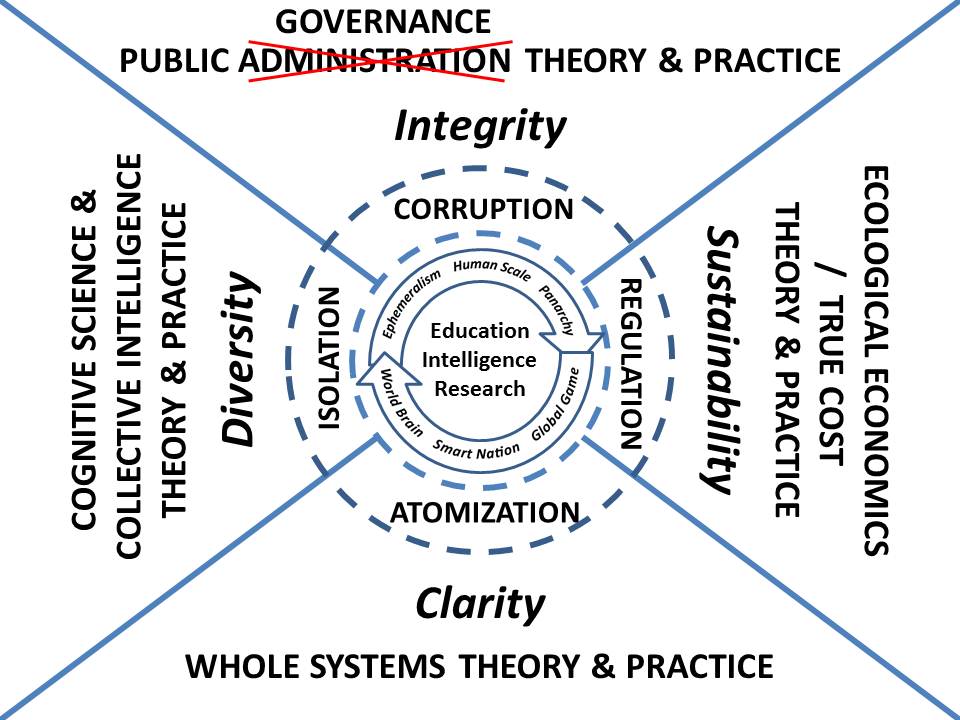
Preliminary thoughts of Robert Steele in Response to
15 Nov 2012 Proposal Deadline 30-31 May 2013 San Francisco Public Administration Theory Network 2013
See Also:
Journal: Reflections on Integrity UPDATED + Integrity RECAP

The truth at any cost lowers all other costs — curated by former US spy Robert David Steele.
Preliminary thoughts of Robert Steele in Response to
15 Nov 2012 Proposal Deadline 30-31 May 2013 San Francisco Public Administration Theory Network 2013
See Also:
Journal: Reflections on Integrity UPDATED + Integrity RECAP

In my opinion, a truly ground-breaking initiative, and a game changer.
Thanks Venessa Miemis, the Quakers, and the whole team, for bringing this about!!
Ask more details via @EmLeaders (twitter).
“”The premise is pretty straightforward: There are plenty of passionate, driven people who want to make cool ideas and projects happen. Access to resources (especially, money) is often a large barrier to actualizing them. So why not create physical locations that don’t require money as a chief organizing energy source, where enthusiastic entrepreneurs, artists, designers and other creatives can come together and prototype their dreams?
The way I previously described the flavor of it was:
the superhero school. a center for disruptive innovation. continuous learning zone. collective intelligence. live/work startup incubator. community center. hackerspace. makerlab. autonomous zone. permaculture and sustainable food production. cooperatively owned communications infrastructure. resilience. r&d lab. a place for creative troublemakers.
The idea wants to happen, so without waiting for conditions to be ‘perfect’ to start, we’ve decided to just go ahead and help build it.

Below is a USGS press release describing some fascinating geological research into the effects of climate change — a huge drought — on the demise of Egypt's Middle Kingdom around 4200 years ago. This is one extreme climate event occurred well before man contributed significant CO2 to the atmosphere. It is also a interesting example of how one can meld science with contemporary/historical/
This research may also be a good object lesson for that subset of paleoclimatologists who are more concerned with erasing the effects of the Medieval Warming Period (~1000 AD when temperatures may well have been as warm or warmer than today) followed by the Little Ice Age (~1600 AD) from human memory, as a means to prove their theory that current temperature increases are unprecedented and therefore due to mankind's generation of CO2. [see Tony Brown's marvelous essay, “The Long Slow Thaw”]
Histories, archives, and folklore have many contemporary accounts of events suggesting the existence both the MWP (settling of Greenland, growing grapes in Scotland) and the LIA (River Thames freezing). The MWP/LIA sequence raises a cyclical possibility and suggests recent temperature increases (since somewhere between 1750 and 1850) may be a normal recovery from the LIA [e.g., see Professor's Akasofu's analysis here].
The stakes of such an hypothesis are huge, because if the MWP/LIA hypothesis is correct, money spent on adaptation would be a far wiser strategy that a huge, and ultimatly futile effort, to reduce CO2 emissions. [1] That is one reason why the study described below is important — it is an example of the benefits that arise from melding science and history and archaeology.
[1] Ironically, while the US is one of, if not, the largest CO2 emitters, its emissions have leveled off and show signs of declining according to data compiled by the Energy Information Administration. [source: here]
Chuck Spinney
Gaeta, Italia
Climate and Drought Lessons from Ancient Egypt: Using Fossil Pollen to Augment Historical Records
Released:8/16/2012 10:00:00 AM
Continue reading “Chuck Spinney: USGS Intelligence with Integrity on Climate Change”
The hysteria coming out of Israel regarding the need to attack Iran raises a question of whether or not Netanyahu is overplaying his hand. Perhaps he is serious. Perhaps he is bluffing in the hope that he can squeeze a huge increase in the annual US aid budget to Israel; perhaps he thinks he can exert enough influence to tip the election in favor of Romney. But if he thinks he can force Obama and the United States into attacking Iran, he is playing a dangerous game that could easily backfire. Mr. Obama is not rising to the bait. Moreover, Netanyahu's odious attempt to manipulate the United States' election process borders on the obscene, and my guess is that Americans, especially independents, are beginning to notice. Netanyahu may be setting himself (and Israel) up for a kind of blowback. Coincidentally or not, Romney's obsequious trip to Israel to harvest Jewish support at home was a public relations bust. Against this background, one wonders what the Iranians are making of this bluster and bombast. Attached is an opinion piece written by an Iranian for the American Iranian Council, an organization dedicated to improving US-Iranian relations. CS
By Shahir ShahidSaless, American Iranian Council
By AIC News – Posted on August 17th, 2012
Israeli threats of an imminent attack against Iran make headlines almost daily. Israel’s media also reflect the latest developments in this respect in a significant fashion. According to Time, “the front pages of the four main Israeli dailies last Friday [August 10] reflected what appeared to be a concerted campaign to create the impression that Israel is preparing itself to start a hot war with Iran sometime over the next 12 weeks.” In an interview with Israeli TV, former Mossad chief Efraim Halevi also said if he were Iranian, he “would be very fearful of the next 12 weeks.”
Continue reading “Chuck Spinney: Smart Iranians, Neutral Americans, Fearful Jews, Idiot Zionists….”
FYI and do share. Many bows to Marilyn.
From: Marilyn Hamilton
Dear friend,
I have big news to share! After months of hard work (well, more like decades actually), I am excited to announce a whole new phase of our Integral City work! This September I will be hosting an online conference called the City 2.0 that will bring together 50 visionaries and hundreds of representatives from cities from around the world. And I want to invite you to join me!
www.integralcitycollective.com

As you know, for years I have been writing, teaching, blogging and preparing for new ways to answer the challenges that city stakeholders face—and we are all stakeholders in our planet’s cities. This September’s conference is the biggest thing to happen in my work since the publication of my book: Integral City: Evolutionary Intelligences in the Human Hive. My colleague Dr. Don Beck remarked that “Marilyn’s two decades of work has created a compelling and important integral and holistic package designed to deal with the unique problems that confront cities”. And it is that design that I want to co-create with you and other citi-zens from around the world. So we've created the conference to allow people worldwide to participate via web and phone or Skype.
The City 2.0 Expo is a 4-week online conference where we will combine our collective best thinking to envision the future of the city and begin to make plans to build it and make it real. As someone who has been following my work (and my blog), I'm imagining you are the perfect person to join us. Don and I will be joined by 50 other authors, experts, and leaders including: Buzz Holling, Bill Rees, Hazel Henderson, Ken Wilber, Terry Patten, Barrett Brown, Jean Houston and many more. Will you come and help me help the emergence of the dream of Integral City in a global community of practice? Just click the link below to find out more or join the conference.
www.integralcitycollective.com
I am so looking forward to connecting with you at this event!
Meshful blessings,
Marilyn
P.S. Please think about who else in your network would be interested in this. We are always asking “Who else should be here?”

Disciplining an Unruly Field: Terrorism Experts and Theories of Scientific/Intellectual Production
Lisa Stampnitzky
Qual Sociol DOI 10.1007/s11133-010-9187-4
Abstract
“Terrorism” has proved to be a highly problematic object of expertise. Terrorism studies fails to conform to the most common sociological notions of what a field of intellectual production ought to look like, and has been described by participants and observers alike as a failure. Yet the study of terrorism is a booming field, whether measured in terms of funding, publications, or numbers of aspiring experts. This paper aims to explain, first, the disjuncture between terrorism studies in practice and the sociological literature on fields of intellectual production, and, second, the reasons for experts’ “rhetoric of failure” about their field. I suggest that terrorism studies, rather than conforming to the notion of an ideal-typical profession, discipline, or bounded “intellectual field,” instead represents an interstitial space of knowledge production. I further argue that the “rhetoric of failure” can be understood as a strategy through which terrorism researchers mobilize sociological theories of scientific/cultural fields as both an interpretive resource in their attempts to make sense of the apparent oddness of their field and their situation, and as schemas, or models, in their attempts to reshape the field. I conclude that sociologists ought to expand our vision to incorporate the many arenas of expertise that occupy interstitial spaces, moving and travelling between multiple fields.
Keywords Terrorism . Experts . Knowledge . Boundary work

