In 1971, Lewis Powell, a mild-mannered, courtly, and shrewd corporate lawyer in Richmond, Virginia, soon to be appointed to the United States Supreme Court, wrote a memorandum to his client, the United States Chamber of Commerce. He outlined a critique and a plan that changed America.
Complete excerpt below the line — real history killing real people.
Joseph Stiglitz (the Nobel prize winning economist) has a great new article: “The Book of Jobs“(behind Vanity Fair's paywall, sorry). In it, he makes a convincing case that the first global depression was caused by a process similar to what we are seeing today (I'm very happy somebody in the social sciences is actually attempting to show how technological change was a driver of the first depression, it's about time). Here it is in a nutshell:first depression, it's about time).
Technological change in the form of the internal combustion engine (cars, tractors, trucks) improved transportation and farm productivity. This led to an agricultural revolution that impacted a huge percentage of the US population.
Farm productivity soared and prices dropped. This forced many farmers into bankruptcy and led to a steady migration of people from rural to urban locations driving down incomes/demand.
The downward pressure on incomes this caused resulted in a protraced economic depression that only ended when the US and Europe mobilized/nationalized every segment of the economy during WW2 (put everyone to work, trained them, etc.).
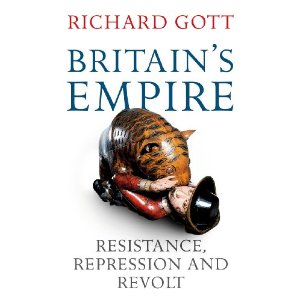
The violence at the heart of colonialism is exposed in Richard Gott's history
Richard Drayton
Guardian, 7 December 2011
Amazon Page for Reviewer's Book Nature's Government
“We insisted on reserving the right to bomb niggers.” So David Lloyd George explained the British government's demand at the 1932 World Disarmament Conference to keep the right to bomb for “police purposes in outlying places”. Airpower had shown its value in spreading what Winston Churchill, when defending in 1919 the use of poison gas against “uncivilised tribes”, had called “a lively terror”. Richard Gott shows how a hundred years earlier more hands-on means were used to similar ends: the heads of rebel slaves in Demerara in 1823 and Jamaica in 1831 were cut from their bodies and placed on poles beside the roads. The mutilation of the corpses of the defeated never quite goes out of fashion.
Amazon Page
Empires have always depended on violence. Killing, torture and the destruction of property are essential to those tasks of destroying resistance, extracting information and collaboration, and demonstrating dominance that underly all conquest. But it is the privilege of conquerors to tell stories that flatter their own past. It is, thus, rare to find the historians of any imperial power describing the ugly business of the frontier as more than unfortunate exceptions to an otherwise honourable enterprise. Britain is no exception: from the Victorians until the 1950s, its historians mainly saw in the British empire a great engine for diffusing liberty and civilisation to the world. If such Whig piety declined in the era after Suez, later scholars, studying particular places and times, never connected all the episodes of massacres, rebellions and atrocities. Popular historians continued profitably to sell happy stories of the empire to the British public – always marketed as daring revisionist accounts.
Gott's achievement is to show, as no historian has done before, that violence was a central, constant and ubiquitous part of the making and keeping of the British empire.
. . . . . . .
What Gott loses by this focus on resistance, however, is any subtlety in understanding the meanings of collaboration. He repeatedly imposes the lens of 20th-century nationalism, and even anti-fascism, so that those who did not rebel become traitors or “fifth columnists”. He does not examine with care or sympathy the varieties of loyalism, and the motives and experiences of those who chose, however mistakenly, to throw in their lot with the British. Neither does he explore how the economic and technological bases of British power changed between 1750 and 1850. For the revolution that science and industry brought to production, transport, communication and war made Britain able to attract and to extort indigenous collaboration more easily, and changed how the British understood themselves as a nation and their rights in the wider world. The empire was made by more than violence.
Found and then lost again in cyberspace….a blogger responds to the question, “Why is Google evil?”
1) They are actively collaborating with NSA and CIA
2) They are focused on exploiting all information with zero privacy controls
3) They are a variation of the Microsoft error–they focus on hacking digital trash instead of empowering humans to make sense–Microsoft focused on “owning” the desktop while shutting out all third party vendors of sense-making through Application Program Interfaces (API) that served as toll booths.
4) They are not open source. I cannot stress this enough. Entire governments (Norway, China) are understanding this now. If it is not open source, it is not suitable for the public domain.
I think we can all agree that this best thing about this site is the collective knowledge and wisdom of its members. As such, last week I commissioned “CaliforniaLawyer” to research and author a “guest post” that would deal with the travesty and threat that is the 2012 National Defense Authorization Act. Fortunately for us, he obliged and his work is presented below.
“All Hail King Obama [Gingrich, Romney, et al.] – New National Defense Authorization Act Renders Constitutional Bill of Rights Mere “Tradition”
Is anyone concerned about the lawlessness and unconstitutionality of the movement to grant the President the power to detain, without trial or representation or due process of law, any citizen that is capriciously perceived to represent a threat to the United States?
Mr. Ferguson is. I am. I know you are, too.
Let’s get right to the issue. The authors of this bill claim that the bill would not enlarge the universe of detainees eligible for indefinite detention in military custody. FALSE. The current Authorization for Use of Military Force, that is, the OLD LAW, confines the universe to persons implicated in the 9/11 attacks or who harbored those who were. The detainee provision in the NEW LAW would expand the universe to include any person said to be “part of” or “substantially” supportive of al-Qaida or Taliban.
“What is keeping us from thriving?” asks the new movie, Thrive. The answer it gives is “the global elite,” the people who control the financial system that in turn controls everything else. Operating through the power institutions of our society, this elite pursues a conscious agenda of total world dominance, purposely suppressing anything that would disrupt their power: from clean energy to alternative cancer cures.
. . . . . . . .
If there ever was an Illuminati orchestrating world events, it has lost control. Today, the atmosphere among the financial elite fluctuates between panic and resignation. They cannot be bothered to suppress films like Thrive, like What on Earth, like Moon Rising, magazines like Infinite Energy, and all the information freely available on the Internet that is accelerating the shift of consciousness away from separation and scarcity.
. . . . . . .
Despite its flaws, in its invocation of evil and in its appeal to technological salvation, Thrive arouses our conviction that the world isn't supposed to be this way, and that a much better world is closer than we dare think. Even if it wrongly ascribes the source of the problem and misidentifies the essence of the solution, still it will stimulate people to deepen their questioning of the boundaries of consensus reality. This is a good thing. Once the questioning starts, it will not stop until we arrive at a new story aligned with the spirit being born today.
Berlin, 1 December 2011 – Corruption continues to plague too many countries around the world, according to Transparency International’s 2011 Corruption Perceptions Index released today. It shows some governments failing to protect citizens from corruption, be it abuse of public resources, bribery or secretive decision-making.
Transparency International warned that protests around the world, often fuelled by corruption and economic instability, clearly show citizens feel their leaders and public institutions are neither transparent nor accountable enough.
The United States Report summarizes and analyzes 73 bribery demands in the U.S. reported anonymously to TRACE’s online Business Registry for International Bribery and Extortion (BRIBEline) between July 11, 2007 and November 15, 2011.
A key finding from the United States report is the prevalence of bribe solicitations made in exchange for an undue advantage. Over one-third of bribe demands in the United States – the highest rate among countries studied to date by BRIBEline – are premised on an improper quid pro quo, such as winning new business (25% of all reported demands), agreeing to attempt to influence a government official in exchange for a bribe (5%) or receiving inappropriate favorable treatment, such as a favorable court ruling (4%).
Phi Beta Iota: Both recommended for a full reading (neither is very long).