Robert Steele: World Bank Open Access / Open Knowledge

Access, Advanced Cyber/IO, Civil Society, Collective Intelligence, Counter-Oppression/Counter-Dictatorship Practices, Cultural Intelligence, Earth Intelligence, Ethics, Future-Oriented, Government, International Aid, IO Deeds of Peace, Key Players, Knowledge, Non-Governmental, Officers Call, Open Government, Peace Intelligence, Policies, Politics of Science & Science of Politics, Resilience, Threats, True Cost, World Bank
Robert David STEELE Vivas

Press Release

WASHINGTON, April 10, 2012 – The World Bank today announced that it will implement a new Open Access policy for its research outputs and knowledge products, effective July 1, 2012. The new policy builds on recent efforts to increase access to information at the World Bank and to make its research as widely available as possible. As the first phase of this policy, the Bank launched today a new Open Knowledge Repository and adopted a set of Creative Commons copyright licenses.

The new Open Access policy, which will be rolled out in phases in the coming year, formalizes the Bank’s practice of making research and knowledge freely available online. Now anybody is free to use, re-use and redistribute most of the Bank's knowledge products and research outputs for commercial or non-commercial purposes.

“Knowledge is power,” World Bank Group President Robert B. Zoellick said. “Making our knowledge widely and readily available will empower others to come up with solutions to the world’s toughest problems. Our new Open Access policy is the natural evolution for a World Bank that is opening up more and more.”

The policy will also apply to Bank research published with third party publishers including the institution’s two journals—World Bank Research Observer (WBRO) and World Bank Economic Review (WBER)—which are published by Oxford University Press, but in accordance with the terms of third party publisher agreements. The Bank will respect publishing embargoes, but expects the amount of time it takes for externally published Bank content to be included in its institutional repository to diminish over time.

Event 21 May 2012 1230-1400 Washington DC

Join us for an Open Discussion: What the Bank's Open Access Policy Means for Development

Monday, May 21, 2012 12:30 p.m. – 2:00 p.m. ET/16:30 – 18:00 GMT

The World Bank will be adopting an Open Access Policy as of July 1. In addition, the Bank recently launched the World Bank Open Knowledge Repository (OKR) and became the first major international organization to adopt a set of copyright licenses from Creative Commons. As a result, a wealth of Bank research and knowledge products are now freely available to anyone in the world for use, re-use, and sharing.

  • Why is this so significant?
  • How can open access contribute to the goal of eliminating poverty?
  • How does the new policy impact the Bank's researchers and authors?
  • How will the OKR benefit users of Bank knowledge, in particular those in developing countries?

Join us in person at the World Bank or online for a lively conversation about these and other aspects of open access to research, and its potential for development progress.

FEATURED GUESTS:
Peter Suber
Director of the Harvard Open Access Project and a leading voice in the open access movement
Cyril Muller
Vice President for External Affairs                  at the World Bank
Michael Carroll
American University law professor and founding board member of Creative Commons
Adam Wagstaff
Research Manager of the World                Bank's Development Research Group
HOST:
Carlos Rossel
World Bank Publisher

See Also:

The Springboard: How Storytelling Ignites Action in Knowledge-Era Organizations

THE OPEN SOURCE EVERYTHING MANIFESTO: Transparency, Truth & Trust

INTELLIGENCE FOR EARTH: Clarity, Diversity, Integrity, & Sustainability

COLLECTIVE INTELLIGENCE: Creating a Prosperous World at Peace

Open Source Agency: Executive Access Point

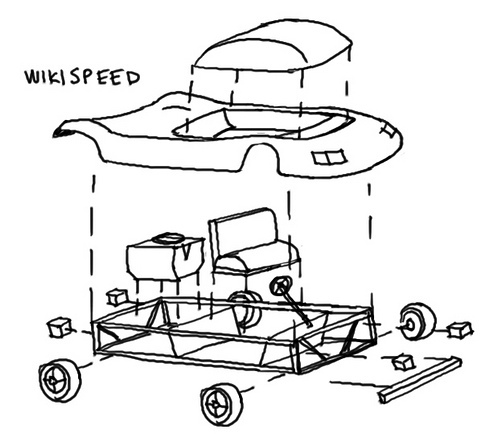
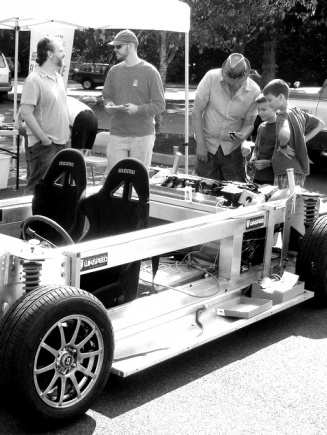
Sepp Hassleberger: Open Source Car Created in Three Months – Interview

03 Economy, 11 Society, Advanced Cyber/IO, Blog Wisdom, Commercial Intelligence, Communities of Practice, Cultural Intelligence, Ethics, Future-Oriented, Hacking, Liberation Technology, Methods & Process
Sepp Hasslberger

Interviewing Joe Justice from Team Wikispeed on the Future of Manufacturing (and Consumption)

Joe Justice is the ideator of Team Wikspeed: a team of volunteers distributed around the world who recently created a prototype car that is open source, modular and ultra-efficient in just three mo… …YES, in just three months compared with the years it takes traditional car manufacturers to bring out a new model.

See Also:

This is an extremely interesting interview with Joe Justice … it gives the gist of where the manufacturing revolution is going.

The interview is in both English and Italian.

Full interview with photos and video.

Click on Image to Enlarge

VIDEO:

Phi Beta Iota:  Achieving an Open Source Everything world is a three part process:

1.  Creation of Open Source Alternatives.

2.  Creation of Integrated infrastructure–pieces need to intersect.

3.  Abolishment of political parties and governments that try to micro-impose safety standards (e.g. air bags) and other onorous measures whose sole real purpose is to make competition unaffordable for the Open Source Everything movement, while blackmailing commerce into contributing to Political Action Campaigns.

Click on Image to Enlarge

See Also:

The Open Source Everything Manifesto: Transparency, Truth & Trust

Robert Steele: Clandestine Operations 101 + Personal Comment

Advanced Cyber/IO, Ethics, Government, Intelligence (government)
Robert David STEELE Vivas

Clandestine Operations 101

Here's how to create a clandestine service that is not the laughing stock of the planet:

00  Stop confusing secure field operations with any need for access to official secrets.  The primary reason CIA is such a mess is the ascendance of security ignorance and myopia combined with sedentary overly fearful managers unable to do anything from outside an official cover safety net.

01  Recruit mid-career US citizens who have unwittingly created their own cover and access.  Do not assign them anything requiring more than 10% of their time.

02  Recruit mid-career non-US citizens, same as above, they never visit HQS or touch secrets not collected by themselves.

03  Get back in the business of Principal Agents (PA) from all countries, same selection concept as above (mid-career, have the cover and access desired).

04  Start doing multinational regional clandestine stations, using indigenous case officers (the Australians and Cambodians seem to have this down pat) while providing close-in technical, money, and leads from the constellation.

05  Be more aggressive (with appropriate caution) in doing what one of my mentors termed “it's just business.”  One time offers based on outcomes, no polygraphs, no approvals from HQS people  out of touch with reality, etcetera.

ON A PERSONAL NOTE

It has come to my attention that someone describing themselves as one of my classmates has said that I nearly killed people in El Salvador, had an accident, and was effectively non-operational from 1982 on.  Since half my class quit within five years, by my calculation there should be no more than one or two of my graduating class (I skipped interims and jumped one class, I remember no one from my EOD class.

Below are the facts, without any grudges.  What I learned from my experiences within CIA remains priceless and has informed my persistent efforts to reform US intelligence.

Continue reading “Robert Steele: Clandestine Operations 101 + Personal Comment”

Patrick Meier: Advice to Future PhDs from 2 Unusual Graduating PhDs – Blog Twitter Hybrid Teach-Consult Dissertation Focus

Advanced Cyber/IO, Blog Wisdom, Collective Intelligence, Communities of Practice, Cultural Intelligence, Ethics, Intelligence (government), Methods & Process, Officers Call
Patrick Meier

Advice to Future PhDs from 2 Unusual Graduating PhDs

Next week I will be attending my official graduation from The Fletcher School to receive my PhD diploma. It is—in a word—surreal. I've been working on my PhD for almost as long as I've known my good friend and colleague Chris Albon, which is to say, a long time. Chris is also a newly minted political science PhD and recently joined the FrontlineSMS team as the director of their Governance Project. Needless to say, our paths have crossed on many occasions over the years and we've had many long conversations about the scholar-practitioner path that we've taken. With graduation just a few days away, we thought we'd write-up this joint post to share our pearls of wisdom with future PhDs.

First: blog, blog, blog! The blog is the new CV. If you don't exist dynamically online, then you're not indexable on the web. And if you're not indexable, then you're not searchable or discoverable. You don't exist! Blog-ergo-sum, simple as that. Chris and I have been blogging for years and this has enabled us to further our knowledge and credibility, not to mention our of network of contacts. The blog allows you to build your own independent brand, not your advisor’s and not your program’s. This is critical. We've received consulting gigs and keynote invitations based on blog posts that we've published over the years. Do not underestimate the power of blogging for your professional (and yes, academic) career. In many ways, blogging is about getting credit for your ideas and to signal to others what you know and what your interests are.

Second: get on Twitter! Malcolm Gladwell is wrong: social media can build strong-tie bonds. Heck, social media is how I originally met Chris. If the blog is the new CV, then consider your Twitter account the new business card. Use Twitter to meet everyone, everywhere. Let people know you'll be in London for a conference and don't underestimate the synergies and serendipity that is the twittersphere. Chris currently follows around 1,200 people on Twitter, and he estimates that over the years he has met around half of them in person. That is a lot of contacts and, frankly, potential employers. Moreover, like blogging, tweeting enables you to connect to others and stay abreast of interesting new developments. Once upon a time, people used to email you interesting articles, conferences, etc. I personally got on Twitter several years ago when I realized that said emails were no longer making it to my inbox. This information was now being shared via Twitter instead. Like the blog, Twitter allows you to create and manage your own personal brand.

Continue reading “Patrick Meier: Advice to Future PhDs from 2 Unusual Graduating PhDs – Blog Twitter Hybrid Teach-Consult Dissertation Focus”

Tom Atlee: Wholesome Capitalism

03 Economy, 09 Justice, 11 Society, Blog Wisdom, Civil Society, Commerce, Ethics
Tom Atlee

Wholesome capitalism?

What would wholesome capitalism look like?

“Wholesome” means healthy, in the sense of something that promotes physical and moral well-being. Wholesome capitalism would take into account the wholeness of people and the social and natural world we live in, and it would enhance that wholeness.

Some people think capitalism already does this. They note how good it has been at generating wealth. The word wealth, meaning abundance, derives from roots meaning well-being and wholeness. Many of capitalism's advocates feel it should be freed from constraints so it can generate more wealth.

Others note that capitalism – while generating wealth for some – many or few, depending on its form in a particular time and place – nevertheless generates much suffering and destruction in the process. It reduces everything to money and maximizes financial return even if it has to degrade and destroy human and natural life to do it. Many of capitalism's critics feel it should be undermined or overthrown.

Still others note both the blessings and problems with capitalism. They think we can have the wealth without so much suffering and destruction. Most of these people promote freeing capitalism's creativity and productivity while restraining its rapaciousness in various ways – using everything from laws, regulations and taxes to moral suasion and consumer-shareholder activism.

In this article I advocate all three positions – odd as that may sound – but only after reframing “capital” and “wealth” to better reflect wholeness.

THE PRIMARY DYNAMIC OF CAPITALISM

The special gift of capitalism is its ability to create MORE – more products and services, more self-organized economic activity, more wealth. In systems science, this tendency to create more-ness is called a positive or reinforcing feedback dynamic.

Continue reading “Tom Atlee: Wholesome Capitalism”

Bojan Radej: Data Journalism Handbook & Graphic Map

Advanced Cyber/IO, Civil Society, Collective Intelligence, Counter-Oppression/Counter-Dictatorship Practices, Ethics, Media, Methods & Process
Bojan Radej

The Data Journalism Handbook is Out

6 months ago at Mozilla Festival 2011, the Data Journalism Handbook was born. Thanks for your interest in the book – I have great pleasure in announcing that the Handbook is now live!

The Handbook features contributions from over 70 leading practitioners of data journalism from every corner of the globe, from Japan to Finland, Nigeria to the US and from leading news outlets such the New York Times, Zeit Online, the BBC and the Guardian. The Handbook is an open educational resource, under a creative commons licence (CC-BY-SA) so please share it with your friends and remix it. We hope that it will encourage many budding data journalists to look at data as a source and give them courage to tackle it, as well as showcasing some great examples of journalism using data as inspiration for future stories.

You can find the handbook at: http://datajournalismhandbook.org/ 

Also available for pre-order is the e- and print version from O'Reilly Media – http://oreil.ly/ddj-e-print – so if you are interested in a version to read offline, take a look!

We will soon have the facility to submit feedback via the website if you spot any errors or have any improvements for the next version,


Lucy Chambers

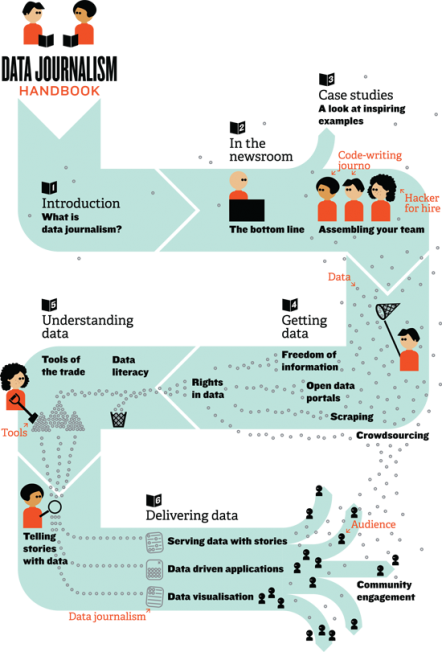
Infographic impresario Lulu Pinney created this superb poster, which gives an overview of the contents of the Data Journalism Handbook.

Click on Image to Enlarge