
Dolphin: USA’s First Coast to Coast Climate Network

03 Environmental Degradation, Advanced Cyber/IO, Communities of Practice, Earth Intelligence, Ethics, Policies

Construction of nation's first coast-to-coast climate network begins

KSL.Com, August 7th, 2011

By Geoffrey Fattah<

LOGAN — Imagine being able to put your fingers on the pulse of America's biosphere — keeping real-time track of weather, water/soil temperature, animal populations and much more. Armed with this information, scientists would be able to detect sudden shifts in climate, perhaps even predict them, allowing the nation to prepare for potential disasters.
Click on Image to Enlarge

The National Science Foundation has given the financial go-ahead to begin construction of the nation's first coast-to-coast network of observatories, including one in Utah, to measure real-time climate changes.

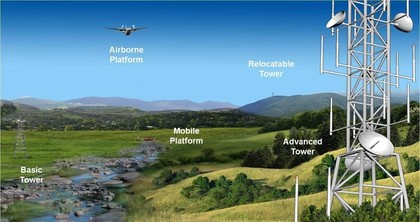
The National Ecological Observatory Network, or NEON, is designed to gather vast amounts of data, every second, from around the country using satellites, observation towers, aircraft sensors, mobile motorized sensors and field work by scientists. From insect samples to weather data, the information will be fed into a central lab to build a picture of the nation's ecological health.

What scientists will keep an eye out for are “threshold events,” or sudden changes in climates, that can lead to droughts, floods, even the spread of diseases, said James MacMahon, dean of Utah State University's College of Science and chairman of NEON's board of directors.

Read more….

Phi Beta Iota:  The most righteous thing the White House has done in our view, starting under Clinton-Gore and continued by Bush-Cheney, has been the Earth Science information-sharing initiative.  The above article neglects the importance of the same initiative being carried out across the oceans, 75% of the Earth's surface.  This particular initiative would do well to adopt the four fundamental opens: Open Source Software, Open Data Access, Open Spectrum, and Open Source Intelligence.


John Robb: Soros Dumps Gold, Could Local Virtual Currencies and Local Water, Food, Energy, and Production be Next Big Thing?

01 Poverty, 02 Infectious Disease, 03 Environmental Degradation, Advanced Cyber/IO, Civil Society, Commerce, Commercial Intelligence, Cultural Intelligence, Earth Intelligence, Ethics, Policies
John Robb

BIG QUESTION: Gold or Virtual Currencies?

As anticipated, we're on the brink of a global economic depression (again).

There's a strong possibility that a long running global depression will lead to a reshuffling of the global economic and political landscape.  IF that happens, many of the fiat currencies we currently use will simply evaporate.

Given this backdrop, here's today's big question:

If the dollar and euro implode…

…will the next global currency be gold or networked virtual currencies (like bitcoin)?  

Until the new currency platform emerges, the safest hedge for the future is building, buying, or trading for anything that can produce food, energy, water, and products locally.

Phi Beta Iota:  George Soros has dumped gold and is largely off the stock market.  John Robb is one of the best observers of chaos versus resilience–his advice above coincides with William Greider's finding in Come Home America, to wit, financial offerings are fraud, asset investments (at the local level) are real.  What all of this leads up to is that we should all stop investing in old systems, and instead do the right thing: invest in bottom-up localized resilience that yields sustainable benefits for all–real assets for real people.

Paul Fernhout: Doug Eaves on Community Management 101

Advanced Cyber/IO, Civil Society, Collective Intelligence, Cultural Intelligence, Ethics, Methods & Process, Policies, Threats
Paul Fernhout

Here is a presentation by David Eaves (from three years ago), on the importance of collaboration, facilitation, and conflict resolution skills for successful free and open source software and content projects (as well as the need for better on-line tools to support all that):

Community Management Presentation

His key point is that “facilitation” (enabling the community) is an essential part of open source software collaborations or open content collaborations, and that we have not prioritized for “facilitation” either in who runs such projects, the companies built around them, how people are trained, or what our online tools are actually good at supporting.

He makes a point that (in round numbers) written text over the web only conveys about 10% of human communication intent, with about another 40% being intonation and the last 50% being body language (so, 90%+ of communicated intent is lost by using text).

He says this is a reason a lot of web communications go wrong with various emotional-related misinterpretations of what people wrote, especially when people have no common face-to-face history together. He presents a model of negotiation where people build “relationship” and “communication”, and then iteratively explore “interests”, “options” to pursue those interests, and “legitimacy” (or likelihood an option will succeed) to find common ground they can work together on as a “commitment” instead of pursuing “alternatives” to the collaboration.

He contrasts that with a competitive up-front take-it-or-leave it style of advocacy for specific actions by others (a style which does not first explore broader common interests that are behind why the specific actions are desired, where common ground might be easier to find by taking a step back from the specific apparent conflict to see a bigger picture of common interests and creative ways to pursue those together).

He suggests that every conversation has four aspects (Inquire, Paraphrase, Acknowledge, and Advocate) and says people spend too much time on “Advocate” to the exclusion of these other important aspects and related skills.  In general, he suggests these communications issues are why so many free and open source projects have problems and that we need better tools to support this sort of facilitation across all aspects of a project (coding, marketing, fundraising, tracking defects, providing support, etc.).

See Also:

Worth a Look: Institute for 21st Century Agoras

John Steiner: Celebrating Chalmers Johnson

03 Economy, 04 Inter-State Conflict, 07 Other Atrocities, 08 Proliferation, 09 Justice, 10 Security, 11 Society, Academia, Advanced Cyber/IO, Analysis, Budgets & Funding, Civil Society, Corporations, Counter-Oppression/Counter-Dictatorship Practices, Cultural Intelligence, Ethics, History, Military, Officers Call, Peace Intelligence, Politics of Science & Science of Politics, Power Behind-the-Scenes/Special Interests, Reform, Secrecy & Politics of Secrecy, Strategy, Waste (materials, food, etc)
John Steiner

Best of TomDispatch: Chalmers Johnson, Dismantling the Empire

Chalmers Johnson (RIP)

TomDispatch.com, 7 August 2011

EXTRACT

Three Good Reasons to Liquidate Our Empire and Ten Steps to Take to Do So

1. We Can No Longer Afford Our Postwar Expansionism

2. We Are Going to Lose the War in Afghanistan and It Will Help Bankrupt Us

3. We Need to End the Secret Shame of Our Empire of Bases

. . . . . . . .

Chalmers Johnson

10 Steps Toward Liquidating the Empire (Abridged)

Dismantling the American empire would, of course, involve many steps. Here are ten key places to begin:

1. We need to put a halt to the serious environmental damage done by our bases planet-wide. We also need to stop writing SOFAs that exempt us from any responsibility for cleaning up after ourselves.

2. Liquidating the empire will end the burden of carrying our empire of bases and so of the “opportunity costs” that go with them — the things we might otherwise do with our talents and resources but can't or won't.

3. As we already know (but often forget), imperialism breeds the use of torture.  Dismantling the empire would potentially mean a real end to the modern American record of using torture abroad.

4. We need to cut the ever-lengthening train of camp followers, dependents, civilian employees of the Department of Defense, and hucksters — along with their expensive medical facilities, housing requirements, swimming pools, clubs, golf courses, and so forth — that follow our military enclaves around the world.

5. We need to discredit the myth promoted by the military-industrial complex that our military establishment is valuable to us in terms of jobs, scientific research, and defense. These alleged advantages have long been discredited by serious economic research. Ending empire would make this happen.

6. As a self-respecting democratic nation, we need to stop being the world's largest exporter of arms and munitions and quit educating Third World militaries in the techniques of torture, military coups, and service as proxies for our imperialism.

7. Given the growing constraints on the federal budget, we should abolish the Reserve Officers' Training Corps and other long-standing programs that promote militarism in our schools.

8. We need to restore discipline and accountability in our armed forces by radically scaling back our reliance on civilian contractors, private military companies, and agents working for the military outside the chain of command and the Uniform Code of Military Justice. Ending empire would make this possible.

9. We need to reduce, not increase, the size of our standing army and deal much more effectively with the wounds our soldiers receive and combat stress they undergo.

10. To repeat the main message of this essay, we must give up our inappropriate reliance on military force as the chief means of attempting to achieve foreign policy objectives.

Read full article with many links…

The Impact Today and Tomorrow of Chalmers Johnson

Steve Clemons

The Washington Note, 21 November 2010

Read full summary….

Phi Beta Iota:  The second article is a stunning review of the intellectual life of Chalmers Johnson, who was among many things a net assessments analyst for Allen Dulles.  He pioneered the study of “State Capitalism” and considered the US to be a greatly under-performing economy for its failure to move away from military unilateralism and toward sustainable development.


Venessa Miemis: Self-Assembling Dynamic Networks and Boundary-less Tribalism (Includes Diaspora)

Advanced Cyber/IO, Autonomous Internet, Civil Society, Collective Intelligence, Cultural Intelligence, Ethics, Hacking
Venessa Miemis

2011: Self-Assembling Dynamic Networks And Boundary-less Tribalism

DK Matai, mi2g

Business Insider, 19 January 2011

“Self-assembling dynamic networks” is one phrase we should all memorise to prepare ourselves and to understand 2011. This phrase encapsulates the defining aspect of both the year ahead and the years to come, as we embark on the second decade of the 21st century.

Whether we act as individuals, families, communities, businesses, government departments or organizations, there can be no question that we have to listen, learn and adapt according to the massive paradigm shift created by self-assembling dynamic networks and their by-product: boundary-less tribalism.

. . . . . . . .

All Silos Penetrated

Just like biological systems, self-assembling dynamic networks are increasingly manifest in every aspect of human thought, behaviour and endeavour in the 21st century enabled by mobile telephones and the Internet. It is no longer a question of when or where… societies, governments, businesses and non-governmental-organisations are all being buffeted by the consequences of this rising phenomenon. Geo-politics, foreign policy, domestic governance, tran-national business, financial markets and online platforms are all being subject to the vagaries of self-assembling dynamic networks in countless ways.

. . . . . . .

Key Features

The key features of self-assembling dynamic networks are as follows:

1. Asymmetric power
2. Unintended consequences
3. No central control
4. No intelligent blueprint or formalised design
5. Rapid scaling
6. Unprecedented speed
7. Trans-national synchronicity
8. Total transparency
9. Creation of boundary-less tribalism
10. New order born out of chaos

Read full article….

Seth Godin: Creativity Demands Deep Understanding

Advanced Cyber/IO, Blog Wisdom, Collective Intelligence, Ethics, Hacking
Seth Godin

Bypassing the leap

Every now and then, a creative act comes out of nowhere, a giant leap, a new way of thinking apparently woven out of a brand new material.

Most of the the time, though, creativity is the act of reassembling many elements that are already known. That's why domain knowledge is so critical.

The screenwriter who understands how to take the build that went into the classic Greg Morris episode of the Dick Van Dyke show and integrate it with the Maurce Chevalier riff from the Marx Bros… Or the way Moby took his encyclopedic knowledge of music and turned into a record that sold millions… if you don't have awareness and an analytical understanding of what worked before, you can't build on it.

That's one of the reasons that the recent incarnation of the Palm failed. The fact that the president of the company had never used an iPhone left them only one out: to make a magical leap.

It's not enough to be aware of the domain you're working in, you need to understand it. Noticing things and being curious about how they work is the single most common trait I see in creative people. Once you can break the components down, you can put them back together into something brand new.

Steve Denning: Reinventing Education

04 Education, 11 Society, Advanced Cyber/IO, Blog Wisdom, Civil Society, Ethics
Steve Denning

Leadership

What’s Involved In Reinventing Education?

Steve Denning

Forbes ASAP 4 August 2011

The significant problems we have cannot be solved at the same level of thinking with which we created them.

Albert Einstein

The US education system is in crisis, putting the long-term future of the economy in question. The evidence is well-known. A root cause of the crisis is the application of the factory model of management to education, where everything is arranged for the scalability and efficiency of “the system”, to which the students, the teachers and the parents have to adjust. “The system” grinds forward, at ever increasing cost and declining efficiency, dispiriting students, teachers and parents alike.

Read full article with new graphic….