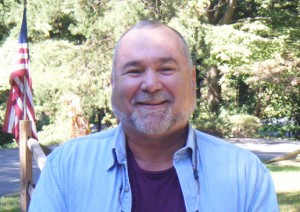
Event: 13-14 July NYC Robert Steele Live at Hackers on Planet Earth (HOPE)

Advanced Cyber/IO, Communities of Practice, Cultural Intelligence, Earth Intelligence, Ethics, Hacking, Knowledge

Hackers on Planet Earth (HOPE) Number 9

HOPE Number Nine will be taking place on July 13, 14, and 15, 2012 at the Hotel Pennsylvania in New York City. H.O.P.E. stands for Hackers On Planet Earth, one of the most creative and diverse hacker events in the world that's been happening since 1994.

Learn more, Register

Robert David STEELE Vivas

Live at the Hotel Pennsylvania in New York City

The opening speaker for HOPE in 1994, he has been invited back to every HOPE since then, offering both a serious briefing, and SPY IMPROV, his “open anything” Q&A.

AnyMan for President

30 Minutes:  Robert Steele: How I Tested the Boundaries of the Two-Party Tyranny – Last Call for Occupy/*

Not to be outdone by Jello Biafra, Robert Steele ran for President in 2012.  Accepted by the Reform Party as a candidate, he tested the boundaries for six weeks, created a world-class presidential platform, a coalition cabinet, and the foundation for a national strike to demand electoral reform.  He also connected with every single other candidate less Romney, and reports his impressions….not pretty at all.  His campaign put forward AnyMan for President, and is the only campaign to focus on a concept instead of a personality.  We the People Reform Coalition
Amazon Page

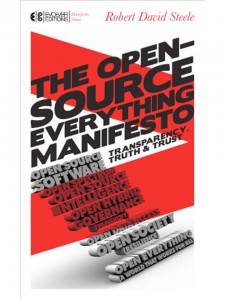
30 Minutes:  2012 The Open Source Everything Manifesto: Transparency, Truth, & Trust (Evolver Editions, June 2012)

If you thought Steele was motivated before, promoting Open Source Intelligence (OSINT), you ain't seen nothin' yet.  Now he's going for the whole enchilada.  In a 215 page pocketbook (use the link above to see the 33 slides and buy it in advance from any number of sources) he lays out how We the People can reconnect with our integrity, harvest the integrity inherent in Nature, and stomp into oblivion the fraud, waste, and abuse characteristic of all of our organizations — academic, civil society, commerce, government, media, military, and non-government/non-profit.  Steele is for intelligence (decision-support) what Stallman is for software. The citizens' intelligence militia is self-organizing, from zip code to global.  Panarchy rules!

2 hours:  SPY IMPROV:  Everything you ever wanted to ask about anything…

Steele, a recovering spy, honorary hacker across multiple continents, and the #1 Amazon reviewer for non-fiction, reading in 98 categories (see the list here) will answer any question on any topic.  Having already set the world record at The Next HOPE (8, 2010) with an eight-hour Q&A, this year the time is being strictly limited to 2 hours.

See Also:

THE OPEN SOURCE EVERYTHING MANIFESTO: Transparency, Truth & Trust

Howard Rheingold: Google’s Next Step in Search

Advanced Cyber/IO, Commercial Intelligence
Howard Rheingold

This is what “Metaweb” was working on before they were acquired by Google — Howard

“When you search, you’re not just looking for a webpage. You’re looking to get answers, understand concepts and explore.

The next frontier in search is to understand real-world things and the relationships among them. So we're building a Knowledge Graph: a huge collection of the people, places and things in the world and how they're connected to one another.

This is how we’ll be able to tell if your search for “mercury” refers to the planet or the chemical element–and also how we can get you smarter answers to jump start your discovery.”

Introducing the Knowledge Graph

Phi Beta Iota: Google continues to do math hacks on digital garbage. While it is beneficial to connect the Internet of things with the Internet of words and numbers, Google is a) not a search company, something most do not understand, and b) not at all committed to making sense in the public interest. When Google can cannot every mind, written and spoken word, thing, and location relevant to understanding poverty, then we will be impressed. Until then, like Microsoft, Google is part of the problem, not the solution.

Owl: Anonymous Makes a Statement – Has Meat, Add Salt

Advanced Cyber/IO, Civil Society, Commerce, Cultural Intelligence, Government, Hacking, Liberation Technology, Non-Governmental
Who? Who?

This interview overall undoubtedly has misconceptions, self-inflated bravado, gross exaggerations and so forth, but if the last statement he utters is true about people coming to them, even to a significantly lesser degree than he indicates, the world-ruling elites might be quaking ever-so-slightly, but involuntarily, in their boots. And much more so if indeed insiders are giving Anonymous the “keys to the kingdom,” the passwords into it.

Insider tells why Anonymous ‘might well be the most powerful organization on Earth

EXTRACT:

Q. What’s next for Anonymous?

A: Right now we have access to every classified database in the U.S. government. It’s a matter of when we leak the contents of those databases, not if. You know how we got access? We didn’t hack them. The access was given to us by the people who run the systems. The five-star general (and) the Secretary of Defence who sit in the cushy plush offices at the top of the Pentagon don’t run anything anymore. It’s the pimply-faced kid in the basement who controls the whole game, and Bradley Manning proved that. The fact he had the 250,000 cables that were released effectively cut the power of the U.S. State Department in half. The Afghan war diaries and the Iran war diaries effectively cut the political clout of the U.S. Department of Defence in half. All because of one guy who had enough balls to slip a CD in an envelope and mail it to somebody. Now people are leaking to Anonymous and they’re not coming to us with this document or that document or a CD, they’re coming to us with keys to the kingdom, they’re giving us the passwords and usernames to whole secure databases that we now have free reign over. … The world needs to be concerned.

Read full article.

Phi Beta Iota:  01  Any system built by humans can be hacked by humans.  02  A system's security is heavily dependent on the legitimacy of the system owner in the eyes of those using the system.

See Also:

Journal: Reflections on Integrity UPDATED + Integrity RECAP

The Search for Security: A U.S. Grand Strategy for the Twenty-First Century

Mini-Me: Cash, and Time, Runs Out for Afghanistan’s Wi-Fi City

Advanced Cyber/IO, Civil Society, Collective Intelligence, Cultural Intelligence, Ethics, Hacking
Who? Mini-Me?

Huh?

Cash, and Time, Runs Out for Afghanistan’s Wi-Fi City

It was a project that symbolized America’s grand ambitions to rebuild Afghanistan: a DIY Wi-Fi network, free for Afghans to use, powering the aid projects and business ventures of the eastern city of Jalalabad. But now funding for the JLink network has run dry, and like so much of the Afghanistan war, it’s run out of time. Most of Jalalabad is about to go offline.

The sudden collapse of the network is causing local aid workers, entrepreneurs and the entire city to adjust to the prospect of life without a freely available internet. JLink is woven into the fabric of Jalalabad: It took about two years for high-speed internet to become available through JLink in the city’s public hospital, local elementary schools and the women’s dorm at Nangarhar University. After one of JLink’s two satellite connections went dark on May 1, some in the city’s aid community considered it a prelude to a larger international withdrawal from Afghanistan.

JLink is not something the Taliban destroyed. Its impending collapse illustrates what happens when grand ambitions lead to grand achievements that ultimately prove unsustainable — perhaps because they proceeded from unstable, utopian premises. And like the war itself, the group that created JLink is out of time to salvage its project.

Continue reading “Mini-Me: Cash, and Time, Runs Out for Afghanistan’s Wi-Fi City”

Patrick Meier: Departing for Qatar

08 Wild Cards, Advanced Cyber/IO, Blog Wisdom, Civil Society, Collective Intelligence, Commerce, Commercial Intelligence, Cultural Intelligence, Earth Intelligence, Ethics, Government, Media, Mobile
Patrick Meier

Joining the Qatar Foundation to Advance Humanitarian Technology

Big news! I'll be taking a senior level position at the Qatar Foundation to work on the next generation of humanitarian technology solutions. I'll be based at the Foundation's Computing Research Institute (QCRI) and be working alongside some truly amazing minds defining the cutting edge of social and scientific computing, computational linguistics, big data, etc. My role at QCRI will be to leverage the expertise within the Institute, the region and beyond to drive technology solutions for humanitarian and social impact globally—think of it as Computing for Good backed by some serious resources.  I'll spend just part of the time in Doha. The rest of my time will be based wherever necessary to have the greatest impact. Needless to say, I'm excited!

My mission over the past five years has been to catalyze strategic linkages between the technology and humanitarian space to promote both innovation and change, so this new adventure feels like the perfect next chapter in this exciting adventure. I've had the good fortune and distinct honor of working with some truly inspiring and knowledgeable colleagues who have helped me define and pursue my passions over the years. Needless to say, I've learned a great deal from these colleagues; knowledge, contacts and partnerships that I plan to fully leverage at the Qatar Foundation.

It really has been an amazing five years. I joined the Harvard Humanitarian Initiative (HHI) in 2007 to co-found and co-direct the Program on Crisis Mapping and Early Warning. The purpose of the program was to assess how new technologies were changing the humanitarian space and how these could be deliberately leveraged to yield more significant impact. As part of my time at HHI, I consulted on a number of cutting-edge projects including the UNDP's Crisis and Risk Mapping Analysis (CRMA) Program in the Sudan. I also leveraged this iRevolution blog extensively to share my findings and learnings with both the humanitarian and technology communities. In addition, I co-authored the UN Foundation & Vodafone Foundation Report on “New Technologies in Emergen-cies and Conflicts” (PDF).

Continue reading “Patrick Meier: Departing for Qatar”

Marcus Aurelius: US SOF Seeks Global SOF Network Including Regional Multinational Op-Intel Centers — What Regional Commands SHOULD Have Created

Advanced Cyber/IO, Military
Marcus Aurelius

U.S. [SOF Commander] Seeks Global Spec Ops Network

1st ‘Node' to Stand Up in '13

Defense News, May 14, 2012, Pg. 1

By Barbara Opall-Rome

AMMAN — U.S. Special Operations Command (SOCOM) wants to establish a worldwide network linking special operations forces (SOF) of allied and partner nations to combat terrorism.

Championed by SOCOM commander Adm. Bill McRaven and Deputy Director of Operations Brig. Gen. Sean Mulholland, the network would comprise regional security coordination centers, organized and structured similarly to NATO SOF Headquarters in Mons, Belgium.

“Imagine the power a confederation of SOF interests could have. It could collectively increase its influence and operational reach around the globe,” Mulholland told participants at a May 7 Middle East Special Operations Commanders Conference here.

Continue reading “Marcus Aurelius: US SOF Seeks Global SOF Network Including Regional Multinational Op-Intel Centers — What Regional Commands SHOULD Have Created”

Robert Steele: World Bank Open Access / Open Knowledge

Access, Advanced Cyber/IO, Civil Society, Collective Intelligence, Counter-Oppression/Counter-Dictatorship Practices, Cultural Intelligence, Earth Intelligence, Ethics, Future-Oriented, Government, International Aid, IO Deeds of Peace, Key Players, Knowledge, Non-Governmental, Officers Call, Open Government, Peace Intelligence, Policies, Politics of Science & Science of Politics, Resilience, Threats, True Cost, World Bank
Robert David STEELE Vivas

Press Release

WASHINGTON, April 10, 2012 – The World Bank today announced that it will implement a new Open Access policy for its research outputs and knowledge products, effective July 1, 2012. The new policy builds on recent efforts to increase access to information at the World Bank and to make its research as widely available as possible. As the first phase of this policy, the Bank launched today a new Open Knowledge Repository and adopted a set of Creative Commons copyright licenses.

The new Open Access policy, which will be rolled out in phases in the coming year, formalizes the Bank’s practice of making research and knowledge freely available online. Now anybody is free to use, re-use and redistribute most of the Bank's knowledge products and research outputs for commercial or non-commercial purposes.

“Knowledge is power,” World Bank Group President Robert B. Zoellick said. “Making our knowledge widely and readily available will empower others to come up with solutions to the world’s toughest problems. Our new Open Access policy is the natural evolution for a World Bank that is opening up more and more.”

The policy will also apply to Bank research published with third party publishers including the institution’s two journals—World Bank Research Observer (WBRO) and World Bank Economic Review (WBER)—which are published by Oxford University Press, but in accordance with the terms of third party publisher agreements. The Bank will respect publishing embargoes, but expects the amount of time it takes for externally published Bank content to be included in its institutional repository to diminish over time.

Event 21 May 2012 1230-1400 Washington DC

Join us for an Open Discussion: What the Bank's Open Access Policy Means for Development

Monday, May 21, 2012 12:30 p.m. – 2:00 p.m. ET/16:30 – 18:00 GMT

The World Bank will be adopting an Open Access Policy as of July 1. In addition, the Bank recently launched the World Bank Open Knowledge Repository (OKR) and became the first major international organization to adopt a set of copyright licenses from Creative Commons. As a result, a wealth of Bank research and knowledge products are now freely available to anyone in the world for use, re-use, and sharing.

  • Why is this so significant?
  • How can open access contribute to the goal of eliminating poverty?
  • How does the new policy impact the Bank's researchers and authors?
  • How will the OKR benefit users of Bank knowledge, in particular those in developing countries?

Join us in person at the World Bank or online for a lively conversation about these and other aspects of open access to research, and its potential for development progress.

FEATURED GUESTS:
Peter Suber
Director of the Harvard Open Access Project and a leading voice in the open access movement
Cyril Muller
Vice President for External Affairs                  at the World Bank
Michael Carroll
American University law professor and founding board member of Creative Commons
Adam Wagstaff
Research Manager of the World                Bank's Development Research Group
HOST:
Carlos Rossel
World Bank Publisher

See Also:

The Springboard: How Storytelling Ignites Action in Knowledge-Era Organizations

THE OPEN SOURCE EVERYTHING MANIFESTO: Transparency, Truth & Trust

INTELLIGENCE FOR EARTH: Clarity, Diversity, Integrity, & Sustainability

COLLECTIVE INTELLIGENCE: Creating a Prosperous World at Peace

Open Source Agency: Executive Access Point

noble gold