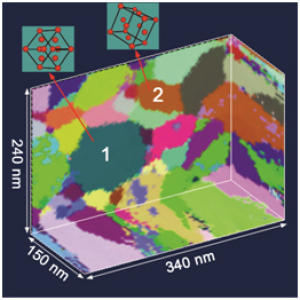
Three-Dimensional Orientation Mapping in the Transmission Electron. This image shows the arrangement of crystals in a 150nm thick nanometal aluminium film. The crystals have identical lattice structure (arrangement of atoms) but they are orientated in different ways in the 3-D sample as illustrated by the labels 1 and 2.
The colours represent the orientations of the crystals and each crystal is defined by volumes of the same colour. The individual crystals of various sizes (from a few nm to about 100 nm) and shapes (from elongated to spherical) are clearly seen and mapped with a resolution of 1 nanometer.
(Credit: Image courtesy of Risø National Laboratory for Sustainable Energy)
ScienceDaily (May 16, 2011) — Scientists from Denmark, China and USA have developed a new method for revealing 3-D images of the structure inside a material.
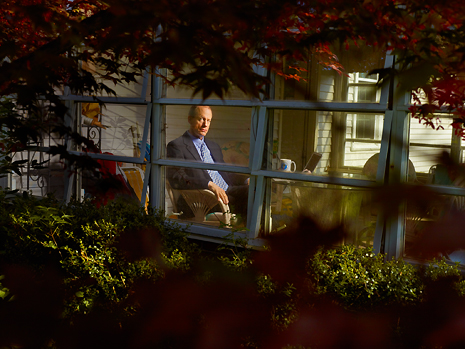
An insightful account of the pending prosecution under the Espionage Act of former National Security Agency official Thomas A. Drake appears this week in The New Yorker. Author Jane Mayer delves deeply into the origins of the case stemming from Drake's critical view of NSA management and surveillance practices. She explores the unfolding consequences of the case and its larger significance.
Among the article's many striking observations on the Drake case is the concluding quote from Mark Klein, a former AT&T employee who exposed warrantless surveillance activity by the Bush Administration. “I think it’s outrageous,” he says. “The Bush people have been let off. The telecom companies got immunity. The only people Obama has prosecuted are the whistle-blowers.”
Photo Caption: Drake, a former senior executive at the National Security Agency, faces some of the gravest charges that can be brought against an American citizen. Photograph by Martin Schoeller.
Before Gutenberg, a book cost about as much as a small house. As a result, only kings and bishops could afford to own a book of their own.
This naturally led to the creation of shared books, of libraries where scholars (everyone else was too busy not starving) could come to read books that they didn't have to own. The library as warehouse for books worth sharing.
Only after that did we invent the librarian.
The librarian isn't a clerk who happens to work at a library. A librarian is a data hound, a guide, a sherpa and a teacher. The librarian is the interface between reams of data and the untrained but motivated user.
After Gutenberg, books got a lot cheaper. More individuals built their own collections. At the same time, though, the number of titles exploded, and the demand for libraries did as well. We definitely needed a warehouse to store all this bounty, and more than ever we needed a librarian to help us find what we needed. The library is a house for the librarian.
EXTRACT: Strip away the mathematical language of economists, and conventional theories of economic growth are rather crude. Economies produce “stuff,” and if you want more stuff to come out of the process, put more stuff in (like human capital, say). Yet economies do not produce stuff so much as billions of distinct types of goods — perhaps 10 billion, according to Eric Beinhocker of the McKinsey Global Institute — ranging from size 34 dark stonewash bootcut jeans to beauty therapies involving avocado. The difference between China's economy and that of the United States is not simply that China's is smaller; it has a different structure entirely.
Phi Beta Iota: This is a very promising line of inquiry. It does not include the vital but poorly understood interactions among political-legal (integrity), socio-economic (fairness), ideo-cultural (education), and techno-demographic (balance), and natural-geographic (true cost, sustainability). As with most intellectual work these days, it is a thin slice across one dimension of very complex sphere–the world is NOT flat.
I'm excited to announce the release of my new movie “Where is Away: Solving
Plastic Pollution in 4 Minutes”. It tracks a plastic bag that I use in my hometown of Santa Cruz California, all the way to the north shore of Oahu, demonstrating both the destruction and solutions along the way. Famous musician Jack Johnson, and Story of Stuff Annie Leonard join me in this fast-paced journey to highlight the power we all have to end plastic pollution.
LAS VEGAS—The era of US economic dominance is rapidly coming to an end as an “American Gothic” age sets in and China becomes the new global leader, economic historian Niall Ferguson said.
. . . . . .
01 The “mother of all Keynsian fiscal binges” in which the government spent nearly $1 trillion on stimulus from which there will be a “hangover” with only the timing at question.
02 A “massive monetary binge” in which the Federal Reserve ultimately will print money to the tune of nearly $3 trillion.
03 An ensuing spike in commodity prices, a process that has gone on virtually unabated since the beginning of Fed intervention and for which there has been a recent pullback.
04 China “is not the Soviet Union,” meaning the nation doesn’t have the same destabilizing economic conditions that brought down the former Communist republic.
Phi Beta Iota: Mr. Ferguson is correct on his four factors, but leaves out much more. The loss of integrity across not just the US Government but across every major “tribe” comprising the US nation-state (see our “Paradigms of Failure” and also “Legitimate Grievances“) is the root problem Within that is the collapse of education, the ruthless export of jobs that could have been kept in the USA if infrastructure had been developed properly, the looming private debt collapse (defaults of credit cards and everything else), and the deep social challenge of dealing with several hundred thousand returning veterans who are mentally and physically ill, facing unemployment, and rapidly discovering that their pain and suffering was for nothing.
The Tehran Peace Conference started on 14 May and ended today, 15 May, (63rd Anniversary of Palestine's Nakbah ) with me chairing the 7:30 am panel entitled, “Terrorism: Concepts and Contexts.” Members of the Clergy from Brazil, Greece, and the U.S. made presentations as well as international lawyers, academicians, and peace activists from Australia, Canada, Ecuador, Venezuela, Spain, Ghana, and Bolivia. My assignment is to write up my report of each of the presentations and submit the recommendations from the panel to the Conference Secretariat.
On Day One of the Opening Plenary with journalist Jim Lobe seated on my right and Rabbis Weiss and Rosenberg sitting in front of me, I was surprised when my name was called to make a presentation at the opening plenary of the Tehran Peace Tribune. I immediately set about writing my remarks and here is what I said:
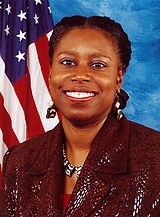
Cynthia McKinney
International Conference on Global Alliance Against Terrorism for a Just Peace
Tehran, Iran
15 May 2011
How wonderful to be at a Conference where the word “love” is used; we are here because we love humankind. We are here from all corners of the earth; we are against terrorism; we want peace.
However, we must clarify peace. What kind of peace do we want?
President John F. Kennedy answered his question by saying: “. . . not a Pax Americana” imposed on the world by weapons of war. He went on to say that the kind of peace we want is the kind of peace that makes life worth living–peace for all men and women for all time.
No Justice, No Peace. No Truth, No Justice!
But, today, U.S. policy is rooted in lies, injustice, and war. And at home, the people of the U.S. suffer. Racism is acute, despite and maybe because of President Obama; hatred is rampant with hatred of Muslims, incarceration of Palestinians, targeting of immigrants, the lynchings of Blacks, disappearances of Latinos, and the pauperization of the people. People inside the U.S. are under attack in the realm of policy:

 Three-Dimensional Orientation Mapping in the Transmission Electron. This image shows the arrangement of crystals in a 150nm thick nanometal aluminium film. The crystals have identical lattice structure (arrangement of atoms) but they are orientated in different ways in the 3-D sample as illustrated by the labels 1 and 2.