Leadership should be about nurturing clarity, diversity, and integrity to achieve sustainability. Leadership strategy is how you get there, combining an absolute demand for the best truth in a holistic fashion, with an absolute demand for integrity across all boundaries.
CIA Decides Not to Get Serious: Memories of a Lost Time and Place
“These documents remained classified for nearly a century until recent advancements in technology made it possible to release them,” CIA Director Leon E. Panetta said. “When historical information is no longer sensitive, we take seriously our responsibility to share it with the American people.” The Director released this statement on the occasion of CIA’s declassification of a handful of WWI documents describing the use of invisible ink for secret messages. CIA originally claimed that these documents had to be classified because they contained information that could be used to identify sources and methods used today (2011)! This whole affair demonstrates to me that CIA has ceased to be a serious intelligence organization.
I’ve blogged about Photosynth before and toyed around with the idea of an Allsynth platform, the convergence of multiple technologies and sensors for human rights monitoring and disaster response. The idea would be to “stitch” pictures and video footage together to reconstruct evidence in multi-media 3D type format. What if we could do this live and in networked way though?
The thought popped into my head while at the Share Conference in Belgrade recently. The conference included a “Share by Night” track with concerts, live bands, etc., in the evenings. What caught my eye, one night, was not on stage but the dozens of smart phones being held up in the audience to capture the vibes, sounds, movements, etc on stage.
Below I am sharing an important email from Bill St. Arnaud, as received.
– – – – – – –
At the this weeks spring Internet 2 meeting there was a major announcement on Internet 2’s new Open Science, Scholarship and Services Exchange (OS3E) initiative. This could be a real game changer. OS3E embodies the concept of “software defined networks” where users (or network operators) can configure their own network topology and architectures using OpenFlow as the underlying enabling technology. For those who are familiar with the technology will recognize many of the same features and capabilities in CANARIE’s UCLP. “UCLP is a software system that allows end-users, either people or sophisticated applications, to treat network resources as software objects and provision and reconfigure lightpaths within a single domain or across multiple, independently managed, domains. Users can also join or divide lightpaths and hand off control and management of these larger or smaller private sub-networks to other users. “
What is exciting to me about OS3E, and one of the original drivers of UCLP, is the fact that it may fundamentally change the future of R&E networking globally.
Have you ever thought about how completely irrelevant structured learning is? Indeed. “The illiterate of the 21st century will not be those who cannot read or write, but those who cannot unlearn and relearn.” – Alvin Toffler. The video below advocates a change in how we learn – network-centric, personal, based on your context, not based on some institution’s agenda. (Thanks to Judi Clark for sending me the link to this video.)
Burkhard Bilger in The New Yorker profiles David Eagleman, a brilliant researcher who’s studying the brain, consciousness, and the perception of time. At a personal level I’ve spent a lot of time in recent years studying and trying to comprehend my own degrees and levels of consciousness and perception. We think of our “conscious experience” as a constant, and our unconscious as inaccessible… but through attention we learn that there are gradations in the range of conscious to “un-” or “sub-” conscious experience; that perceptions can vary with context; that memory is selective and undependable; that our perception of the world is generally incomplete though we do a good job of filling the gaps. When David Eagleman was a child he fell from a roof and realized that his perception of time had changed as he was falling. Now he’s doing evidence-based research to determine how people experience the world, what are the variations, how does the brain work and how does the mind work? Read about it here. If you know about similar studies and writings, please post in comments.
I came across the attached sample from a recently published e-book, highlighted on a Competitive Intelligence (CI) blog I regularly follow.
This Eric Garland is on the Phi Beta Iota wavelength — I clearly see where the threats and developments he is most concerned about segue very closely to your own. Additionally, his analyses are very grounded — and although I am not a CI-professional myself, having served as a government intelligence professional for the whole of my career, I can confidently say that his analytic approach and reasoned insights represent the best-in-class in intelligence analysis, something I have rarely — if ever — observed while serving in the public sector (to our shame).
His sarcastic and somewhat sardonic delivery of these so-called “tips” are entertaining, educational, and unfortunately all-too disturbingly accurate in their portrayal of the decision making process (if you could even call it that) of our senior leadership.
I highly recommend this sample for reading. I found it both enjoyable and meaningful — and best of all — its simplicity is it's greatest strength.
Home Page
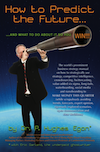
WORLD FAMOUS FUTUROLOGICAL PREDICTOLOGIST Dr. P. Hughes Egon, who shows us 25 “sure-fire” ways to “predict the future and win” (while in reaiity, these are traps to avoid):
Below the line Codeword OSCAR SIERRA. The US Air Force will put you in JAIL if you dare to click and read….