Here's a little-spoken truth learned via crowdsourcing:
Most people don't believe they are capable of initiative.
Initiating a project, a blog, a wikipedia article, a family journey. Initiating something even when you're not putatitively in charge.
At the same time, almost all people believe they are capable of editing, giving feedback or merely criticizing.
So finding people to fix your typos is easy.
A few people are vandals, happy to anonymously attack or add graffiti or useless noise.
If your project depends on individuals to step up and say, “This is what I believe, here is my plan, here is my original thought, here is my tribe,” then you need to expect that most people will see that offer and decline to take it.
Most of the edits on Wikipedia are tiny. Most of the tweets among the billions that go by are reactions or possibly responses, not initiatives. Q&A sites flourish because everyone knows how to ask a question, and many feel empowered to answer it, if it's specific enough. Little tiny steps, not intellectual leaps or risks.
I have a controversial belief about this: I don't think the problem has much to do with the innate ability to initiate. I think it has to do with believing that it's possible and acceptable for you to do it. We've only had these doors open wide for a decade or so, and most people have been brainwashed into believing that their job is to copyedit the world, not to design it. [Emphasis Added.]
There's a huge shortage… a shortage of people who will say go.
(from left to right) Tom Ricks of Foreign Policy magazine and The Washington Post, along with fellow FP editors Joshua Keating and Blake Hounshell all rushed to discredit Hersh and the contents of his January 17th, 2011 speech.
It seems unusual for a staid, respected publication (one that has received three National Magazine Awards in just this past decade) to start treating a celebrated journalist (who himself has won two National Magazine Awards in just this past decade) as if he were nothing more than a paranoid crank.
It seems unusual, but it’s exactly what the staff of Foreign Policy has done to Seymour Hersh, following a lecture the venerated reporter gave at Georgetown University’s campus in Doha, Qatar. You may know Hersh as the dogged investigator who exposed the My Lai Massacre during Vietnam. You may know him as the staff writer for The New Yorker who published some of the earliest pieces on Abu Ghraib in May 2004. You might even know him as the man derided and then vindicated for claiming that Dick Cheney was running a secret assassination squad right out of the Vice President’s office. (In truth, the squad was and is a bipartisan affair, initiated under Clinton and still operative under Obama.) Read more….
Phi Beta Iota: Sy Hersh is as honest as it gets. Foreign Policy used to be a reputable, imaginative endeavor. This is now the second time it has been disreputable and ignorant. Inquiry has established that Moises Naim, the extraordinary editor who took Foreign Policy from nothing to being twice as good as Foreign Affairs, has moved to other duties within the Carnegie Endowment, and it is clear to us that with his departure, Foreign Policy has lost its integrity as well as its intelligence.
Autonomous Internet Google Group Comment: Not sure what it solves what http://code.google.com/p/torchat/ doesn't do live. Also, I wonder why they picked MIX and not PIR, as Twatr isn't too latency-sensitive, so you can pick systems more resistant to timing analysis.
Riposte: I imagine it's got a good name is a good reason for the trend. As we've seen in this group, the tech isn't always what brings people it's the political implications of what they are doing. The best tech may not win.
In the vast literature of intelligence-related memoirs, the new book Long Strange Journey by Patrick G. Eddington stands out in several ways.
Eddington entered the intelligence arena as an imagery analyst for the CIA's National Photographic Intelligence Center. Imagery analysis is a predominately technical activity and is not normally considered a hotbed of intrigue or controversy. Nor has it been widely featured in the intelligence “literature of discontent.” Eddington provides an introduction to the world of light tables, mensuration and the now-defunct world of the NPIC analyst.
Then Eddington himself defies easy stereotyping. As an Army veteran, a political conservative, and a person of faith, he might have been voted least likely to rock the boat and to become a whistleblower. But that's what he did. Continue reading “Secrecy News: CIA Culture In Detail”
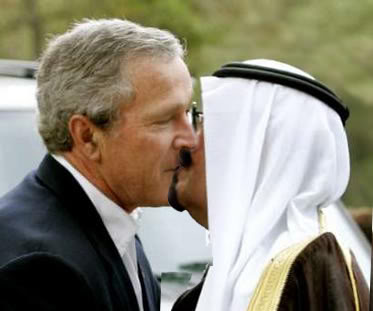
Wikileaks just released a motherload of info on the taboo subject of Saudi Arabian royal rents.
The 1996 cable — entitled “Saudi Royal Wealth: Where do they get all that money?” — describes legal and illegal ways that royals grab money, according to Reuters.
For legal ways, there's the monthly allowance given to thousands of princes and princesses. This ranged from $800 a month for “the lowliest member of the most remote branch of the family” to $270,000 a month for sons of Abdul-Aziz Ibn Saud.
For illegal ways, schemes include skimming $10 billion yearly from off-budget projects related to defense and infrastructure. One Saudi prince complained: “One million barrels per day” go entirely to “five or six princes.”
It's nothing to start a revolution over, but the sheer scale of payments might anger the Saudi people. The big concessionary social-welfare package offered last week was worth only $37 billion. Big anti-government protests are scheduled for later in March.
Phi Beta Iota: The cable is also valuable in demonstrating that the US Government (regardless of party in power) chose to sell our soul for Saudi crude.