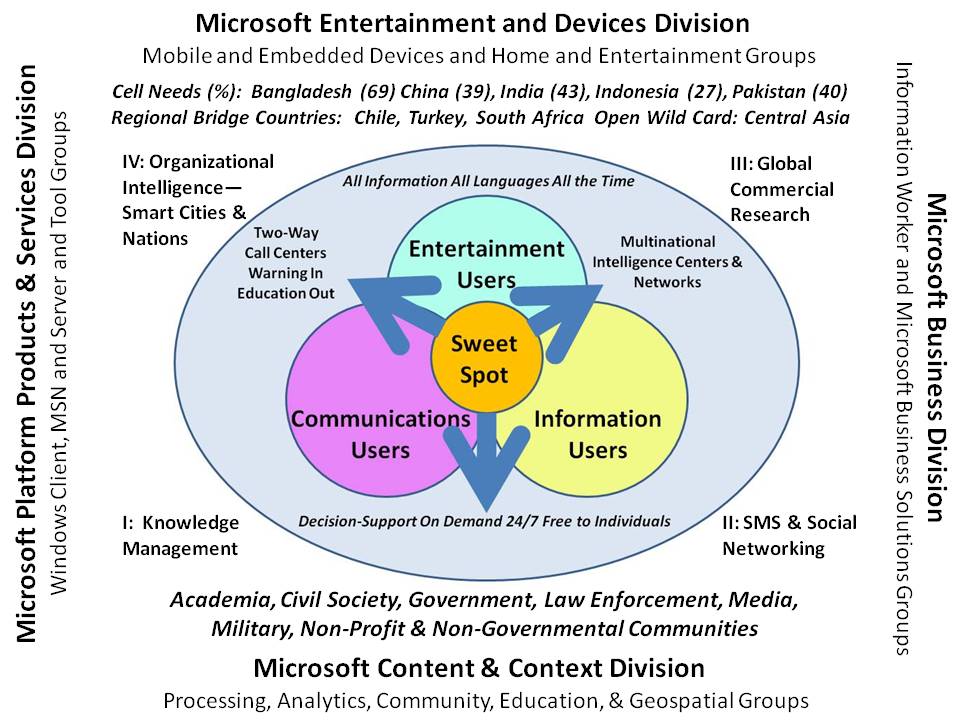
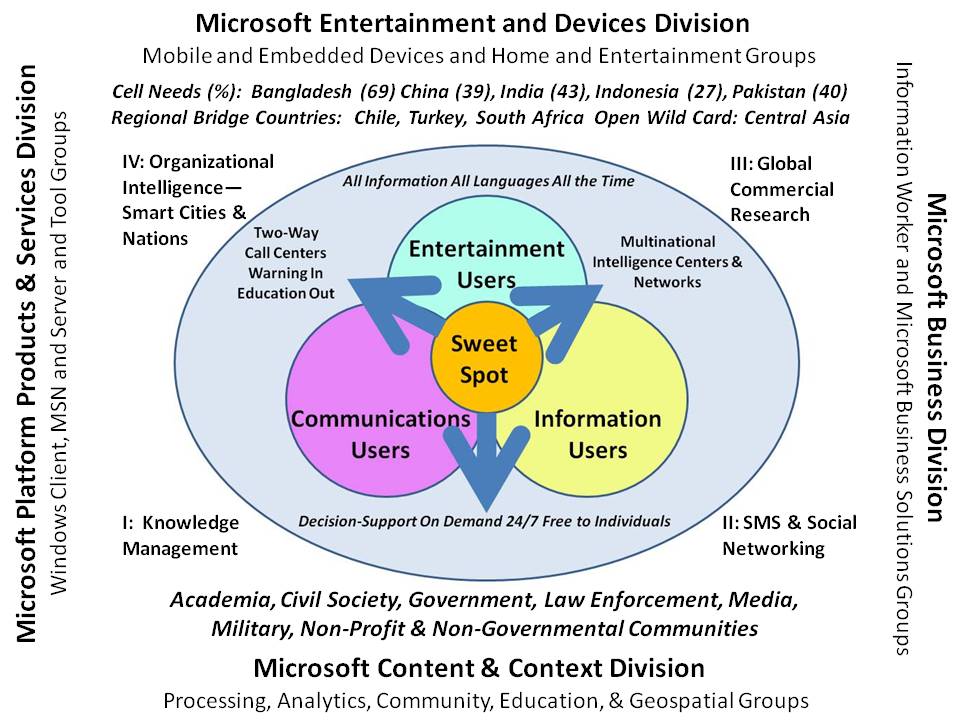
Phi Beta Iota: This is very depressing. Read the entire Fast Company article for solid paragraphs on each of the five lessons. The truth-teller is #5 and as best we can tell this is Steve Ballmer's firing notice–he's run the company into the ground, most of the groups do not make money, and he has no vision–antics are not a substitute for vision. Below is one vision for the future of Microsoft, highly unlikely to ever be realized.
ANKARA — Davutogluism is a mouthful. It’s not going to make Fox News any time soon. But if I could escort Sarah Palin, Tea Partiers and a few bigoted anti-Muslim Europeans to a single country illustrating how the world has changed, it would be the home of the D-word, Turkey.
Ahmet Davutoglu, who birthed a foreign policy doctrine and has been Turkey’s foreign minister since May 2009, has irked a lot of Americans. He’s seen as the man behind Turkey’s “turning East,” as Iran’s friend, as Israel’s foe, as a fickle NATO ally wary of a proposed new missile shield, and as the wily architect of Turkey’s new darling status with Arab states. The Obama administration has said it is “disappointed” in Turkey’s no vote on Iran sanctions last June; Congress is not pleased, holding up an ambassadorial appointment and huffing over arms sales.
Nostalgia is running high in Washington for the pliant Turkey of Cold-War days. Davutoglu is having none of it. “We don’t want to be a frontier country like in the Cold War,” he told me. “We don’t want problems with any neighbor” — and that, of course, would include Iran.
Zero problems with neighbors lay at the core of Davutoglu’s influential book Strategic Depth, published in 2001. Annual trade with Russia has since soared to $40 billion. Syrian-Turkish relations have never been better. Turkey’s commercial sway over northern Iraq is overwhelming. It has signed a free trade agreement with Jordan. And now Turkey says it aims — United Nations sanctions notwithstanding — to triple trade with Iran over the next five years.
All this makes the anemic West edgy: The policy has produced 7 percent growth this year. There’s also something deeper at work: The idea of economic interdependence as a basis for regional peace and stability sounds awfully familiar. Wasn’t that the genius of the European Union idea?
Phi Beta Iota: The author produced Alternative Paradigms in 1993, this book is available in English. At the time he was Professor of Political Science at the International Islamic University in Malaysia. Turkey is a world power, as is Iran, anyone who cannot get a grip on that reality will be flattened by reality. The axis between Malaysia and Indonesia, and between Muslims in Asia and Muslims centered on Dubai, is going to strengthen.
The author of attached article in the Guardian, George Monbiot is a pious Global Warming enthusiast. He probably despises the Koch brothers because they are funding anti-global warming efforts. But setting the writer's biases aside, as well as his somewhat condescending tone, his report (which is based primarily on the New Yorker’s brilliant expose of the Koch brothers and the new documentary “(Astro)Turf Wars,”) is an excellent summary of how behind-the-scene manipulators are funding the Tea Party movement and are shaping and energizing the Orientation of Tea Party’s collective OODA loop — i.e., the lens thru which its members Observe the world, interpret their all-to-real problems, provides focus to their anger, and thereby shapes the Decisions guiding their Actions.
The strategic leverage gained by shaping a group's Orientation ought be self-evident at this point: it unleashes and focuses the free-wheeling energy of the individuals to enthusiastically work together for the well being of others without requiring the coercive and ultimately revealing and self-defeating effects of top-down control.
The following quote (near end of article) provides an excellent statement of the strategic aim guiding those shaping efforts.
“Most of these bodies call themselves “free-market thinktanks”, but their trick – as (Astro)Turf Wars points out – is to conflatecrony capitalism with free enterprise, and free enterprise with personal liberty. Between them they have constructed the philosophy that informs the Tea Party movement: its members mobilise for freedom, unaware that the freedom they demand is freedom for corporations to trample them into the dirt.”
On the other hand, any strategy grounded in deception must be wrapped in a protective cloak of ambiguity, because a deception builds into the OODA loops of the ‘deceived' the seeds of a crucial vulnerability: Once the ambiguity is penetrated, and the scam is exposed and its effects appreciated, the Orientation of the ‘deceived' will flip and their rage will be energized and focused on the deceivers by the desire for vengeance. Which is why the passive or active connivance of the mainstream media in the US (most of which is owned by crony capitalists) in supporting the manipulation is central to keeping the game going.
The Tea Party movement: deluded and inspired by billionaires
By funding numerous rightwing organisations, the mega-rich Koch brothers have duped millions into supporting big business
The Tea Party movement is remarkable in two respects. It is one of the biggest exercises in false consciousness the world has seen – and the biggest Astroturf operation in history. These accomplishments are closely related.
A “must read” piece of solid British analysis….
Phi Beta Iota: A new set of unwitting fools–no offense intended, but that's the story….those elected under the Tea Party banner will caucus with the Republicans, and that is the truth-teller.
If you want to get elected in the US, you need media.
When TV was king, the secret to media was money. If you have money, you can reach the masses. The best way to get money is to make powerful interests happy, so they'll give you money you can use to reach the masses and get re-elected.
Now, though…When attention is scarce and there are many choices, media costs something other than money. It costs interesting. If you are angry or remarkable or an outlier, you're interesting, and your idea can spread. People who are dull and merely aligned with powerful interests have a harder time earning attention, because money isn't sufficient.
Thus, as media moves from TV-driven to attention-driven, we're going to see more outliers, more renegades and more angry people driving agendas and getting elected. I figure this will continue until other voices earn enough permission from the electorate to coordinate getting out the vote, communicating through private channels like email and creating tribes of people to spread the word. (And they need to learn not to waste this permission hassling their supporters for money).
Mass media is dying, and it appears that mass politicians are endangered as well.
Phi Beta Iota: For the first time, Seth Godin has caused us to realize that the Koch Brothers funding the Tea Party might be a good thing….it is lighting the path that eventually could be lit by hundreds of millions whose 1-2 dollar contributions will outweight the “loose change” that the super rich are willing to spend on political chicanery. Joe Trippi was there first, but this is a new spin that we find salutory.
On October 20, I caught Steven Johnson’s talk at Book People in Austin. I’ve known Steven since the 90s – we met when he was operating Feed Magazine, one of the early web content sites. After Feed, Steven created a second content site, actually more of a web forum, called Plastic.com.
Daniel Pink has a smart article on flip thinking, a trend in innovation. It’s a matter of rethinking sequence logic: for instance, a math instructor finds that it makes more sense to work on problems in class, and follow with the lecture (uploaded to YouTube, where students watch as homework). You experience the tension of the problem first, and get hands-on guidance from the instructor. Having learned your way around the problem, you see the lecture that contextualizes that learning.
While the idea is great, and Pink offers excellent examples where turning sequences around might work, the more compelling lesson is about creativity: we should rethink our habits and routines, and consider re-engineering our processes, as a matter of course. It’s too easy for ruts to form. We avoid disruptive innovation because it can be painful, but it’s productive pain.
Mexico: For the record. Suspected members of the Sinaloa drug trafficking cartel warned that they would kill 135 people after security forces seized 134 tons of marijuana last week in Tijuana, Baja California state, Milenio reported today, 25 October. The warning was made over a police radio frequency late on 24 October reportedly minutes after gunmen killed 13 patients at a drug rehabilitation center in Tijuana.
Phi Beta Iota: This kind of indiscriminate mass murder in retaliation for what are relatively minor interdictions suggests that on the one hand, both the US and Mexican government have not only lost all control of the territory for which they are responsible for providing good order and public safety and security; but also that neither government has an effective intelligence capability to guide operations in detail. We are reminded of how long it took to hunt down one man in Colombia, Pablo Escobar. A MAJOR obstacle is the recalcitrance of the US secret intelligence community with $75 billion or more being applied to produce “at best” 4% of what is needed, to reinvent itself and engage in M4IS2: multinational, multiagency, multidisciplinary, multidomain information-sharing and sense-making. The El Paso Intelligence Center (EPIC) is a massive failure precisely because it embodies all of the handicaps of the past and none of the advantages of the present.
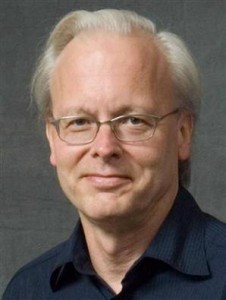
In a memo, Microsoft executive Ray Ozzie warned that the industry is moving to a post-PC world, and warned Microsoft employees that they must either lead or be pushed aside.
Ozzie said that memo had helped Microsoft on to success in the cloud, with products like Microsoft Azure, Microsoft Windows Live, and a socially-connected Xbox.
“Our products are now more relevant than ever,” Ozzie wrote. “Bing has blossomed and its advertising, social, metadata & real-time analytics capabilities are growing to power every one of our myriad services offerings. Over the years the Windows client expanded its relevance even with the rise of low-cost netbooks. Office expanded its relevance even with a shift toward open data formats & web-based productivity. Our server assets have had greater relevance even with a marked shift toward virtualization & cloud computing.”
Ozzie's latest memo, however, may have much less impact than his previous missive, however. That's because Ozzie said he would step down from his post as chief software architect after an undisclosed amount of of time. Ozzie apparently has no plans after that.
Ozzie's memo acknowledged the reality of “always-on” services like Facebook or Twitter, or Web mail services like Gmail or Hotmail, combined with connected devices like the Boxee Box or Apple TV.





 On October 20, I caught Steven Johnson’s talk at Book People in Austin. I’ve known Steven since the 90s – we met when he was operating