Journal: Why Intelligence Keeps Failing

Government, Intelligence (Government/Secret), Uncategorized
Thomas Leo Briggs

On 16 January 2010, Herbert Meyer, who served during the Reagan Administration as Special Assistant to the Director of Central Intelligence and Vice Chairman of the CIA's National Intelligence Council, wrote the following:

“No one among us is perfect, or even close to perfect. In the real world, intelligence failures will happen from time to time no matter how honorable, hardworking, or talented the men and women are on whom we rely to keep us safe. But after so many intelligence

Full Meyer Op-Ed

failures in such a short time, we have got to stop making the same mistake over and over again. This week's Washington cliché is that our system failed. No. Systems don't fail; people fail. Put the right people in charge, and the “system” will fail much, much less frequently.”

I couldn't agree more with Mr. Meyer.

The final chapter of my book, Cash on Delivery: CIA Special Operations During the Secret War in Laos, is titled “Speaking Truth to Power – Lessons Learned”. In it I wrote, “It probably is wonderful that so many politicians, wide variety of pundits and family members of victims of terrorist attacks have taken such an interest in the organization of the CIA and other intelligence community agencies. I see no reason why they should not criticize what they see and understand about what the CIA has or has not done. However, they do not know the full story and they ought to know they do not know it. Yet, they proceed to suggest just how the CIA should be re-organized, without any experience in the collection, analysis and dissemination of intelligence and without all the details of how any particular intelligence, and certainly not how all of it, was collected, analyzed and disseminated. Most often, the solution they suggest boils down to rearranging the lines and boxes on organization charts. People populate the boxes on organization charts. How can it be that the perceived failures they are correcting were merely the result of the boxes not being connected properly among the lines? If the failures were the fault of the people, why don’t they ask that all those people be fired or demoted? Would that do any good? You cannot just go out and hire experienced intelligence professionals from a vast pool that just happens not to be working for the CIA at the time. Intelligence professionals must be grown from seed; they cannot be transplanted from mature plants. Yet, reorganizations are always proposed as changes of the alignment of lines and boxes or the creation of more lines and boxes added to the top of the whole structure, e.g. the National Counterterrorism Center or the Director of National Intelligence. Just how does adding more people to boxes and placing them on top of a bureaucratic structure make it better? Where do the people come from? If they are experienced intelligence professionals, how did anyone figure out how to identify the ones who were not part of the problem? If they are not experienced intelligence professionals why does anyone believe they will have what it takes to lead such a complex undertaking that has no valid lateral experience other than to mature within the intelligence structure?”

Reorganizations look good on paper and play well in the media, but they don't solve the true problem of a lack of first class leadership.  When there is a failure to “connect the dots” you need to determine why the people you have did not or could not make the connections.  Then you must take remedial actions to lead those people to better performance and to inspire them to, in the words of the U.S. Army, be all they can be.

Intelligence organizations like the CIA will still fail to connect all the dots and will still lose officers killed in action, no system can be perfect and the fight against terrorism will not be without casualties, but when we have failures or casualties we must be able to figure out whether there was nothing we could have done, or whether the leaders we have failed in their duties.  Then we replace those leaders and do our best to give them the remedial training they need to become better, if and when they lead again.  If we have the best leaders we can get, they will determine how the lines and boxes should be connected and we should expect they will be correct.

Worth a Look: InSTEDD Emergency Support to Emergencies, Diseases, and Disasters

Gift Intelligence, Peace Intelligence, Worth A Look

Home Page

Our Mission

InSTEDD's mission is to harness the power of technology to improve collaboration for global health and humanitarian action. We are an innovation lab for tools designed to strengthen networks, build community resilience and improve early detection and response to major health-related events and natural or human-caused disasters. We grapple daily with the challenges of finding new approaches and new designs:  a simple, reliable way to bring it all together — the people, the tools and the data — and create the kinds of information flow that we know will save lives.  We think that with new, free and open-source technologies we can help humanitarian and public health organizations around the world work together more effectively in crises. We aim to reduce mortality, accelerate recovery and help prepare communities to face the unexpected with confidence in their own resilience.

Journal: Haiti Log-Jam Situation Report

08 Wild Cards, Gift Intelligence, Methods & Process, Military

With the Military in Haiti: Breaking the Supply Logjam

…after dozens of U.S. military 
helicopters began arriving in force Friday, using the aircraft carrier USS 
Carl Vinson a few miles offshore as their base, the delivery of food, water 
and medical supplies got galvanized. “We're still running out of water 
faster then we can deliver it,” Marine Maj. Will Klumpp told me above the 
deafening roar of copter rotors. “But at least we feel like we've started to 
keep up with what the Haitians need now.”

TIME Magazine's Comprehensive HAITI Home Page

Hunger And Misery Amid Haiti Aid Logjam

The log jam at the airport has put the 82nd behind schedule. An 800-man battalion was supposed to be on the ground Friday but by yesterday there were only 240.

World leaders have pledged aid to rebuild earthquake-hit Haiti – but survivors are still waiting for food, water and medicine.

Five days after the 7.0 magnitude tremor killed up to 200,000 people, international rescue teams were continuing to find victims alive under the rubble in capital Port-au-Prince.

Hundreds of thousands of hungry Haitians desperately need help, but logistical logjams kept major relief from reaching them.

Beset by logistical challenges, Haiti relief presses on

WASHINGTON — With many nations vying to get urgent relief into horror-struck Haiti after the devastating earthquake, US officials acknowledged Saturday it was “critical” to better coordinate the massive influx of aid.

Though the aid operation was picking up steam, it was still not reaching many of the survivors desperately scrambling for badly-needed food and water four days after the quake believed to have killed tens of thousands.

Bringing the Military's Might to Aid Haiti

Water, water everywhere, and yesterday it finally got to people who need it.

Paratroopers from the 82nd Airborne landed on a hill where survivors had gathered. So often these days, the face of America is that of a soldier – in this case, Captain Jonathan Hartsock.

The log jam at the airport has put the 82nd behind schedule. An 800-man battalion was supposed to be on the ground Friday but by yesterday there were only 240.

The main port is a disaster area, and until a second one can be opened up at Cap-Haitien on the north shore, the American military is trying to move into Haiti through that single-runway airport.

Your search – 95th civil affairs brigade haiti – did not match any documents

Phi Beta Iota: This is a fascinating peace challenge that the WWII D-Day planners would have appreciated–the US does not appear to leveraging all of the instruments of national power, including Sea Bees, landing craft, combat bridge repair, etcetera.

See also: Journal: Haiti Rolling Update (Chronology with Links)

Journal: Haiti Op-Eds

08 Wild Cards, Collaboration Zones, Communities of Practice, Methods & Process, Mobile, Policies

Guantanamo Base

Guantanamo To The Rescue

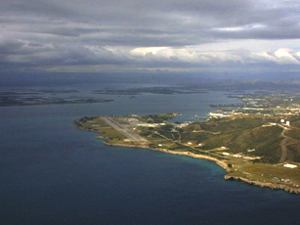
The base has two airfields, a state-of-the-art communication system and brand-new water and sewage lines that could accommodate as many as 45,000 refugees. And the base is large enough to stage an aid effort without impinging on prison operations.

Put The Pentagon In Charge

The other truth is that the only entity on the planet with the capacity to bring help to Haiti on the scale needed is the U.S. military. The United Nations will find it impolitic to admit this; the big international relief groups, proud of their noncombatant status, will shy from acknowledging it. But it is the reality

Frictions Between Nations Rise Over Struggle Of Getting Aid To Haiti

But there were growing tensions over which country's planes were allowed to land here first, with each nation insisting its aid flight was a priority, according to an official involved in the relief operation.

France, Brazil and Italy were said to be upset, and the Red Cross said one of its planes was diverted to Santo Domingo, the capital of neighboring Dominican Republic.

Le Bret said that the Port-au-Prince airport has become “not an airport for the international community. It is an annex of Washington.”

Phi Beta Iots: Haiti is an Information Operations (IO) challenge.  Obviously the Pentagon is not addressing it as such, so they will continue to have log-jams because they are not pushing the “information perimeter” out to the take-off and loading points.  A needs matrix should be in place, and the stuff should be coming in via four landing masters (Air Wheels, Air Drop, Beach, Road) with an intelligence-driven load and deliver flow plan.  This is not rocket science.  It just takes the right mind-set and a global C4I grid that DoD does not have at the same time that it refuses to use the obivous existing public networks.

See also: Journal: Haiti Rolling Update (Chronology with Links)

Journal: Haiti Earthquake Unconventional C4I

08 Wild Cards, Civil Society, Collective Intelligence, Gift Intelligence, IO Mapping, IO Multinational, IO Sense-Making, Methods & Process, Mobile, Non-Governmental, Peace Intelligence, Real Time, Technologies, Tools

Sample Commercial Image

Apps for Haiti: An SMS 911, a People Finder, and more to come

Haiti Earthquate Person Registry (Seeking/Found) (Merged with Google Person Finder)

Spreadsheet of 152 Organizations Rendering Aid to Haiti

Wikipedia Page Participants on the Ground and Unconventional Communications

Haiti Crisis Camp Page and Feedback

GeoEye Post-Earthquake Sample Image

ESC Imagery Aid

See also: Journal: Haiti Rolling Update (Chronology with Links)

Contributing Editor: Thomas Leo Briggs

Authors & Editors
Thomas Leo Briggs

Thomas Leo Briggs, was born in Staten Island, New York in 1942. The grandson of Italian and Greek immigrants, he graduated from the University of Delaware in Newark, Delaware in 1964 with a B.A. degree in history and an R.O.T.C. commission as a 2nd Lieutenant in the U.S. Army.

After one year of law school, Mr. Briggs entered on active duty in 1965 and served for three years as a military police officer volunteering for Vietnam where he served with the 504th Military Police Battalion as a platoon leader. He left active duty with the rank of captain, an Army Commendation Medal and a Bronze Star.

After the Army, he spent three years as a DEA special agent and 26 years as a CIA case officer, retiring from federal service as a GS-15.

During his 26 years with the Central Intelligence Agency Mr. Briggs had assignments in East Asia, Latin America and Europe and was awarded the CIA’s Certificate of Merit and Certificate of Exceptional Service. He finished his CIA career as a manager of computer software development.

After his retirement from government service he worked as an independent consultant, both overseas and domestically, on terrorist targeting, technical operations and computer forensics.

Review: Cash on Delivery–CIA Special Operations During the Secret War in Laos

noble gold