Journal: Haiti, Obama’s Katrina, NGO-Foundation Rip-Off

08 Wild Cards, Communities of Practice, Ethics, IO Mapping, IO Sense-Making, Mobile, Policies, Real Time, Threats, Topics (All Other)

Full Article Online

When Haitian Ministers Take a 50 Percent Cut of Aide Money It's Called “Corruption,” When NGOs Skim 50 Percent It's Called “Overhead”

Crushing Haiti, Now as Always

By PATRICK COCKBURN

The US-run aid effort for Haiti is beginning to look chillingly similar to the criminally slow and disorganized US government support for New Orleans after it was devastated by hurricane Katrina in 2005. Four years ago President Bush was famously mute and detached when the levies broke in Louisiana. By way of contrast President Obama was promising Haitians that everything would be done for survivors within hours of the calamity.

Phi Beta Iota: As we pointed out earlier, Haiti is both an OPPORTUNITY, and a Multinational Engagement decision-support and information-management challenge, nothing more—it demands open source everything, which the U.S. military especially and the U.S. government generally is simply not good at because they have spent 21 years refusing to listen to “not invented here” iconoclasts.  What we SHOULD be doing is using Haiti for a CAB 21 Prototype operation in which we flood the place with ground truth assets–civil affairs “wired” eyes and ears, and then create a global open back office that itemizes needs at the household level and connects those needs to resolution via guided paradrops and helo sling loads.  The infrastructure is not there for planes, trains, and trucks.  Use Guantanamo, McDill, Miami, and Norfolk.  Put amphibs out as parking lots and filling stations.  Any questions?  Just call.

See also:  Journal: Haiti Rolling Update (Chronology with Links)

Journal: US Response to Haiti Reveals Old Mindsets

Collaboration Zones, Communities of Practice, Ethics, Geospatial, InfoOps (IO), Key Players, Methods & Process, Mobile, Policies, Real Time, Reform, Strategy, Threats, Tools
Full Story Online

The Right Testicle of Hell: History of a Haitian Holocaust

By Greg Palast

Blackwater before drinking water

6. From my own work in the field, I know that FEMA has access to ready-to-go potable water, generators, mobile medical equipment and more for hurricane relief on the Gulf Coast. It's all still there. Army Lt. Gen. Russel Honoré, who served as the task force commander for emergency response after Hurricane Katrina, told the Christian Science Monitor, “I thought we had learned that from Katrina, take food and water and start evacuating people.” Maybe we learned but, apparently, Gates and the Defense Department missed school that day.

7. Send in the Marines. That's America's response. That's what we're good at. The aircraft carrier USS Carl Vinson finally showed up after three days. With what? It was dramatically deployed — without any emergency relief supplies. It has sidewinder missiles and 19 helicopters.

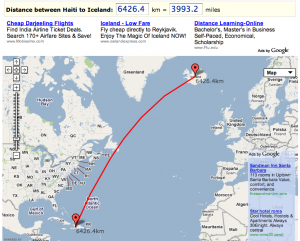
8. But don't worry, the International Search and Rescue Team, fully equipped and self-sufficient for up to seven days in the field, deployed immediately with ten metric tons of tools and equipment, three tons of water, tents, advanced communication equipment and water purifying capability. They're from Iceland.

Any Questions?

Phi Beta Iota: This is what we were thinking of when we laid out the CAB 21 Peace Jumpers scenario.  The Pentagon is out of touch with reality because they have such a narrow mind-set that is uninformed about the possibilities and simply does not compute Whole of Government resourcing or clean drinking water as a security device vastly more effective than a Marine standing guard over nothing.  With all humility, if DIA goes not get its act together in the Open Source Intelligence (OSINT) and Multinational Engagement arena, and help the Pentagon learn about the new craft of waging peace with Whole of Government non-secret campaign plans and multinational virtual harmonization of resource needs identification and fulfulfillment at the Twitter level, we will continue to fail ourselves and everyone else.  As we pointed out early on, Haiti's disaster was/is an OPPORTUNITY.   Evidently no one in the Pentagon is thinking that way.

See also:  Journal: Haiti Rolling Update (Chronology with Links)
Journal: DARPA Catches Up with 1994

10 Security, Academia, Civil Society, Collective Intelligence, Commercial Intelligence, Computer/online security, Cultural Intelligence

Darpa: U.S. Geek Shortage Is National Security Risk

Darpa’s worried that America’s “ability to compete in the increasingly internationalized stage will be hindered without college graduates with the ability to understand and innovate cutting edge technologies in the decades to come…. Finding the right people with increasingly specialized talent is becoming more difficult and will continue to add risk to a wide range of DoD [Department of Defense] systems that include software development.”

Phi Beta Iota: Great insight….only 16 years behind the point made by the opening speaker at Hackers on Planet Earth 1994.  He said “When the Israeli's catch a hacker, they give him a job.  When we catch a hacker, we kick them in the teeth and throw them in jail.” We wait with bated breath for DARPA to reach 1998.

See also:

Journal: Cyber-Security or Cyber-Scam? Plus Short List of Links to Reviews and Books on Hacking 101

Journal: Cyber-War, Cyber-Peace, Cyber-Scam

Journal: Cyber-Security Etc. & Multinational Engagement

Reference: Are Hackers Pioneers with the Right Stuff or Criminal Pathological Scum? Mitch Kabay Reprises

Journal: German Hackers Point to 9-11 Text Messages

Journal: Climate Change and “Hacktivism”

Journal: Haiti Highlights Death of US C4I

Collaboration Zones, Communities of Practice, Ethics, Key Players, Methods & Process, Mobile, Policies, Real Time, Threats
Full Story Online

Things are going to get a lot worse in Haiti before they get better, and that was never clearly articulated by the President, State Department, SOUTHCOM, or Rajiv Shah to the American people, who may begin to doubt our governments efforts in the very near future. President Obama is positioned to take a political hit for what happens over the next 48-72 hours for apparently having advisors who are treating Haiti as anything but the most important event of his political career to date.

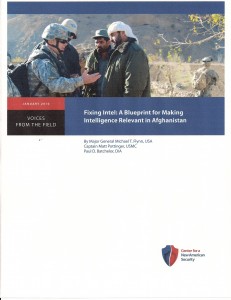
Phi Beta Iota: The USG, the US IC, and DoD have been told for 21 years, beginning with General Al Gray's 1989 article, “Global Intelligence Challenges in the 1990's,” and ending most recently with General Mike Flynn's Fixing Intel–A Blueprint for Making Intelligence Relevant in Afghanistan, that they are not being serious about Open Sources, Multinational Engagement, the Eight Tribes, and on and on and on.  We need a Defense Open Source Center (DOSC) with an embedded Multinational Decision Support Center (MDSC) that simultaneously creates a global grid with the 90 countries that have OSINT centers within their military C4I structure, and regional grids that are under the control and in the service of the various regional unions, beginning with UNASUR and then AU and SCO and ASEAN, and so on–our money, their information.  Haiti is Obama's Katrina–not because he's a bad President or has an inattentive Cabinet, but because the “system” of governance is Industrial-Era C4I totally out of touch with modern possibilities.

Reference (2010): Fixing Intel–A Blueprint for Making Intelligence Relevant in Afghanistan

08 Wild Cards, DoD, Ethics, Government, Military, Monographs, Peace Intelligence

UPDATE: A colleague from within asked us to highlight this quote with the observation that neither the US IC nor DoD have any clue how to execute.  We agree.  Both lack leadership with vision and multinational panache; they simply do not know what they do not know because they have both wasted the last 21 years refusing to listen or learn.

P.23.  They must embrace open-source, population-centric information as the lifeblood of their analytical work. They must open their doors to anyone who is willing to exchange information, including Afghans and NGOs as well as the U.S. military and its allies. As General Martin E. Dempsey, commander of the U.S. Army Training and Doctrine Command, recently stated, “…[T]he best information, the most important intelligence, and the context that provides the best understanding come from the bottom up, not from the top down.”

The Cold War notion that open-source information is “second class” is a dangerous, outmoded cliché. Lieutenant General Samuel V. Wilson, former director of the Defense Intelligence Agency, captured it perfectly: “Ninety percent of intelligence comes from open sources. The other 10 percent, the clandestine work, is just the more dramatic.

28 Pages Online

News Story with Links: Spies Like Us: Top U.S. Intel Officer Says Spooks Could Learn From Journos

USMC WM in AF

Good News: Some good people in the field have finally re-invented half the wheel–the company-level bottom-up half.  Unfortunately they have absolutely no idea what can be gotten from the rest of the world (non US citizens without clearances); they are jammed into a legacy system that demands at least a SECRET clearance; there is no Multinational Engagement Network that is totally open albeit commercially encrypted, and therefore this is going nowhere.  We could fix this on leftover loose-change, but ONLY if DoD intel leadership will accept the iconoclastic multinational solutions that have been in gestation for 21 years.

Bad News: CIA and DIA are still broken and not likely to get fixed anytime soon.  The Human Terrain Teams (HTT) are an utter disgrace.  DoD commanders still have not figured out Open Source Intelligence (OSINT) and OSINT does not appear in this report, nor does Reach-Back, 24/7 tribally-nuanced on demand web-cam translator services, and on and on and on.  Army G-2 is non-existent–Army is simply not trained, equipped, nor organized to do tactical intelligence in small wars.  Neither is the Marine Corps, but they adapt better.  What is so very tragic is that this is a problem that can be  fixed FAST with Multinational Engagement and a proper use of distributed linguistic and cultural assets.  All it needs is an internationalist mind-set, which no one now serving in DIA or CIA actually can muster. All of the pathologies we have been writing about since 1988 are to be found in Afghanistan, and none of the solutions that many, many authors have written about for the last 21 years are even on the table.

See also:

Continue reading “Reference (2010): Fixing Intel–A Blueprint for Making Intelligence Relevant in Afghanistan”

Worth a Look: UNICEF RapidSMS

Methods & Process, Technologies, Tools, Worth A Look

UNICEF Innovation RapidSMS

RapidSMS is UNICEF's open source platform for data collection, logistics coordination and communication allowing any mobile phone to interact with the web.

About UNICEF

UNICEF is on the ground in over 150 countries and territories to help children survive and thrive, from early childhood through adolescence. The world's largest provider of vaccines for developing countries, UNICEF supports child health and nutrition, good water and sanitation, quality basic education for all boys and girls, and the protection of children from violence, exploitation, and AIDS. UNICEF is funded entirely by the voluntary contributions of individuals, businesses, foundations and governments.

Journal: Haiti Public Intelligence Emergent

08 Wild Cards, Analysis, Budgets & Funding, Collaboration Zones, Communities of Practice, Ethics, Geospatial, InfoOps (IO), IO Mapping, Methods & Process, Mobile, Policies, Real Time, Threats, Tools

Full Story Online

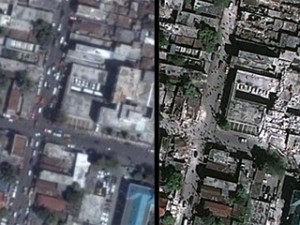
Google Maps updates with new Haiti pics: Hours-old satellite images show destruction

Google has released a new KML overlay — tech speak for map layer — that includes fresh images of Port-au-Prince.

According to GeoEye , the satellite imagery company that provided the photos, they were taken at 10:30 a.m. yesterday from a satellite 423 miles up.

By toggling the new image layer on and off, it’s easy to compare what the city looked like before the earthquake with the way it looks now.

Aside from the obvious destruction, one of the most striking features of the new images is the large number of presumably homeless people in the streets of the ruined neighborhoods.

Click here to see the new images in Google Maps.

Phi Beta Iota: Finally, but kudos never-the-less.  This should always be the first thing done, perhaps with a global arrangement that has regional cost-sharing in place and can use military air breathers where commercial are not immediately available, but respecting Google's software and end-user delivery offering.  There is still the matter of getting to shared Spacial Reference Systems (SRS).  This could and should be used to “plot” Twitter messages that identify need, and in the back office, matching RapidSMS messages that can be aggregated to fund need resolution.

Where Are Haiti Earthquake Relief Funds Going?

Millions in donations have been raised since the earthquake in Haiti on Tuesday, but where is the money going?

Like Wyclef Jean's Yele Haiti which is urging people to text “Yele” to 501501 to donate $5 to the cause — which has raised more than $2 million so far — many other relief organizations have used mobile messaging to quickly gather funds.

Phi Beta Iota: What is most interesting about this is the fact that fund-raising (financial incentive for the organizers that take a 5% to 50% “cut) is very well developed and moving money, while the other end (requirements definition, logistics coordination, and “by household” delivery” is NOT developed at all.  This is a good start toward the Global to Local Range of Needs Table, when that is developed, this will “flip” in that people will give for SPECIFIC itemized needs, not as a leap of faith in intermediaries that generally do NOT deliver full value.

What is LACKING is a single trusted Multinational Decision Support Center with both regional and global non-profit “cachet” as well as two-way reachback into all eight tribes of all nations, that can be the single point orchestrating the receipt and integration of all information in all languages in near-real-time, and the trusted point for validating both needs and the resolution of needs through the application of fundss.

See Also:

Continue reading “Journal: Haiti Public Intelligence Emergent”

noble gold