A Case for NOT Reducing Federal Debt?

03 Economy, 07 Other Atrocities, 11 Society, Civil Society, Commerce, Cultural Intelligence, Government, Money, Banks & Concentrated Wealth, Power Behind-the-Scenes/Special Interests, Secrecy & Politics of Secrecy, True Cost
Chuck Spinney Recommends...

Can the US Have an Expansionary Fiscal Contraction?

All  … the attached essay was written by Simon Johnson, Ronald Kurtz Professor of Entrepreneurship, MIT Sloan School of Management; Senior Fellow, Peterson Institute for International Economics; and co-founder of Baseline ScenarioJohnson used to be Chief Economist of IMF and is, IMO, one of the sanest voices in economics. It summarizes his recent testimony to the Joint Economic Commitee of Congress.  The question is — Should we reduce federal debt to slow the build up of private debt?  He lays out 4 reasons why such a contractionary fiscal policy will create even worse problems.
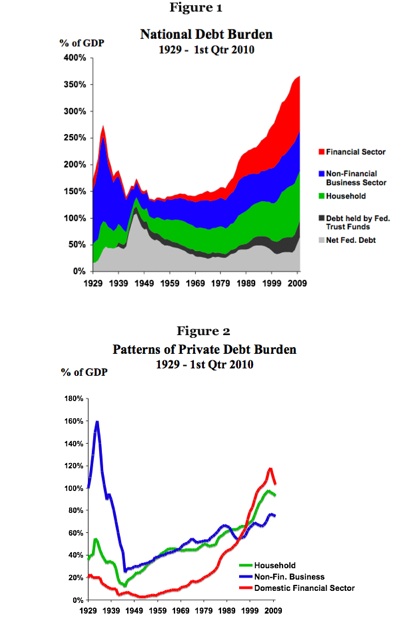
Click on Image to Enlarge

His penultimate paragraph places the real issue — who is going to pay for the liquidation of the private bubble (see chart below, which I compiled from Fed. Reserve data) into context (the red typing is mine to clarify the ambiguity in his double use of debt).  Also, I urge you to read his testimony (you can download it from the link indicated below) — it is more detailed and he has a brief discussion about how the cost of the financial meltdown (looming private debt liquidations — particularly the bubbles of debt in the financial and household sectors — which Fig 2 shows has not really begun to bite) are being shifted to the middle class.  Note, the rise in the light gray area in Figure 1 is the spike in federal debt that has taken place since the meltdown.

Chuck

The Baseline Scenario

What happened to the global economy and what we can do about it

Could The US Have An “Expansionary Fiscal Contraction”?

By Simon Johnson.  My full written testimony to Tuesday’s hearing of the Joint Economic Committee of Congress is available here.

The US has a large budget deficit and a debt-to-GDP ratio that, in most projections, continues to rise over time.  Some House and Senate Republicans are arguing strongly that this situation calls for large and immediate cuts to government spending, for example as part of any agreement to increase the federal government’s debt ceiling.

The Joint Economic Committee of Congress held a hearing on Tuesday to discuss whether such spending cuts would be “contractionary” or “expansionary” for the economy in the short-run.  My assessment, after participating as a witness at the hearing, is that large immediate spending cuts would tend to slow the economy (a webcast of the hearing is here).


Read full posting….

Digital Currency for Environmental Sustainability

03 Economy, 11 Society, Advanced Cyber/IO, Civil Society, Commerce, Commercial Intelligence, Counter-Oppression/Counter-Dictatorship Practices, Cultural Intelligence, Ethics, Gift Intelligence, Money, Banks & Concentrated Wealth
Venessa Miemis

Ven: A Digital Currency Designed for Environmental Sustainability

Hub Culture is a global collaboration network with over 25,000+ members distributed across 110 countries. Their stated mission to expand collective consciousness is driven by the blend of online workspaces for knowledge sharing with offline Pavilions for meeting and connecting – all powered by their digital currency, Ven. Below is an interview with Hub Culture’s Founding Director, Stan Stalnaker.

What compelled you to create Ven?

For us it was a matter of practicality – with a global, diverse community, we found that no single currency could offer a single pricing structure for global inventory in Hub Culture.  Our members needed a global wallet – as simple to use in Rio as Shanghai. As a social network, we thought linking this system to the social profile of our users would help them share and create value.  We needed a simple, transparent way for our members to exchange value and favors, and the answer was Ven.  It has been a learning experience for us. The currency has evolved and grown since its debut in the summer of 2007, and we have discovered ways to make it more useful for our members and the planet at large.

You’ve said Ven can be thought of as ‘green money’? Why?

Today Ven is the only digital currency to be priced from a basket of currencies, commodities and carbon futures.  These components give the Ven advantages of other currencies: the basket encourages price stability on a forward basis, and the link to commodities grounds value in hard assets.  The introduction of carbon to the basket is helping us think about how money can serve better social purposes – in this case to support and stimulate demand for carbon credits and social impact development, driving offsets for every transaction used with Ven.  This is how the idea of ‘green money’ developed with Ven – because its carbon linkages are able to play a role in this area.  I really like the idea that Ven is green, social and efficient, with a mission to improve the lives of its users and the communities that use it.

Read full interview….

Venessa Miemis: People-Powered Markets– 60 Resources

03 Economy, 11 Society, Advanced Cyber/IO, Civil Society, Cultural Intelligence, Ethics, Gift Intelligence
Venessa Miemis

People-Powered Markets — 60 Resources

There is a growing movement towards peer-to-peer value exchange and production, prompted by a variety of things, like economic conditions, shifting cultural values, exploration into collective intelligence, and further enabled by social technologies.

I've been tracking the online marketplaces that have been cropping up for sharing, swapping, gifting and renting, as well as sites that give people different kinds of opportunity to share skills and knowledge, innovate, and work collaboratively both on and offline. Below are a few sites I've come across, please add any I've missed.

Below the line:  Sharing Cars, Rides, Bikes, Space, Land; Gifting, P2P Rentals; Swap Trading, Goods and Money Sharing/Borrowing/Lending;  Co-Working, Co-Production, Distributed Work, Skill Sharing, Barter Networks, Idea/Innovation Marketplace.

Continue reading “Venessa Miemis: People-Powered Markets– 60 Resources”

Panera (bread) “cares cafes” pay what you can

03 Economy, 06 Family, 07 Health, 11 Society, Civil Society, Commerce, Commercial Intelligence, Cultural Intelligence, Ethics, Gift Intelligence, IO Deeds of Peace
John Steiner

Ron Shaich Lets Panera Bread Customers Pay What They Can

Lucas Kavner

Huffington Post, 15 June 2011

Ron Shaich, the founder and chairman of Panera Bread, has sculpted his company into one of the most successful small restaurant chains in the country. He's also done something no other chain has done before.

By creating a unique, pay-what-you-can model at three “Panera Cares” cafes around the country — and more are coming soon — he has proven an idea that seems revolutionary for a large corporation, but is actually very simple: trust people; they'll often surprise you.

. . . . . . .

“It worked,” Ron said. “20 percent would leave more than the suggested donation, 60 percent would leave the suggested amount, and 20 percent would leave less.”

Read full article…..

US Billions in Cash Stolen in Early Days of Iraq II

03 Economy, 07 Other Atrocities, 08 Wild Cards, 09 Justice, 10 Security, Budgets & Funding, Commercial Intelligence, Corruption, Cultural Intelligence
Who, Me?

US: $6.6bn in Iraq aid ‘may have been stolen'

By David Usborne, US Editor

Tuesday, 14 June 2011

Years after American auditors said they had lost track of vast sums of reconstruction cash for Iraq in the wake of the ousting of Saddam Hussein they are now admitting for the first time that much of it was almost certainly stolen.

In a revelation that is stirring anger both on Capitol Hill and among Iraqi officials in Baghdad, the office that was created by the Bush administration to monitor efforts to get Iraq on its feet after the 2003 invasion is saying that $6.6bn (£4bn), all delivered in cash, cannot be accounted for.

Just how much of the missing money was pocketed either by US contractors or Iraqis is not clear, nor is it likely that a full picture of what happened will ever be painted. Even so, Stuart Bowen, who runs the monitoring office, says that the errant billions may represent the “largest theft of funds in national history”.

Read full article….

Phi Beta Iota: This is old news and it was much more.  By one account, Paul Bremer was unable to account for over $10 billion in shipped cash (12 airplanes, $2 billion each, rough estimate $24 billion.  That is completely apart from the fact that we paid tens of millions to US contractors when local engineers who built the originals were asking for hundreds of thousands.

See Also:

Continue reading “US Billions in Cash Stolen in Early Days of Iraq II”

DOT&E Documents and Tony Capaccio Story

03 Economy, 07 Other Atrocities, 10 Security, Budgets & Funding, Commerce, Commercial Intelligence, Corporations, Corruption, Cultural Intelligence, Ethics, Government, Military, Policy, Politics of Science & Science of Politics, Standards, Technologies
Winslow Wheeler

There are a set of documents at the DOT&E website which offer DOT&E insights into the reason for why about 40 programs have experienced delays — and costs.  These documents relate to a Tony Capaccio story in today's Bloomberg News (below).

The document titled “Updated DOT&E Input on Program Delays” (at the DOT&E link shown above) identifies various specific reasons for the problems programs experience — different from most of the explanations from contractors and other system advocates in and out of the Pentagon.  (Eg. for the F-35:  Fly rates per month lowered to more realistic projections (from 12 max for all variants and venues to 10 max for CTOL/CV flight sciences, 9 max for STOVL flight sciences, 8 max for all mission systems); increased planning factors for re-fly and regression (up 15% for flight science, 10% for mission systems); more time required for software development and incremental builds.”)

Beyond the F-35, the various systems described in the analysis are typically more obscure programs (eg. AIM-9X 8.212 Software Upgrade) but there are also a few better known ones, such as LCS, which is described in “fly before buy,” Congress and the Navy want to rush ahead of testing to buy 4 LCS in the 2012 HASC DOD Authorization bill for $1.8 billion in production costs.

Availability of complete mission packages will be delayed until at least 2015.

Instead of withholding production of untested systems with clear and obvious development problems, Congress and the Pentagon are intent on business as usual.  The LCS is a good example: instead of “fly before buy,” Congress and the Navy want to rush ahead of testing to buy 4 LCS in the 2012 HASC DOD Authorization bill for $1.8 billion in production costs.

Some will think the DOT&E analysis and documents to be obscure and too “in the weeds” to pay much attention to.  Instead, they offer a major part of the explanation for why hardware costs and delays are so out of control, and they offer a stunning view into how little is being done about that.

BloombergNews.com, June 13, 2011

Weapons Testers Found Not to Blame for Procurement Delay

Howard Rheingold’s Pick: Information Curation

03 Economy, 04 Education, 11 Society, Advanced Cyber/IO, Civil Society, Collective Intelligence, Commercial Intelligence, Cultural Intelligence
Howard Rheingold

My top pick today:

Maria Popova: In a new world of informational abundance, content curation is a new kind of authorship

NiemanJournalismLab,10 June 2011

EXTRACT: The point is that new tools in general, and Twitter in particular, greatly challenge the binary dichotomy of attention as something that is either given or taken away, distracted. Instead, these tools allow us to direct attention to destinations where it can be sustained with more concentration and immersion.

See Also:

Review: Everything Is Miscellaneous–The Power of the New Digital Disorder

noble gold