Phi Beta Iota: Below is circulating among the Gold Warriors in Asia. We anticipate the nationalization not only of mines, but of land, followed by a rejection of most foreign debt, foreign seed, and foreign vaccines and medications. We continue to believe 2012 will be a year of awakening and bring a major correction to how power is exercised in the public interest. Public intelligence will play a huge rule, and will have a marketable value based on transparency, truth, and trust. We reassert our commitment to non-violent truth & reconciliation. There is money to be made in healing humanity and Earth, unleashing the power of the three billion brains now largely idle for lack of connectivity and back-office exploitation.
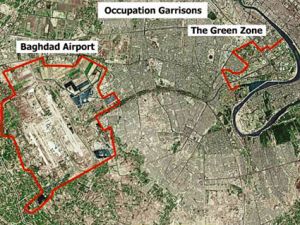
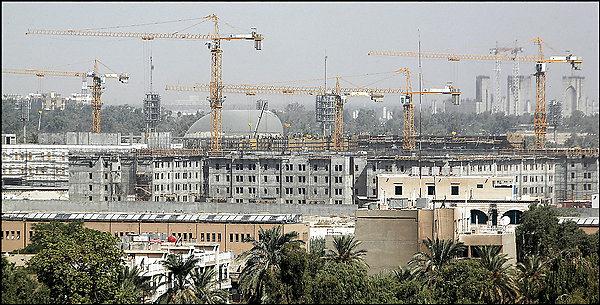
Even as we withdraw troops, the enormity of the US embassy compound in Baghdad sends the wrong message.
— By Peter Van Buren
Mother Jones, 11 June 2011
EXTRACT:
Eight disastrous years after we invaded, it is sad but altogether true that Iraq does not matter much in the end.
Click on Image to Enlarge
It is a terrible thing that we poured4,459 American lives and trillions of dollars into the war, and without irony oversaw the deaths of at least a hundred thousand, and probably hundreds of thousands, of Iraqis in the name of freedom. Yet we are left with only one argument for transferring our occupation duties from the Department of Defense to the Department of State: something vague about our “investment in blood and treasure.”
Think of this as the Vegas model of foreign policy: keep the suckers at the table throwing good money after bad. Leaving aside the idea that “blood and treasure” sounds like a line from Pirates of the Caribbean, one must ask: What accomplishment are we protecting?
The war's initial aim was to stop those weapons of mass destruction from being used against us. There were none, so check that off the list. Then it was to get rid of Saddam. He was hanged in 2006, so cross off that one. A little late in the game we became preoccupied with ensuring an Iraq that was “free.” And we've had a bunch of elections and there is a government of sorts in place to prove it, so that one's gotta go, too.
What follows won't be “investment,” just more waste. The occupation of Iraq, centered around that engorged embassy, is now the equivalent of a self-licking ice cream cone, useful only to itself.
In 1990 new proteins were engineered into the American food supply. Other countries don't allow it. Walmart, Kraft and Pepsi actually formulate different food for export. America has highest cancer rates in the world.
Robyn O'Brien gives us information and patterns she has assembled and synthesized about how our food “industry” makes us sick (allergies, cancer, etc., etc.), raises our health care costs, weakens our global competitiveness, etc. and what we can do about it.
Phi Beta Iota: Industry–which operates on public incorporation commissions–lacks integrity because the government lacks integrity, as does the media in a corporate state. We have had a failure of integrity across the entire US system of systems (see Paradigms of Failure).
But as US action around the world aimed at eliminating the recently won right to self-determination for the peoples of Asia and Africa under the guise of “Western democracy” fighting “totalitarian communism”, which left a trail of millions murdered by the US and its allies (starting with Korea and moving to the Congo, to Indonesia, Vietnam, Cambodia, and Laos, and from Guatemala to Brazil to Argentina, Uruguay, El Salvador, and Chile, to Southern Africa and the Middle East), the cruel US invasions of Iraq and Afghanistan in the last decade have hardly changed this anti-democratic trend. Yet two important victories are always touted by supporters of US foreign policy on the democratic front: namely, the fall of the Soviet Union and the ensuing “democratisation” of Eastern Europe, and the end of Apartheid in South Africa. The US hopes that its policies in both places will guide it to achieve similar ends for those uprisings of the Arab world that it cannot crush.
Joseph Massad is Associate Professor for Modern Arab Politics and Intellectual History at Columbia University in New York.
This blaster is intended to bring two very important reports and a short third report to your attention. The three should be thought about together.
1 is an essay by Robert ParryConsortium News. It is an excellent summary of the last 10 years of perpetual war and the debacle wrought by the Neoconmen. It also explains why these wars are now un-winnable and how President Obama has walked merrily into the Aftrap and is being set up as the fall guy to the Neconmen's debacle. (My essay, which appeared in the Jan-Feb issue of Challenge, explaining the domestic politics underpinning the Pentagon's need for perpetual war can be found here.)
2 is a more narrowly focused but deeply disturbing essay in Counterpunch by Gareth Porter, who reports on a recent book by Saleem Shahzad, the distinguished Pakistani journalist whose body was found outside Islamabad last week. As Porter explains, Shahzad has laid out how Al Qaeda, especially Dr. Ayman Zawahiri (the brains of the outfit), laid out a strategy that played President Bush (and his fellow travellers) like like a violin. Porter describes how the name of the game has been to dupe the cowboys in America to overreact to generate blowback in the Muslim word. He explains why Zawahiri wants the US mucking around in Afghanistan. But Belogolova's report does raise a valid concern. If Shahzad is right in his assessment of Zawahiri, the good Dr must be laughing his rocks off … because from his perspective, Afghanistan may turn out to be the gift that keeps on giving.
3 is Olga Belogolova's report on a new Senate study in the 8 June issue of National Journal …. She tells the reader that the Senate report suggests we can not even leave Afghanistan without collapsing the economy. This is kind of thinking can be used as yet another pretext for signing up to Zawahiri's script of the U.S. staying in Afghanistan forever, enraging the Muslim world — and in the near term for scaring Obama into not withdrawing significant forces in July as he has promised to do. I am not so sure this concern over the economic effects of reducing aid is that important. If so much of the aid money goes into the swamp of corruption, a large part of the collapse may be related to corruption. Is eliminating the honey pot stoking corruption that bad for the Afghan people (or the Americans for that matter)? Will Afghanistan really collapse? Who knows? But I doubt it.
The real subject of these essays, however is the sorry state of the United States and its political elites who are either working for the benefit of other countries (i.e., see Parry's discussion of the Neoconmen and Israel) or are brain dead strategists in Versailles on the Potomac, who, as we used to say in the Pentagon, “went for the cape — right off the cliff.” An now the numbskulls who got the United States into these messes are suggesting we must stay the course. Which brings us back to the Colonel's lament in my last blaster.
Chuck Spinney
La Ciotat, France
Phi Beta Iota: Integrity might be lost at the top, but it is the failure of integrity among all ranks that enables the corruption at the top to persist. We swear an oath to the Constitution, not to the chain of command, but all of our officers, with few exceptions, appear at this time to be in violation of their oath to the Constitution.
The Kenyan Government has been getting quite tech savvy in the recent past, becoming more pronounced as Kenyans join the civil service. This has resulted in subtle, but solid, movements towards a better connected Government as was showcased during the Connected Kenya Summit in Mombasa in April.
If you haven't already heard about bitcoin, the first popular cypto-currency, you soon will. The idea for the currency is simple. It's a software system that makes it possible to manufacture and trade (P2P), in a public and decentralized way, a limited digital resource. That's it.
So why the interest in bitcoin?
Simple. It appears to be gaining critical mass as a transactional currency that operates outside of the traditional monetary conduits (banks, SWIFT, etc.). That fact alone has attracted lots of people to the system, despite the fact that it's not built to allow completely anonymous transactions (it can't be, given that it requires network broadcasts of every transaction to maintain the integrity of the system and prevent counterfeiting).
As a transactional currency that operates outside of traditional systems, it's actually a pretty good medium of exchange (particularly if those transactions are small and quick). The problems arise when people confuse bitcoin's role as a transactional medium and its role as a store of value (as in: holding it as an asset).