Phi Beta Iota: Our political, policy, and military leaders simply do not know what they do not know. Assuming–desiring–that they have the best of intentions–the reality is that they are not receiving the intelligence (decision-support) that they require to make intelligent decisions. In both Iraq and Afghanistan, because there was political will, trillions have been wasted on “security” instead of sustenance. Haiti, because there were no political will, was a microcosm–20,000 troops with a huge logistics tail when what was really needed were CAB 21 Peace Jumpers able to call in a Reverse TPFID…. Advanced Cyber/IO starts with imagination & intelligence.
The American Way of War: If You Can See Everything, Can You Know Anything?
With Air Force's new drone, ‘we can see everything,'in today's Washington Post (attached below) is a good example of how the high-cost addiction to techno war is running amok. One thing ought to be clear in Afghanistan: A tiny adversary armed with the most primitive weapons, and a command and control system made up of prayer rugs and cell phones, has brought the high tech US military to a stalemate … or even worse, the looming specter a grand-strategic defeat, because we are becoming economically and morally exhausted by the futility of this war. It does not matter whether it is President Obama presiding over a vapid strategic review or a low ranking grunt on point in Afghanistan — the central problem facing the United States in Afghanistan is the absence of what the Germans call fingerspitzengefühlor the feeling in the fingerprints needed for an intuitive feel for or connection with one's environment.
As the American strategist Colonel John Boyd (USAF Ret.) showed, fingerspitzengefühl is absolutely essential to the kind of synthetic (as opposed to analytic) thinking that is necessary for quick, relevant, and ultimately successful decision making in war, where quick decisions and sharp actions at all levels must be made and harmonized in an ever-present atmosphere of menace, uncertainty, mistrust, fear, and chaos that impedes decisive action.[1]
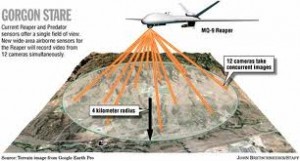
Article About Grogon Stare
To paraphrase Clausewitz, these difficulties multiply to produce a kind of friction, and therefore, even though everything in war is simple, the simplest thing is difficult. Clausewitz considered friction is the atmosphere of war. Nevertheless, according to the Post, the Air Force is about to deploy to Afghanistan a “revolutionary airborne surveillance system called Gorgon Stare, which will be able to transmit live video images of physical movement across an entire town.”
Quoting Maj. Gen. James O. Poss, the Air Force's assistant deputy chief of staff for intelligence, surveillance and reconnaissance, “Gorgon Stare will be looking at a whole city, so there will be no way for the adversary to know what we're looking at, and we can see everything.” Nirvana. While the Post dutifully reports a smattering of opposing views, it misses the ramifications of the central idea epitomized by General Poss's confident assertion: namely, how the American ideology of techno war assumes it can negate the human need for fingerspitzengefühl on a battlefield.
General Poss's confidence suggests quite clearly he believes seeing everything enables one to know everything. This a stunning theory of knowledge. It is also a classic example of the American military's unquestioned belief that complex technologies coupled to step-by-step analytical procedures can negate the friction of combat to solve any problem in war. Lifting the fog of war is, in fact, a phrase frequently used in contractor brochures touting the efficacy of these technologies. This reflects theory of knowledge — really an unquestioned ideology — that views war as fundamentally a procedural problem of methodical analytical thinking, as opposed to its messy reality of being in large part an art of synthetic thinking.
Officer won't sign order for troop indoctrination, asks to be relieved of command over repeal of ‘gay' ban in military
Worldnet.com,Posted: December 24, 2010
An Army lieutenant colonel has asked to be relieved of command rather than order his troops to go through pro-homosexual indoctrination following the repeal of the policy, which required homosexuals to keep silent about their sexual preference.
This year will see the 10th anniversary of the war in Afghanistan and, according to current plans, the beginning of British troop withdrawal. A decade into the military campaign, there is no longer even discussion of winning. The initial objective to release the country from the despotic grip of the Taliban and prevent its use as a safe haven for al-Qaida was achieved within months. Since then, it has only ever become harder to discern what victory might look like.
There is some clarity on what would count as defeat. If Nato withdrawal leads to the total collapse of Hamid Karzai's government and a return to Taliban rule, there would be no disguising the humiliation to western powers, nor the increased security threat from jihadi terrorism. Not that President Karzai is an attractive ruler. His administration is corrupt and repressive.
Summary: The author discusses the intellectual but not the ethical underpinings of the failure of US foreign policy and national security since the first Clinton Administration. He touches on alternative policies such as isolationalism, offshore balancing, selective engagement, global dominance, and then settles on offshore balancing as the way to go: pulling back the Army and Marines from overseas, sharply reducing their budgets, and restoring budget to the Air Force and the Navy.
Special report: In the last of his series from Afghanistan, Ghaith Abdul-Ahad asks Taliban leaders past and present what kind of regime they would run – and whether there is a chance of negotiated peace
The administrator
In the south-eastern city of Khost, the everyday business of the Taliban administration carries on across the street from the fortified, government-run city court and police station.