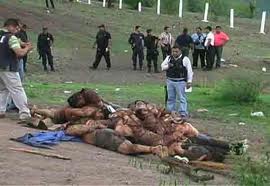
Mexico: For the record. Suspected members of the Sinaloa drug trafficking cartel warned that they would kill 135 people after security forces seized 134 tons of marijuana last week in Tijuana, Baja California state, Milenio reported today, 25 October. The warning was made over a police radio frequency late on 24 October reportedly minutes after gunmen killed 13 patients at a drug rehabilitation center in Tijuana.
Phi Beta Iota: This kind of indiscriminate mass murder in retaliation for what are relatively minor interdictions suggests that on the one hand, both the US and Mexican government have not only lost all control of the territory for which they are responsible for providing good order and public safety and security; but also that neither government has an effective intelligence capability to guide operations in detail. We are reminded of how long it took to hunt down one man in Colombia, Pablo Escobar. A MAJOR obstacle is the recalcitrance of the US secret intelligence community with $75 billion or more being applied to produce “at best” 4% of what is needed, to reinvent itself and engage in M4IS2: multinational, multiagency, multidisciplinary, multidomain information-sharing and sense-making. The El Paso Intelligence Center (EPIC) is a massive failure precisely because it embodies all of the handicaps of the past and none of the advantages of the present.
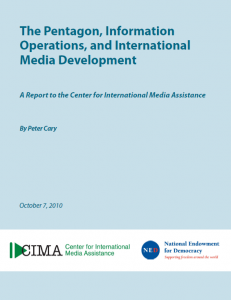
CIMA is pleased to release a new report, The Pentagon, Information Operations, and Media Development, by Peter Cary, a veteran journalist with extensive experience reporting about the U.S. military. As part of its post-9/11 strategy, the Department of Defense has launched a multi-front information war, both to support its troops on the ground and to counter the propaganda of radical Muslim extremists. The DoD’s global public relations war, however, has fostered criticism that the department has over-reached and tarred the efforts of non-DoD Americans doing media development work abroad.
While the DoD cannot be criticized for trying to protect the lives of its soldiers, it has spent vast amounts of money on media operations–which can tend to be conducted in secrecy and whose effectiveness often cannot be measured. This report examines the impact of DoD information operations on international media development efforts and offers recommendations – including that the DoD leave media activities that could be considered public diplomacy to the State Department.
Phi Beta Iota: Most of the weapons being used by the cartels do NOT come from US gun shops. They come from the Latin American militaries who have received large shipments of “older” weapons and ammunition from the US, and then turned around and sold them to the cartels. Just as the US is indirectly funding the Taliban in Afghanistan, it is indirectly enabling the cartels with weapons. Furthermore, to imagine that with the money they have the cartels cannot “order in” anything they wish from the Chinese, Israeli, or Russian arsenals, is naive in the extreme. As many or more are dying violent deaths every day in this region as in Iraq or Afghanistan. In our view, the current era of politicians (1981-date) is going to be held accountable for four major strategic blunders, all of them deliberate:
1. Elective invasions and occupations of Afghanistan and Iraq on top of irresponsible military cuts and acquisition pathologies
2. Willful acceptance from Bush Senior onwards of the willful destruction of the US economy for the benefit of a few led by Goldman Sachs, Citi-Bank, and Morgan
3. Ignoring the depth and extent of the Southwest Border instability and threat to local communities
4. Ignoring the imminent clean water crisis across the entire region as well as across America
These photographs were taken on an 852-mile, 72-hour trip across the Southwest border, from San Diego, California to Arizona and back. Many citizens from the United States and Mexico have never seen the line that divides and defines their countries, marked by walls, barbed wire fences, U.S. Border Patrol checks and, increasingly, controversy.
One day as Wall Street was crashing, President George W. Bush had the temerity to plaintively ask his treasury secretary, Henry Paulson: “How did this happen?” Paulson, who headed Goldman Sachs before taking the Treasury job, remarks in his memoir: “It was a humbling question for someone from the financial sector to be asked—after all, we were the ones responsible.”
That’s an honest enough admission about the culpability of the financial community in bundling the toxic derivatives packages still disastrously undermining the economic health of the nation. Even more startling was Paulson’s admission in his memoir that he, at the time he was advising the president, still did not know that home mortgages were at the heart of those troubling securities that his former company had marketed to others with such wild abandon.
Were President Barack Obama to ask that question about the origins of this crisis of Tom Donilon, one of his closest aides whom he recently appointed to the critical job of national security adviser, Donilon would find it even more awkward to invoke the defense of ignorance. As the chief lobbyist for Fannie Mae from 1999 to 2005, he was far more intimately involved than Paulson in the manufacturing of this crisis. He successfully pressured Congress to give Fannie Mae the green light to speed past any sound regulation. Indeed, had Congress endorsed the barest semblance of regulation of the Fannie Mae-led housing scam, it would have been stillborn instead of being a very much alive Frankenstein creation.
Phi Beta Iota: Henry Kissinger was and remains a de facto war criminal (see The Trial of Henry Kissinger) but he never actively cheated the entire US public or was party to the deliberate–with malice aforethought–destruction of the entire US economy in the intimate manner of the new “National Security Advisor,” one Tom Donilon. Perhaps his title should be changed to Goldman Sachs Security Advisor. Kissinger did assure the death of another 20,000 US soldiers by cravenly undermining the Paris Peace Talks the first time around, and he did approve of NATO/CIA “dirty tricks” that killed people in Europe, so perhaps it is a toss-up. Relevant book: Politics Lost–How American Democracy Was Trivialized By People Who Think You’re Stupid (Hardcover).
A recent article in Christian Science Monitor on military health care costs identified, in microcosm, the battle we face in the coming years in defending the military community’s sunk investment in its future.
Full Story Online
After citing all DoD’s arguments that it’s being “eaten alive” by “unsustainable” military health care cost increases, the reporter had the courtesy of quoting me on the other side of the argument:
“’There’s a fundamental difference between social insurance programs open to every American and military benefits earned by decades of service and sacrifice,’ said Steve Strobridge, director of Governmental Relations for MOAA.
“What Mr. Strobridge raises here is a moral issue: Should the military be treated differently than nonmilitary America when it comes to pay and benefits? The armed forces put their lives, limbs, and mental health on the line for the safety of the country, or they potentially do. On a practical level, you need strong benefits to recruit and maintain a strong, all-volunteer military.”
And then came this kicker:
“But here’s another moral angle: Sacrifice goes with the territory of being in the armed services, and the military budget needs serious cutting. Should sacrifice not also extend to the defense of the nation’s financial health if it’s in critical danger?”
And there’s the problem. Sacrifices already endured are assigned no value. It’s the budget shrug: “They volunteered, didn’t they?”
Every 15 years or so, that indifference leads to cuts that eventually wreck retention — and then national leaders have to pull out all the stops and spend even more to solve the military manpower crisis they refused to prevent.
The real issue is, “How much is it worth for the country to be able to defend itself?”
Phi Beta Iota: With all due respect to MOAA, the real issue is NOT “what price defense” but rather “how best to defend.” There are three simple solutions to the military and and benefits problem that do NOT require reductions:
1. Restore the universal draft including immigrants and including a mid-career “sabatical” between military and private sector. This bonds the nation–one boot camp, three choices: Armed Forces, Peace Corps, Homeland Service.
2. Establish Constitutional honest government tht does not lead the Republic into elective wars for ideological and private reasons on the basis of (most recently) 935 documented lies. The same honest government can be expected to end the acquisition of things we do not need (e.g. missile defense in Poland, J-22, new nuclear submarine) at costs we cannot afford.
3. End the fiction that future Medicare costs re unfunded. They are only unfunded because a corrupt Congress in cahoots with a corrupt Administration (both parties) has forbidden price negotiation. The minute we restore honest government current and future Medicare costs come down to 1% (ONE percent) of what we pay now.
Thomas Jefferson: A Nation's best defense is an educated citizenry.
Russell Ackoff: Stop trying to do the wrong things righter; do the right things.
Robert Steele: The truth at any cost reduces all other costs.
You can only hope that the very preliminary peace efforts in Afghanistan bear fruit before long. But for evidence that the United States is letting its claim to greatness, and even common decency, slip through its fingers, all you need to do is look at the way we treat our own troops.
The idea that the United States is at war and hardly any of its citizens are paying attention to the terrible burden being shouldered by its men and women in uniform is beyond appalling.
Bob Herbert
We can get fired up about Lady Gaga and the Tea Party crackpots. We’re into fantasy football, the baseball playoffs and our obsessively narcissistic tweets. But American soldiers fighting and dying in a foreign land? That is such a yawn.
I would bring back the draft in a heartbeat. Then you wouldn’t have these wars that last a lifetime. And you wouldn’t get mind-bending tragedies like the death of Sgt. First Class Lance Vogeler, a 29-year-old who was killed a few weeks ago while serving in the Army in his 12th combat tour. That’s right, his 12th — four in Iraq and eight in Afghanistan.
I believe Obama's schtick during his campaign for president was to subtly encourage his adversaries to impale themselves of the horns of their own contradictions. This kind of strategy can be particularly effective in the all-important moral dimension of an election, or indeed, any other kind of conflict. To be sure, Obama had the help of widespread disgust with Bush, as well as an exquisitely timed, terrible financial meltdown, but the parallels in his campaigns against Hillary Clinton and John McCain suggest he had an instinctive feel for gaining leverage by using what reformers in the Pentagon called the Motherhood and Mismatch, or M&M, strategy. (See my CounterPunch essay on that theme.) But to date, his strategy for governance has failed utterly to live up to that brilliance. He blew at least two stunning opportunities that seemed designed in heaven for a decisive M&M strategy. He capitulated to a morally bankrupt establishment by bailing out the banksters and then caving in to the insurance companies on health care reform.
Obama now has a third opportunity, and like his campaigns against Clinton and McCain, it is partly the result of his own making, be it accidental or deliberate. As Ira Chernus shows in a persuasively argued 19 October essay, Israel's hypocrisy in the so-called peace process has reached stunning proportions. The Palestinians are going out of their way to accommodate Israel in the so-called peace talks, but each time the Palestinians sell out their patrimony by caving in to a new Israeli demand — like recognizing Israel as a Jewish state as opposed to recognition of Israel per se, the Israelis up the ante by inserting poison pills aimed at queering any deal — like saying that settlement expansion in East Jerusalem will not be part of a settlement freeze because East Jerusalem is a part of Israel, a claim not recognized by international law, the United States, or Europe, and then acting as if Israel is the injured party.