Obama’s surge and de-surge has, therefore, created a reinforcing dynamic that is playing into the hands of the insurgents by seducing the United States into increasing its reliance on a pointless, reactive, “whack-a-mole” strategy. Like a judo specialist, the insurgents will use the expenditure of American energies to exhaust American forces and paralyze American political willpower by inducing our military to over and under react to an unfolding welter widely dispersed insurgent attacks
Phi Beta Iota: At home, the teen riots have started in Philadelphia. More riots are certain to follow, and more “random” shootings of anyone representing the US Government are likely west of the Mississippi. This is almost the perfect storm–all that is missing is a water failure in New York City followed by a firestorm, and massive epidemic across California.
Three Good Reasons to Liquidate Our Empire and Ten Steps to Take to Do So
1. We Can No Longer Afford Our Postwar Expansionism
2. We Are Going to Lose the War in Afghanistan and It Will Help Bankrupt Us
3. We Need to End the Secret Shame of Our Empire of Bases
. . . . . . . .
Chalmers Johnson
10 Steps Toward Liquidating the Empire (Abridged)
Dismantling the American empire would, of course, involve many steps. Here are ten key places to begin:
1. We need to put a halt to the serious environmental damage done by our bases planet-wide. We also need to stop writing SOFAs that exempt us from any responsibility for cleaning up after ourselves.
2. Liquidating the empire will end the burden of carrying our empire of bases and so of the “opportunity costs” that go with them — the things we might otherwise do with our talents and resources but can't or won't.
3. As we already know (but often forget), imperialism breeds the use of torture. Dismantling the empire would potentially mean a real end to the modern American record of using torture abroad.
4. We need to cut the ever-lengthening train of camp followers, dependents, civilian employees of the Department of Defense, and hucksters — along with their expensive medical facilities, housing requirements, swimming pools, clubs, golf courses, and so forth — that follow our military enclaves around the world.
5. We need to discredit the myth promoted by the military-industrial complex that our military establishment is valuable to us in terms of jobs, scientific research, and defense. These alleged advantages have long been discredited by serious economic research. Ending empire would make this happen.
6. As a self-respecting democratic nation, we need to stop being the world's largest exporter of arms and munitions and quit educating Third World militaries in the techniques of torture, military coups, and service as proxies for our imperialism.
7. Given the growing constraints on the federal budget, we should abolish the Reserve Officers' Training Corps and other long-standing programs that promote militarism in our schools.
8. We need to restore discipline and accountability in our armed forces by radically scaling back our reliance on civilian contractors, private military companies, and agents working for the military outside the chain of command and the Uniform Code of Military Justice. Ending empire would make this possible.
9. We need to reduce, not increase, the size of our standing army and deal much more effectively with the wounds our soldiers receive and combat stress they undergo.
10. To repeat the main message of this essay, we must give up our inappropriate reliance on military force as the chief means of attempting to achieve foreign policy objectives.
Phi Beta Iota: The second article is a stunning review of the intellectual life of Chalmers Johnson, who was among many things a net assessments analyst for Allen Dulles. He pioneered the study of “State Capitalism” and considered the US to be a greatly under-performing economy for its failure to move away from military unilateralism and toward sustainable development.
They got it wrong…. Internal Auditor recently published an article by Neil Baker “Managing the Complexity of Risk” claiming that “The ISO 31000 framework aims to provide a foundation for effective risk management within the organization.” Well….not so fast.
“Complexity” has become something of a buzz word in today’s business culture, becoming more vague and imprecise than many of us attempting to understand complexity would like. Naming something is not the same as actually knowing anything about what you just named (see my essay “The Red Wagon Principal: Knowing Is Better Than Naming”). The misappropriation of the concept is always done with the best of intentions. However, Neil was savvy enough to introduce Mandelbrot and fractal geometry into the mix doesn’t get a free pass.
In the past six months, hedge fund manager George Soros has been an outspoken critic of the economicrecovery.And as the U.S. digests the S&P downgrade, it's helpful to remember that as Barclays analysts Ajay Rajadhyaksha and Anshul Pradhan put it, The S&P's action is not a surprise. So to gain a market expert's view, we've gone through many of Soros' recent interviews and selected his main points.
Soros describes the key arguments the market is dealing with right now and makes predictions on what will happen next.
His quotes are dated in chronological order.
Phi Beta Iota: The original article has photos and more context for each quote. Eleven quotes only are below the line.
“Israel has two principal targets in Iran’s cyberspace,” said a defense source with close knowledge of the cyber war preparations. “The first is its military nuclear program and its military establishment. The second is Iran’s civil infrastructure. Attacking both, we hope, will cripple the entire country’s cyberspace.”
Phi Beta Iota: What Israel is saying, particularly with regard to its second target spread, is that it is waging undeclared unjust war against Iran and the people of Iran. To blithely announce that the civil infrastructure of another country is “fair game” should call into question the sanity and legitimacy of the perpetrators.
It is obvious that this man has no clue. We are developing fighters
(F-22/35) that have no threat that cannot be handled by the F-117 (which is the be all to end all) but we are dangerously close to imploding if more budget cuts come our way? Strengthen the force, reduce the technology (which doesn't work in most cases) and let's put DoD on the right path, defense of the Nation (and not police force of the world)……
Leon Panetta Hypes al Qaeda to Ward Off More Defense Cuts
Steve Clemons
The Atlantic, 6 August 2011
EXTRACT:
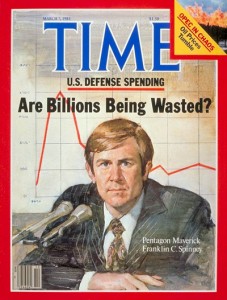
It seems that one week, al Qaeda is on the run and “near collapse” and the next, al Qaeda remains the reason why the US needs to continue to spend hundreds of billions of dollars on a Pentagon designed to fight the wrong wars. This is irresponsible hyping of a threat to justify massive defense spending during a period of real fiscal stress.
Phi Beta Iota: Daniel Ellsberg had it exactly right when he lectured Henry Kissinger in the 1970's on Viet-Nam:
The danger is, you’ll become like a moron. You’ll become incapable of learning from most people in the world, no matter how much experience they have in their particular areas that may be much greater than yours” [because of your blind faith in the value of your narrow and often incorrect secret information].
Panetta would be well-served by attending to what Bob Seelert, Chairman of Saatchi & Saatchi Worldwide (New York) has to say:
When things are not going well, until you get the truth out on the table, no matter how ugly, you are not in a position to deal with it.
Paul Jacob is president of Citizens in Charge, a non-profit, non-partisan group working to protect and expand voter initiative rights, and the Citizens in Charge Foundation, a charitable foundation conducting research on the initiative process, educating the public and litigating to defend the petition rights of Americans.
Early last week, insider Republican and CNN columnist David Frum lashed out at the GOP’s Tea Party wing, writing: “You can’t save the system by destroying the system.” I responded on This is Common Sense:
If the system has put America on a crash course with disaster, then that system must be replaced. With a better one.
When I wrote that I had not yet fully comprehended the full import of the goofy creation (by the debt deal) of what Rep. Ron Paul calls a Super Congress — the select committee of senators and representatives to be put in charge of budgeting, with the rest of Congress not allowed to amend their proposals, just vote yea or nay.