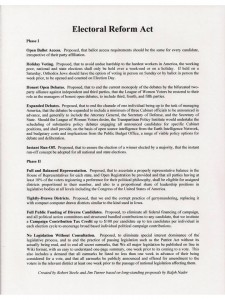
Reference: Electoral Reform 9 Steps

11 Society, Fact Sheets
One Page Online

Electoral Reform is the “fast track” toward restoring the Constitution and the Republic (We the People must be sovereign or it is not a Republic).  As long as the Executive and Congress are led by unethical politicians working for unethical corporations, public intelligence can and should be used to expose each individual, each transaction, each transgression.  That is the “slow road.”  However, if the Independents, Greens, Reforms, and the honest Libertarians (not faux Libertarians like the Koch Brothers) can get together on this ONE THING, the “fast track” is possible in time for 2012.

Corrected 30 Oct 2010 to number 01-09, not thirteen steps.

Reference: Obama, Populism, and 2012

03 Economy, 04 Education, 11 Society, Civil Society, Collective Intelligence, Commerce, Commercial Intelligence, Corruption, Cultural Intelligence, Government

Lawrence Goodwyn: The Great Predicament Facing Obama

An interview with legendary historian Lawrence Goodwyn on Obama, the larger currents in our political life, and the possibility of a rebirth in our democratic culture.

October 30, 2010

What happened to the dream of Barack Obama's transformational politics? There's been very little deviation from the disastrous Bush years on the key issues of war, empire and the distribution of wealth in the country.

I turned to Lawrence Goodwyn, historian of social movements whose books and methods of explaining history have had a profound influence on many of the best known authors, activists and social theorists of our time. Goodwyn's account of the Populist movement, Democratic Promise, is quoted extensively by Howard Zinn in People's History of the United States, and also in William Greider's masterpiece on the Federal Reserve, Secrets of the Temple. You can find Goodwyn quoted in the first paragraph of Bill Moyers' recent book, On Democracy, and cited in just the same way in countless other books and essays.

I interviewed Goodwyn from his home in Durham, North Carolina about the pitfalls of recording American history, Obama's presidency in light of previous presidents, and portents of change in our political culture.

Read Full Long Interview Online….

Contributor John Steiner says:

This is a remarkable, long, worth reading every word interview, in which Goodwyn compares Obama favorably with Lincoln and recounts the history of the financial elites in America. His concluding sentences: ³Strap on your
seat belts, Jan (Frel). The election in 2012 is going to define the meaning of the American idea.

Phi Beta Iota: There are two major flaws with this Democratic Party love-fest: 1) the Democrats are just as corrupt as the Republicans, just more inept; and 2) Obama will not get a second term because he sold out–anyone who had Rahm Emanuel as his “enforcer” and that still has Axelrod as his advisor,while also installing a Goldman Sachs lobbyist as “national security advisor,” is part of the existing system, not its antithesis.  Independents and Electoral Reform (13 Steps) will produce the outcome Goodwyn posits, not Obama and not the Democratic Party.

See Also:

Worth a Look: Book Review Lists (Positive)

Worth a Look: Book Review Lists (Negative)

Journal: The Aging of Humanity

11 Society, Civil Society, Cultural Intelligence, Earth Intelligence
DefDog Recommends...

Think Again: Global Aging

A gray tsunami is sweeping the planet — and not just in the places you expect. How did the world get so old, so fast?

Foreign Policy BY PHILLIP LONGMAN | NOVEMBER 2010

Yes, but of old people. Not so long ago, we were warned that rising global population would inevitably bring world famine. As Paul Ehrlich wrote apocalyptically in his 1968 worldwide bestseller, The Population Bomb, “In the 1970s and 1980s hundreds of millions of people will starve to death in spite of any crash programs embarked upon now. At this late date, nothing can prevent a substantial increase in the world death rate.” Obviously, Ehrlich's predicted holocaust, which assumed that the 1960s global baby boom would continue until the world faced mass famine, didn't happen. Instead, the global growth rate dropped from 2 percent in the mid-1960s to roughly half that today, with many countries no longer producing enough babies to avoid falling populations. Having too many people on the planet is no longer demographers' chief worry; now, having too few is.

FP Photo Essay the Grayest Generation

NIGHTWATCH Extract: China-Pakistan & Kashmir Terror, Regional Water…and Palestine

09 Terrorism, 12 Water, Cultural Intelligence, Earth Intelligence

China-Pakistan: Chinese Major General Yang Hui, director general of the Intelligence Directorate, visited Chief of Army Staff General Kayani at General Headquarters on 28 October, Associated Press of Pakistan reported. The two discussed matters of professional interest, according to Pakistan's Inter Services Public Relations.

NIGHTWATCH Comment: A visit by a Chinese intelligence general to Pakistan usually signifies a problem. The usual problem is that Pakistan is harboring, aiding, training and abetting anti-Han Chinese Islamic terrorists in the 42 terrorist camps that Pakistani intelligence sustains in Pakistani Kashmir.

Chinese intelligence officials seldom visit unless there is a problem. The Chinese do not seem concerned that Pakistani-trained terrorists kill Indians or Americans, but they do object to Pakistan providing or tolerating training of Xinjiang Uighurs who want to kill Han Chinese.

NIGHTWATCH KGS Home

Phi Beta Iota: This is interesting at multiple levels–it suggests among other things that the US and China could be constructively discussing an international solution to Kashmir and to regional water issues (what really underlies Kashmir).  That in turn could be tied to an international solution and regional water issue around Palestine.

Journal: College True Costs versus True Ignorance

04 Education

Seth Godin Home

Pushing back on mediocre professors

College costs a fortune. It takes a lot of time and it takes a lot of money.

When a professor assigns you to send a blogger a list of vague and inane interview questions (“1. How did you get started in this field? 2. What type of training (education) does this field require? 3. What do you like best about your job? 4. what do you like least about your job?”) I think you have an obligation to say, “Sir, I'm going to be in debt for ten years because of this degree. Perhaps you could give us an assignment that actually pushes us to solve interesting problems, overcome our fear or learn something that I could learn in no other way…”

When a professor spends hours in class going over concepts that are clearly covered in the textbook, I think you have an obligation to repeat the part about the debt and say, “perhaps you could assign this as homework and we could have an actual conversation in class…”

When you discover that one class after another has so many people in a giant room watching a tenured professor far far in the distance, perhaps you could mention the debt part to the dean and ask if the class could be on video so you could spend your money on interactions that actually changed your life.

The vast majority of email I get from college students is filled with disgust, disdain and frustration at how backwards the system is. Professors who neither read nor write blogs or current books in their field. Professors who rely on marketing textbooks that are advertising-based, despite the fact that virtually no professional marketers build their careers solely around advertising any longer. And most of all, about professors who treat new ideas or innovative ways of teaching with contempt.

“This is costing me a fortune, prof! Push us! Push yourself!”

Phi Beta Iota: Virtually everything we have been “sold” as essential (e.g. university credentialing, sub-zero fridges) comes with time-energy costs that are not known to the public.  Now, increasingly, the true cost versus true worth of alternative time-energy expenditures (e.g. two years spent traveling around the world versus four years listening to tenured professors pretend to teach), is “visible.”  2012 could be the year of great convergence-emergence in which all of the pent-up possibilities of the Information Era begin to visibly drown all of the drawn-out losers of the Industrial Era.

2010 Reference Core Clinical Collection: Essential overviews of globally important diseases

02 Infectious Disease, 07 Health, Research resources
link

Access the entire collection anytime for $50.00. Or purchase seminars individually for $19.95.

Acute hepatitis C
Acute lymphoblastic leukaemia
Acute myeloid leukaemia
Acute myocardial infarction
Acute pancreatitis
Acute renal failure
Adult epilepsy
Advances in leishmaniasis
Age-related macular degeneration
Alcohol-use disorders
Alzheimer's disease
Amyotrophic lateral sclerosis
Ankylosing spondylitis
Asthma in older adults
Atrial fibrillation: strategies to control, combat, and cure
Autism
Autosomal dominant polycystic kidney disease
Bipolar disorder-focus on bipolar II
disorder and mixed depression

Bladder cancer
Cerebral palsy
Chagas disease
Childhood obesity
Cholera
Chronic kidney disease: the global challenge
Chronic lymphocytic leukaemia
Chronic myeloid leukaemia
Chronic obstructive pulmonary disease
Coeliac disease
Colorectal cancer
Community-acquired pneumonia
Crohn's disease
Cushing's syndrome
Cutaneous melanoma
Cystic fibrosis
Deep vein thrombosis
Dengue
Dilated cardiomyopathy
Down's syndrome
Early breast cancer
Eating disorders
Endometrial cancer
Epilepsy in children
Essential hypertension
Gastric cancer
Haemochromatosis
Heart failure
Hepatitis B virus infection
Hepatocellular carcinoma
HIV/AIDS epidemiology, pathogenesis, prevention, and treatment

Hodgkin's lymphoma
Human African trypanosomiasis
Human papillomavirus and cervical cancer
Human schistosomiasis

Hyperthyroidism
Hypertrophic cardiomyopathy
Hypothyroidism
Infective endocarditis
Inflammatory bowel disease: cause and immunobiology
Inflammatory bowel disease: clinical aspects and established and evolving therapies
Leprosy
Liver cirrhosis
Malaria
Malaria in children
Management of atrial fibrillation
Management of severe asthma in children
Maternal and neonatal tetanus
Measles: not just another viral exanthem
Migraine
Multiple myeloma
Multiple sclerosis
New drugs for exacerbations of chronic obstructive pulmonary disease
Non-Hodgkin lymphoma
Osteoporosis
Ovarian cancer
Pancreatic cancer
Parkinson's disease
Pathogenesis and management of pain in osteoarthritis
Peptic ulcer disease
Polymyalgia rheumatica and giant-cell arteritis
Primary biliary cirrhosis
Primary open-angle glaucoma
Prostate cancer
Rabies and other lyssavirus diseases
Recent developments and current controversies in depression
Renal cell carcinoma
Rheumatoid arthritis
Rubella
Schizophrenia
Shiga-toxin-producing Escherichia coli and haemolytic uraemic syndrome

Sickle-cell disease
Small-cell lung cancer
Stroke
Subarachnoid haemorrhage

Suicide
Systemic lupus erythematosus
Systemic sclerosis: hypothesis-driven treatment strategies

Testicular germ-cell cancer
The metabolic syndrome
The muscular dystrophies
Trachoma

Tuberculosis
Type 1 diabetes
Type 2 diabetes: principles of pathogenesis and therapy
Typhoid and paratyphoid fever
Ulcerative colitis

Thanks to Cryptome.org

noble gold