Journal: Pentagon Flails in Defending Cyberspace

03 Economy, 04 Education, 10 Security, 11 Society, Corruption, IO Multinational, IO Secrets, Military, Officers Call
Marcus Aurelius Recommends

Beyond belief, but here it is: the “official” explanation of why we are going to waste 12 billion dollars a year on contractors without a clue (vapor-ware).   There is zero return on investment here for the taxpayer, only for the contractors and Congress, neither of which will be held accountable for fraud, waste, and abuse.

See Also:

2010: OPINION–America’s Cyber Scam
2009 Defense Science Board Report on Creating an Assured Joint DoD and Interagency Interoperable Net-Centric Enterprise
2006 General Accountability Office (GAO) Defense Acquisitions DoD Management Approach and Processes Not Well-Suited to Support Development of Global Information Grid
Journal: Cyber-Security or Cyber-Scam? Plus Short List of Links to Reviews and Books on Hacking 101
Journal: Pentagon’s Joint Strike Fighter (JSF) as a Metaphor for a Predictable Defense Meltdown


ESSAY

Defending a New Domain

The Pentagon's Cyberstrategy

William J. Lynn III
WILLIAM J. LYNN III is U.S. Deputy Secretary of Defense.

In 2008, the U.S. Department of Defense suffered a significant compromise of its classified military computer networks. It began when an infected flash drive was inserted into a U.S. military laptop at a base in the Middle East. The flash drive's malicious computer code, placed there by a foreign intelligence agency, uploaded itself onto a network run by the U.S. Central Command. That code spread undetected on both classified and unclassified systems, establishing what amounted to a digital beachhead, from which data could be transferred to servers under foreign control. It was a network administrator's worst fear: a rogue program operating silently, poised to deliver operational plans into the hands of an unknown adversary.

Read Entire Article Below the Line.

Continue reading “Journal: Pentagon Flails in Defending Cyberspace”

Journal: Denmark Ceases on Afghanistan

04 Inter-State Conflict, 05 Civil War, 07 Other Atrocities, 08 Wild Cards, 10 Security, Military, Peace Intelligence

Afghanistan-Denmark-NATO: Today the Danish Foreign Minister said Denmark has turned down a NATO request to send F-16 fighters to Afghanistan because it believes it has done enough for the international military mission there.

“We are one of the countries that contributes the most to Afghanistan,” Foreign Minister Lene Espersen told the media after a meeting of parliament's foreign affairs committee. “This is why we rejected the NATO request” which was also made to other member countries, she said.

Espersen said the committee “has a strong desire to scale down engagement” in Afghanistan as the Danish defense budget was “under pressure” and the government “is under no obligation to do more” there. Denmark “can be proud” of its role in Afghanistan, she said, adding that “it's up to other countries to play a role and meet demands”.

NIGHTWATCH Comment: Denmark has 750 soldiers in Afghanistan serving in the International Security Assistance Force force, primarily in Helmand province. Its small contingent has sustained, proportionally, the heaviest losses of any ISAF nation with 34 combat deaths. The fight in Afghanistan is not popular in NATO. More countries may be expected to decline further involvement and pursue early withdrawal in 2011.

NIGHTWATCH KGS Home

Phi Beta Iota: Denmark spends more than most on waging peace, and its government is vastly more intelligent and holistic than the US Government (USG).  The raw truth is that the US made a huge mistake in both Iraq and Afghanistan, Denmark felt obliged to honor its NATO commitment when NATO compounded the mistake by making Afghanistan a NATO mission (equivalent to asking Mexico to declare Cuba a threat to national security–we all die laughing).  The USG is incapable of demonstrating any return on investment for its foreign and national security policies, and the US public is among the losers for this lack of intellectual integrity.

Journal: Brains Beat Algorithms….Again

04 Education, Advanced Cyber/IO, Analysis, Citizen-Centered, Civil Society, Collective Intelligence, info-graphics/data-visualization, InfoOps (IO), IO Sense-Making, Methods & Process, Politics of Science & Science of Politics, Tools
Full Story Online

Today's issue of Nature contains a paper with a rather unusual author list. Read past the standard collection of academics, and the final author credited is… an online gaming community.

Scientists have turned to games for a variety of reasons, having studied virtual epidemics and tracked online communities and behavior, or simply used games to drum up excitement for the science. But this may be the first time that the gamers played an active role in producing the results, having solved problems in protein structure through the Foldit game. (Also related, TED talk on how gaming can make a better world).

See Also:

Graphic: Jim Bamford on the Human Brain

2010: Human Intelligence (HUMINT) Trilogy Updated

Journal: Newsweek on SecDef Departure

10 Security
Marcus Aurelius Recommends

Why Gates Seems Set on a 2011 Departure, by Jim Watson. So Robert Gates is set on retiring from government – for the second time. Or so he says. In an interview with ForeignPolicy.com, he has repeated more firmly than ever his desire to resign as secretary of defense sometime in 2011.

Why would he decide on 2011, and not 2010 or 2012? Strange but true: the arcane workings of the Pentagon budget process are one of the key factors behind his timing. Drawing up the annual defense budget – especially one now totaling $719 billion – is so complex that each exercise actually takes close to two years. Thus, the defense budget for 2012, the last year of President Obama's term in office, is already taking shape. Its unveiling in February of next year will place a capstone on Gates's extraordinary career.

Phi Beta Iota: The magazine appears poorly informed on several fronts, and most obviously, fails to recognize Senator Chuck Hagel as a possible successor to Gates.  Whoever it is, they are going to have to come in with a strategic analytic perspective that gives them a grip on reality, and an absolute non-negotiable mandate from Congress and the President to re-do Title 10 while also redirecting the CINCdoms into Whole of Government multinational information-sharing and sense-making networks.  Leon Panetta?  Why not Rahm Emanuel or David Axelrod?

Reference: Citation Analytics 201

About the Idea, Advanced Cyber/IO, Analysis, Analysis, Articles & Chapters, Augmented Reality, Balance, Budgets & Funding, Collaboration Zones, Collective Intelligence, Communities of Practice, History, ICT-IT, info-graphics/data-visualization, InfoOps (IO), Maps, Methods & Process, Multinational Plus, Policies, Policies-Harmonization, Policy, Political, Politics of Science & Science of Politics, Power Behind-the-Scenes/Special Interests, Processing, Real Time, Research resources, Secrecy & Politics of Secrecy, Strategy-Holistic Coherence, Threats, Tools, Tribes

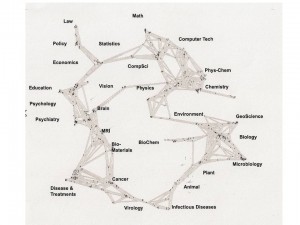
Phi Beta Iota: Most serious analysts now understand Citation Analytics 101.  It's time to move to Citation Analytics 202, and there is no better way to introduce the art of the possible than by pointing to Kevin W. Boyack, Katy Borner, and Richard Klavans (2007), “Mapping the Structure and Evolution of Chemistry Research (11th International Conference of Scientometrics and Infometrics, pp. 112-123.

Full Article with Color Graphics
Graphic as Printable Single Page PPT

There are several take-aways from this article, which is more or less the “coming out” of the Klavens-inspired infometrics field now that he has won his law-suit and has unchallenged access to all Institute of Scientific Information (ISI) access [this was one of the sources we used to win the Burundi Exercise before the Aspin-Brown Commission in 1995].

Continue reading “Reference: Citation Analytics 201”

Bangladesh Farmers + ICT, Increasing Awareness to Increase Income, Model for Other Countries

01 Agriculture, 01 Poverty, 03 Economy, 03 Environmental Degradation, 04 Education, 08 Wild Cards, Civil Society, Commerce, Technologies
source article

eKrishok

Farmers wise up online

by Nahid Akhter (Aug 20, 2010)

(clipped from full article) Bangladeshi farmers have to go through numerous hardships. Natural calamities cannot be avoided. However, if the farmer knew when to expect one and thereby take appropriate preventive measures, maybe some of his crops could be saved. Besides natural calamities, he is always running the risk of crop infestations and rainfall that is either too low or too high, thereby producing poor yields. Due to poor education, many farmers may be following the practices of his fore-fathers blindly, without looking for better agricultural methods or practices.

Without proper information, a farmer whose crops have been infested by pests, for example, would think that this is the end and that his crops are only destined to die. This would mean a bad income that year, and no food for his family.

So what if this farmer was armed with easy access to the correct information at the correct time? This could lighten his load by ridding him of numerous uncertainties during his agricultural process and thereby raise his family's living standards. A better living standard for the farmers would mean a more developed Bangladesh.

BIID , with support from UNDP, has teamed up with Grameenphone by setting up Community Information Centres all over the country. In the pilot phase, 10 Centres had been opened in various locations, but the aim is to scale this up to more than 1000 locations in the country.

Continue reading “Bangladesh Farmers + ICT, Increasing Awareness to Increase Income, Model for Other Countries”

Video: Japanese Machine Making Fuel from Plastic, “Trash into Treasure”

03 Environmental Degradation, 05 Energy, 08 Wild Cards, Technologies, Waste (materials, food, etc)

The Japanese company Blest has developed one of the smallest and safest PLASTIC-to-OIL conversion machines out on the market today. It's founder and CEO, Akinori Ito is passionate about using this machine to change the way people around the world think about their plastic trash. From solving our landfill and garbage disposal issues to reducing our oil dependancy on the Middle East, his machine may one day be in every household across Japan.
While holding up a bag of trash, he states, “It's a waste to throw away, isn't it? This is a treasure.”

Comment: a comment from a YouTube viewer asking the energy-use of this machine is highly relevant, especially for poorer regions and it would have been better to have included much more info in the video. However, it's interesting to think that those in the trash recycling business may have received a new economic prospect.

Thanks to “Hacker News”

noble gold