Seth Godin: The Arrogance of Willfull Ignorance

Blog Wisdom, Cultural Intelligence, IO Impotency
Seth Godin Home

The arrogance of willful ignorance

People have come before us, failed, learned, written it down. Scientists have figured out what works, and proven it. Economists have gained significant understanding about the long-term impacts of short-term decisions. And historians have seen it all before.

How dare we, then, decide to just wing it? To skip class. To make up history. To imagine that science is a matter of opinion, something optional, a diversion for the leisure classes… How can we work in the marketing tech field, for example, without knowing about David Ogilvy and Lester Wunderman and Claude Hopkins? Or Kaushik and Shirky?

If you're doing important work (and I'm hoping you are), then you owe it to your audience or your customers or your co-workers to learn everything you can. Feel free to ignore what you learn, but at least learn it.

Phi Beta Iota:  Willful ignorance is a form of corruption or lack of integrity.

See Also:

Review: Daydream Believers–How a Few Grand Ideas Wrecked American Power

Review: Day of Reckoning–How Hubris, Ideology, and Greed Are Tearing America Apart

Review: Empire of Illusion: The End of Literacy and the Triumph of SpectacleReview: In the Name of Democracy–American War Crimes in Iraq and Beyond

Review (Guest): Idiot America — How Stupidity Became a Virtue in the Land of the Free

Worth a Look: Book Review Lists (Negative)

Tom Atlee: Global Interdependence Movements Et Al

Advanced Cyber/IO, Blog Wisdom, Collective Intelligence, Communities of Practice, Cultural Intelligence, Earth Intelligence, Ethics, Gift Intelligence, Peace Intelligence
Tom Atlee

GLOBAL INTERDEPENDENCE MOVEMENTS, DECLARATIONS AND DAYS

by Tom Atlee

It is so good to celebrate INdependence Days in the United States and the many other countries that have successfully gained and defended their independence from colonial rule.

For countries as well as individuals, independence is a dramatic move from dependence into a more self-defined, self-created life.

The next developmental step takes us into greater INTERdependence – bringing ourselves into increasingly mutual, peer, give-and-take relationships with others.

Continue reading “Tom Atlee: Global Interdependence Movements Et Al”

Howard Rheingold: Cooperation Theory

Advanced Cyber/IO, Articles & Chapters, Book Lists, Briefings (Core), Communities of Practice, Cultural Intelligence, Ethics, Gift Intelligence, Peace Intelligence, Policies
Howard Rheingold

Introduction to Cooperation Theory

A six week course using asynchronous forums, blogs, wikis, mindmaps, social bookmarks, synchronous audio, video, chat, and Twitter to introduce the fundamentals of an interdisciplinary study of cooperation: social dilemmas, institutions for collective action, the commons, evolution of cooperation, technologies of cooperation, and cooperative arrangements in biology from cells to ecosystems.

If you are interested in signing up, contact howard@rheingold.com

Learning objectives

About this course: Expect participative and collaborative learning

Schedule

Missions

Below the line: synopsis of course with many open links.

Continue reading “Howard Rheingold: Cooperation Theory”

Resiliency Wiki & Open Source Insurgency

09 Justice, 11 Society, Blog Wisdom, Civil Society, Counter-Oppression/Counter-Dictatorship Practices, Cultural Intelligence, IO Deeds of Peace
John Robb

JOURNAL: The Resilient Community Wiki

The great part about starting out small, simple, and a little cheesy is that it can only get better from there.  Using that logic, my friends and I have launched a wiki called Miiu (pronounced me-you).  Miiu is a visual wiki.  Essentially, a catalogue of things (products, tools, etc.) and places (homes, businesses, gov't buildings, etc.).

The Resilient Community Wiki

To start off, our goal is to do what lots of people have asked me to create: a wiki that catalogues everything related to resilient communities.  We'd like to create a visual catelogue of the things (from DIY solar stills to an inventory of homes, farms, businesses in your community) that will be useful in the development of resilient communities.

JOURNAL: Lulzsec as an Open Source Insurgency

Lulzsec has some claims to being an open source insurgency.  It operated as a foco by generating a plausible promise: its hacks were high profile and successful, proving that it's possible to successfully attack/damage all big organizations despite the billions they spend on computer security.   This promise has also generated copycats/clones around the world.  Finally, it is now disbanding (forgoing any formal leadership role).  If they can disband in a way that lets them escape unscathed, that only adds to the promise. Quote from their website:

“For the past 50 days we've been disrupting and exposing corporations, governments, often the general population itself, and quite possibly everything in between, just because we could.  We hope, wish, even beg, that the movement manifests itself into a revolution that can continue on without us. The support we've gathered for it in such a short space of time is truly overwhelming, and not to mention humbling.  Please don't stop. Together, united, we can stomp down our common oppressors and imbue ourselves with the power and freedom we deserve.”

Network Learning to Team/Autonomous Learning

04 Education, 11 Society, Advanced Cyber/IO, Blog Wisdom, Collective Intelligence, Commercial Intelligence, Ethics, InfoOps (IO), Methods & Process, Strategy
Howard Rheingold

Harold Jarche » Network Learning: Working Smarter

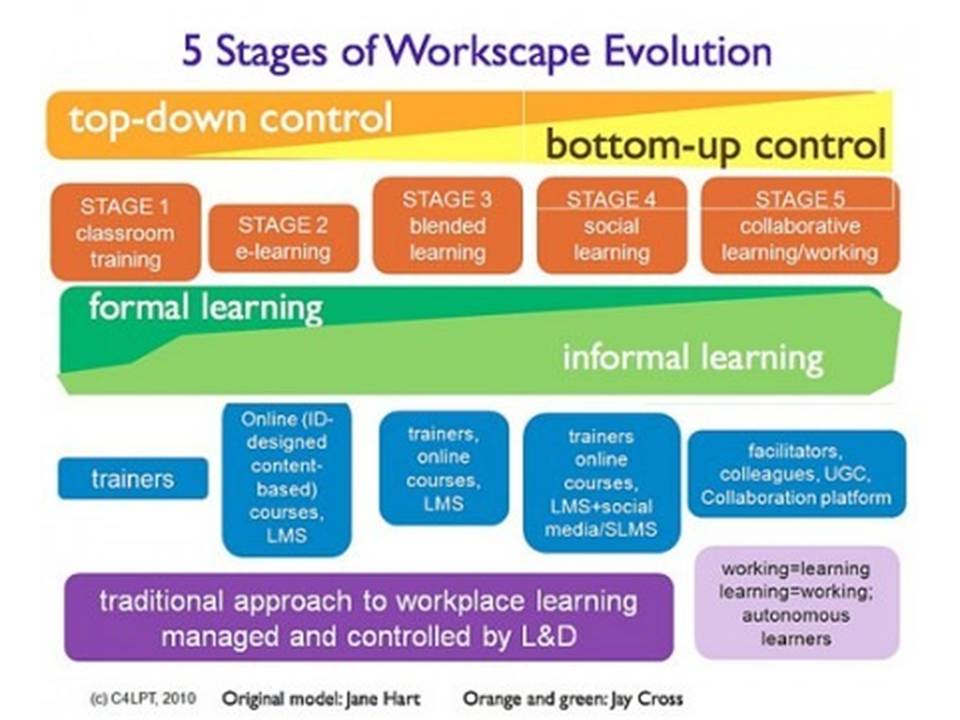
At its core, network learning is a way to deal with an ever-increasing amount of digital information. It requires an open attitude toward learning and finding new things. Each worker needs to develop individualized processes of filing, classifying and annotating information for later retrieval.

Source: www.jarche.com

Network Learning: Working Smarter

Posted on October 22nd, 2010 by Harold Jarche

Click on Image to Enlarge

“In the period ahead of us, more important than advances in computer design will be the advances we can make in our understanding of human information processing – of thinking, problem solving, and decision making…” ~ Herbert Simon, Economics Nobel-prize winner (1968)

The World Wide Web is changing how many of us do our work as we become more connected to information and each other. In California, Ray Prock, Jr. (2010) uses a Web-based note system to store messages, manage his financial risk and stay on top of the multiple factors necessary to run a successful dairy farm. He is constantly learning as he works and has found a method to keep up, thanks to the Internet.

Continue reading “Network Learning to Team/Autonomous Learning”

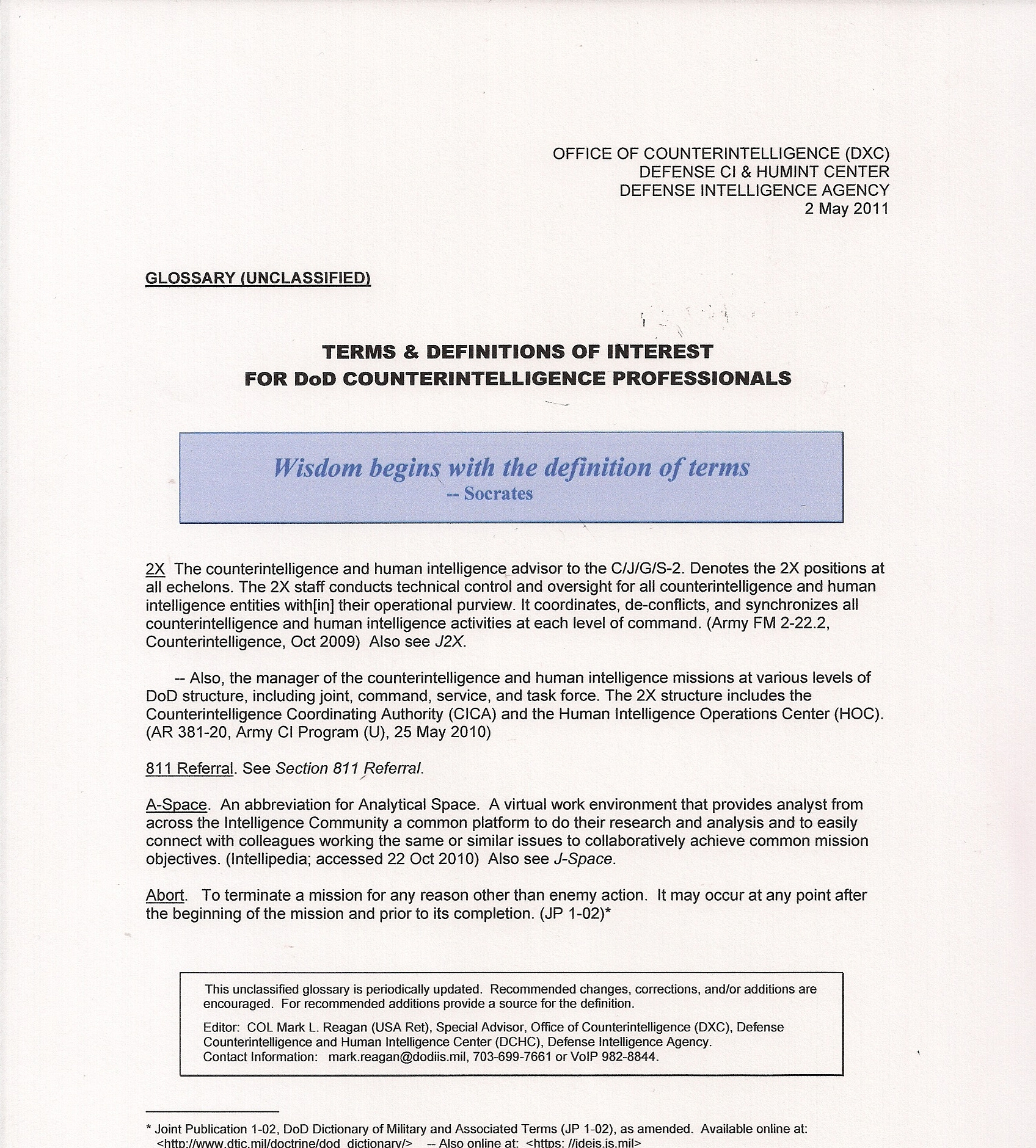
Reference: USA Counterintelligence Glossary

Director of National Intelligence et al (IC), DoD, Intelligence (government)
Click on Image to Enlarge

Primary Source (USG)

Back-Up Source (OSS)

Phi Beta Iota: This is an extraordinarily good contribution–a virtual compendium of every side of the secret world.  Amusingly it acknowledges that 90% of what we need to know comes from open sources of intelligence without noting the irony that we spend $80 billion on everything other than open sources.  It repeats the US Government mis-conception that open sources are “second-hand,” and it neglects multinational intelligence and counterintelligence precisely because the US Government refuses to be serious about that necessary evolution.  Over-all, an absolute pleasure to read, a serious contribution.

Changing the World Takes All Kinds…

Blog Wisdom, Civil Society, Cultural Intelligence, Earth Intelligence, Ethics
Tom Atlee

Dear friends:

What is the relationship between transforming ourselves and transforming the world?

In my previous essay, I described seven forms of leverage for deep transformation.  When I wrote it, I was thinking of social transformation.  The seven forms of leverage, in increasing potency, were:

1.  Ameliorate the pain
2.  Slow the damage.
3.  Create alternatives.
4.  Catalyze connections.
5.  Understand the big picture.
6.  Change the story.
7.  Transform the systems.

Hearing this list, a close colleague was surprised that I did not include personal transformation.  His view comes close to two related views held by many transformational agents:  (1) Social change cannot be adequate without serious efforts by change agents to transform themselves and (2) transformation of individual consciousness is a (if not the) primary driver of systemic transformation.

I agree that both these dynamics are important and helpful, but I consider neither essential for social transformation.  Nor do I see them as distinct forms of transformational leverage.

Continue reading “Changing the World Takes All Kinds…”