As of about 8 a.m. PST Thursday (or 6 p.m. in Tripoli, Libya's capital), the nation's Internet traffic began to flatline, and has been at zero since, says Google's Transparency Report.
Phi Beta Iota: While the world watches Libya, the USA is in the process of making the Internet a monopoly that can charge by the application instead of by the packet. In brief, Internet “neutrality” is a fraud in the USA, and the FCC is a front for the very large ISP's just as the Federal Reserve is a front for the private banks. Autonomous Internet is something that matters everywhere, including especially the USA.
We activated the Standby Volunteer Task Force (SBTF) on March 1st and quickly launched a Crisis Map of Libya to support humanitarian preparedness opera-tions. This is the largest deployment of the Task Force since it was formed at the 2010 International Conference on Crisis Mapping in Boston (ICCM 2010). I'm amazed at how far we've come since the response to the Haiti earthquake.
Phi Beta Iota: We've been championing Open Everything since 1988, each year growing from our first realization that Open Source Intelligence (OSINT) was urgently needed to bring government back to accountability, legitimacy, and sanity through transparency. Below are two graphics, two briefings and two chapters that summarize our recent work in this area. Here we want to emphazize the emergence of the Autonomous Internet Road Map and the fact that the Crisis Mapping initiative is a very strong manifestation of the power of public intelligence in the public interest.
Phi Beta Iota: Along with OpenBTS, SolarOne, VECTOR, and “Buy This Satellite,” Freedom Box joins the vanguard of the global revolution. “Connected, We Are One.” [Connexum Sumus Unum–scholarly check welcomed]. Please give as generously as you can, this is the non-violent equivalent of Bunker Hill in the global war against corruption and the many attrocities associated with repression of diversity and dissent.
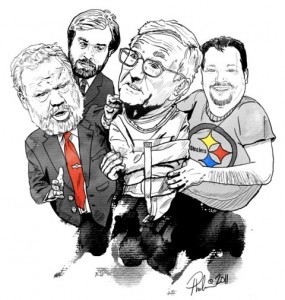
(from left to right) Tom Ricks of Foreign Policy magazine and The Washington Post, along with fellow FP editors Joshua Keating and Blake Hounshell all rushed to discredit Hersh and the contents of his January 17th, 2011 speech.
It seems unusual for a staid, respected publication (one that has received three National Magazine Awards in just this past decade) to start treating a celebrated journalist (who himself has won two National Magazine Awards in just this past decade) as if he were nothing more than a paranoid crank.
It seems unusual, but it’s exactly what the staff of Foreign Policy has done to Seymour Hersh, following a lecture the venerated reporter gave at Georgetown University’s campus in Doha, Qatar. You may know Hersh as the dogged investigator who exposed the My Lai Massacre during Vietnam. You may know him as the staff writer for The New Yorker who published some of the earliest pieces on Abu Ghraib in May 2004. You might even know him as the man derided and then vindicated for claiming that Dick Cheney was running a secret assassination squad right out of the Vice President’s office. (In truth, the squad was and is a bipartisan affair, initiated under Clinton and still operative under Obama.) Read more….
Phi Beta Iota: Sy Hersh is as honest as it gets. Foreign Policy used to be a reputable, imaginative endeavor. This is now the second time it has been disreputable and ignorant. Inquiry has established that Moises Naim, the extraordinary editor who took Foreign Policy from nothing to being twice as good as Foreign Affairs, has moved to other duties within the Carnegie Endowment, and it is clear to us that with his departure, Foreign Policy has lost its integrity as well as its intelligence.
In the vast literature of intelligence-related memoirs, the new book Long Strange Journey by Patrick G. Eddington stands out in several ways.
Eddington entered the intelligence arena as an imagery analyst for the CIA's National Photographic Intelligence Center. Imagery analysis is a predominately technical activity and is not normally considered a hotbed of intrigue or controversy. Nor has it been widely featured in the intelligence “literature of discontent.” Eddington provides an introduction to the world of light tables, mensuration and the now-defunct world of the NPIC analyst.
Then Eddington himself defies easy stereotyping. As an Army veteran, a political conservative, and a person of faith, he might have been voted least likely to rock the boat and to become a whistleblower. But that's what he did. Continue reading “Secrecy News: CIA Culture In Detail”