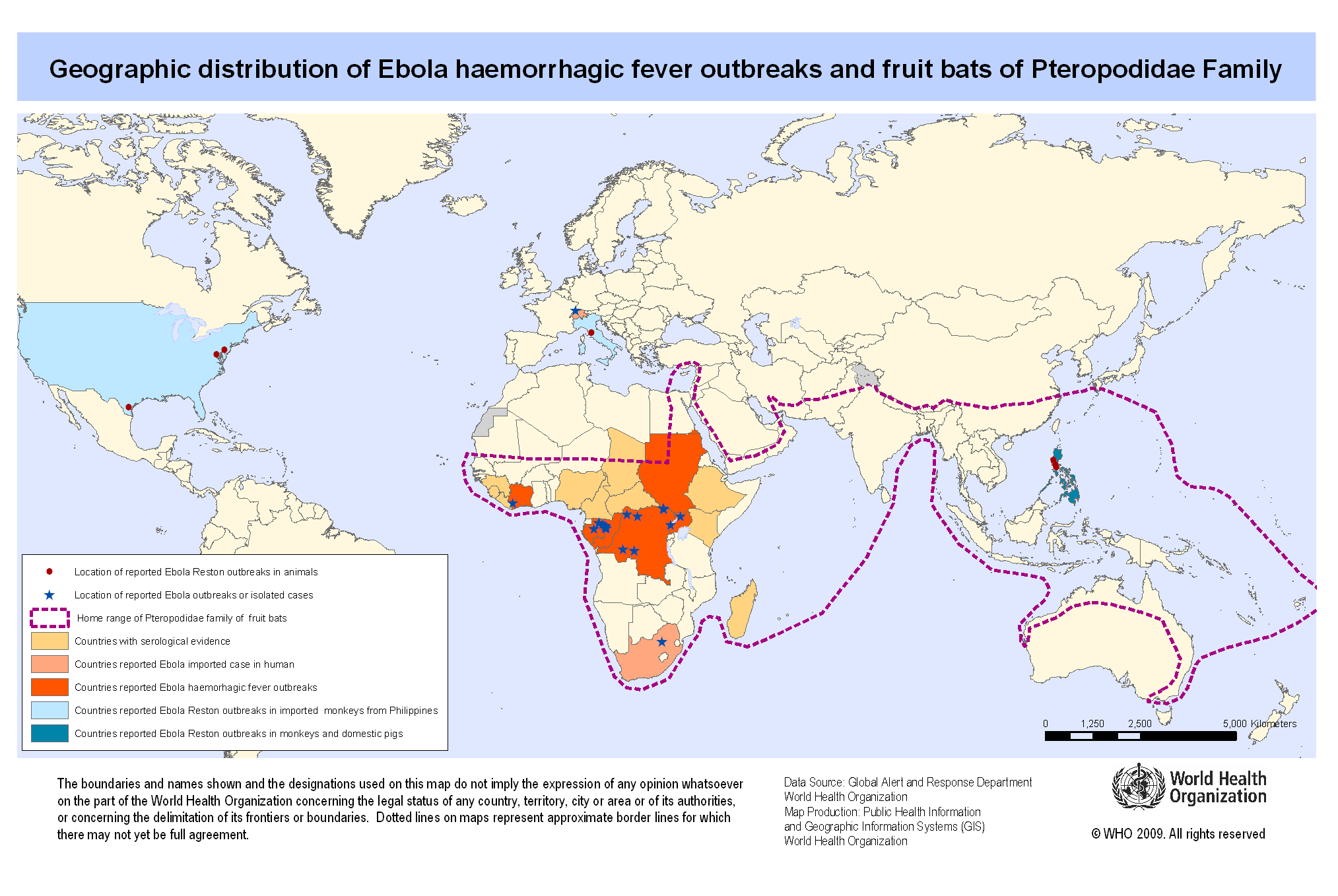
The outbreak of Ebola Virus in seven west African countries has broken through all containment efforts and is spreading like wildfire. According to Christian Relief groups working in Guinea and Liberia, the number of confirmed infections jumped 15% in just the last 24 hours. In addition, 40 illegal alien migrant workers from the outbreak area, who came ashore in Pisa, Italy, are showing signs of Ebola infection and are being isolated in Pisa Italy because of fever and “conjunctivitis” (bloody around the eyes). According to the World Health Organization, this strain of Ebola is entirely new and although it is close to the Zaire strain, it is different, thus accounting for false-negative test results . . . . . for weeks!
Those false-negative results meant people who were actually infected with Ebola, were returned to their families and neighborhoods to recover from what they believed was the Flu or a case of food poisoning, only to spread the Ebola further.
The result has been a complete loss of containment of this Ebola outbreak.
With the likely arrival of Ebola in Pisa, Italy, the European continent is now at severe risk.
Rasmussen is a right leaning survey operation. I mention this because context matters and a Right leaning poll with these results is worthy of close attention. I think this is telling us that the basis of trust upon which our democracy was based is eroding as quickly as the ice sheet covering Greenland.
Thirty-seven percent (37%) of Likely U.S. Voters now fear the federal government, according to a new Rasmussen Reports national telephone survey. Forty-seven percent (47%) do not, but another 17% are not sure.
Perhaps in part that’s because 54% consider the federal government today a threat to individual liberty rather than a protector. Just 22% see the government as a protector of individual rights, and that’s down from 30% last November. Slightly more (24%) are now undecided. (To see survey question wording, click here.)
As recently as December 2012, voters were evenly divided on this question: 45% said the federal government was a protector of individual rights, while 46% described it as a threat to those rights.
Two-out-of-three voters (67%) view the federal government today as a special interest group that looks out primarily for its own interests. Just 17% disagree, while 15% are undecided.
Attached herewith is an important report in the Guardian. It places the deregulation of Wall Street during the Clinton Administration into a particularly smarmy perspective by examining documents just released by the Clinton library. Note the connections to players now in the Obama Administration.
This report paints a revealing albeit depressingly familiar portrait of how the iron triangle of individuals and money moving between government executive positions, and private sector, together with friendly legislators in Congress encourages corruption that leads ultimately to taxpayer bailouts. Consider please the following:
1. Note how the memos make it look like President Clinton was being rushed, implying a certain degree of passivity and manipulation by advisors. But before taking this at face value, bear in mind, Clinton was never a passive actor; quite the opposite, he was a highly energetic president. He set the tone, and he picked these advisors; he stayed with them; and he passed many of them on to President Obama.
2. Note that the repeal of Glass Steagall — Clinton’s signature deregulation of the financial markets and perhaps the major contributor to the rise of speculation that culminated in 2008 crash — was not a last minute affair. In fact, the memos show effort to repeal reaches bat to at least in February 1995 and May 1997 and the reference to eating the paper after you read it suggests a degree of malevolent cynicism.
3. Note the tight connection between the repeal Glass-Steagall and the pending Citigroup merger with Travelers Group, and particularly, the central the role played by Secretary of the Treasury Robert Rubin in the promotion of the of that repeal. Rubin was Secretary of the Treasury from 11 January 1995 to 2 July 1999 — the period covered by the memos contained in the Guardian report.
4. Finally, the reader should note that four months after leaving the Treasury Department, in Oct 1999, Rubin joined Citigroup. Here is a contemporary portrait painted by a 27 October 1999 report in the New York Times,
“Mr. Rubin, 61, a former top official of Goldman, Sachs & Company, said yesterday that he had joined Sanford I. Weill and John S. Reed, the chairmen and chief executives Citigroup, in what Mr. Reed described as a ”three-person office of the chairman” that will oversee what has become the first true American financial conglomerate since the Depression.
The appointment came less than a week after the Clinton Administration and Congress agreed on a compromise bill that would overhaul the laws that regulate the financial industry, a measure that removes many of the restrictions preventing banks, securities firms and insurance companies from buying one another or engaging in one another's businesses. Both Mr. Rubin and Citigroup strongly supported the bill, which would greatly benefit the company. Mr. Rubin said he played a role in arranging the final compromise that will probably lead to the repeal of the so-called Glass-Steagall legislation. But he said that had nothing to do with his decision to join the company.”
By 2007 Rubin was Chairman of Citigroup. And in 2008, nine years after the repeal of Glass Steagall, the worst financial crisis since the Great Depression hit Wall Street to trigger the worst and longest recession since the Great Depression. That crisis, among other things, collapsed the stock markets, destroyed retirement nest eggs, wrecked the housing markets, and put millions of people out of work — and our nation has still not recovered. Then the “best government money can buy” added insult to injury by bailing out of the banks that created the mess, while ducking the issue of re-regulating their behaviour with anything close to proven power of defunct Glass-Steagall Act. Some observers are now warning the government’s failure to reign in speculative behaviour is setting the stage for yet another crash (e.g., here and here)
And what about Rubin’s role? According to information in Wikipedia, on 3 December 2008, shortly after the financial collapse, the Wall Street Journal characterized Rubin’s mix of oversight and management responsibilities at Citigroup “murky.” In an interview with the Journal, Rubin defended himself, saying: “I think I've been a very constructive part of the Citigroup environment.”But, the Journal reported that Citigroup shareholders suffered losses of more than 70 percent since Rubin joined the firm and that he encouraged changes that led the firm to the brink of collapse.[23] Investors filed a lawsuit in December contending that Citigroup executives, including Rubin, sold shares at inflated prices while concealing the firm’s risks. A Citigroup spokesman said the lawsuit was without merit.[24].
But what happened to Rubin personally? According to a 20 September 2012 report in Bloomberg, Rubin received a total compensation of $126,000,000 from Citigroup between 1999 and 2009.Among other things, the former eagle scout is now co-chairman of the prestigious Council on Foreign Relations.
A new scientific report took into account 1,779 policy issues as well as many variables and found that the people of the United States have little, if any, say in the policies that impact them. You won't believe the rest.
In a detailed report from Malaysia Chronicle dated April 8, it said that Freescale launched what could be the world's smallest microcontroller in Feb 2013 called the Kinesis KL02.
KL02 measures 1.9 mm by 2mm and contains RAM, ROM and a clock. Even with its minute size, KL02 might be the most potent next-generation war weaponry.
Whether remotely controlled or automatically programmed, KLO2 can be utilised to employ drones smaller than flies. Such small-sized drones were allegedly being used to deliver lab-cloned viruses or toxic drugs instrumental for spreading plague, virus and disease; track spy satellites or large scale and hidden weaponries.
Interesting timing, as UK is seen to be protecting its elite pedophiles, and US begins slowly investigating the spread of pedophilia into common police and fire fighter ranks.