Journal: Endless Money for War, No Checks & Balances

04 Inter-State Conflict, 05 Civil War, 09 Terrorism, 10 Security, Military, Strategy
Chuck Spinney

It is becoming increasingly clear that 1981 was a watershed year in the history of the American political economy. What checks and balances that remained broke down. Deregulation, for example, took off and the bomb of private debt exploded (recall the chart I circulated earlier). The trade deficit skyrocketed after 1981, and deindustrialization, which started in the late 1960s took off with a vengeance. The growth in real income stagnated and gap between the rich and poor began to expand rapidly.

The same collapse of political-eocnomic checks and balances occurred in what was already a poorly checked defense sector. During the first 30 years of the Cold War with the Soviet superpower, between 1950 and 1980, the defense budget never experienced more than three consecutive years of real growth (i.e., after removing the effects of inflation) before going into decline. During war and peace, the inflation adjusted budget oscillated around a relatively constant or slightly growing median value (if one believes the Pentagons estimates of inflation). That pattern changed radically with the ascent of Ronald Reagan to the presidency. The budget began to grow much more rapidly and the checking process weakened markedly during the 1980s and especially the mid 1990s, when the budget began increasing even though the superpower threat evaporated.

With the election of George Bush II in 2000, any remaining checks on budget growth came off (as can been seen in Slide 1 of my June 2002 statement to Congress, which can be downloaded here), and then, spurred on by the politics of fear which enveloped the US after 911, the checking process to ceased completely and the defense budgeting process spun out of control, as a part of it went to fight never ending guerrilla wars but most of it went to propping up a modernization program and force structure that is an outmoded legacy of the Cold War.

Now, if there is any truth to the attached AP report, Bush's insane madness has captured President Obama and he is power boosting the defense budget further, albeit with feeble promises of small declines in the future, which will no doubt be forgotten in the unfolding politics of the permanent war economy.

Chuck

AP Exclusive: Obama wants $33 billion more for war

By ANNE GEARAN and ANNE FLAHERTY

The Associated Press  January 12, 2010

The Obama administration plans to ask Congress for an additional $33 billion to fight unpopular wars in Afghanistan and Iraq, on top of a record request for $708 billion for the Defense Department next year, The Associated Press has learned.
Worth a Look: Empathetic Smart Civilization

Collaboration Zones, Communities of Practice, IO Sense-Making, Methods & Process, Reform, Worth A Look
Amazon Page

Phi Beta Iota: this specific book is rocketing around Reuniting America, Transpartisan (Left) and Post-Partisan (Right) circles, the 50 million or so Americans–possibly more now–that consider themselves Cultural Creatives.  This book will be reviewed here in a week or two.  Below are related books with links to their review page and from there to their Amazon page.  Put simply, conscious evolution is an information-sharing problem, nothing more or less.  You liberate and enrich people in the aggregate by connecting them (cell phones) and then empowering them (access to free information).

See also:

Continue reading “Worth a Look: Empathetic Smart Civilization”

Journal: Haiti–Ready for a Rapid-Response Open-Source-Intelligence-Driven Inter-Agency Multinational Multifunctional Stabilization & Reconstruction Mission…

01 Brazil, 01 Poverty, 02 Infectious Disease, 03 Environmental Degradation, 07 Other Atrocities, 07 Venezuela, 08 Wild Cards, 10 Security, 11 Society, 12 Water, Collaboration Zones, Communities of Practice, Methods & Process, Mobile, Real Time
Full Story Online

AP: Injured Haitians plead for help after quake

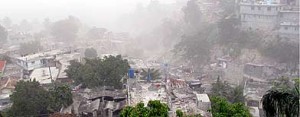
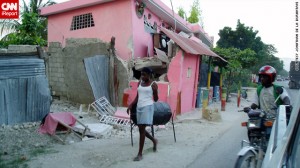
Haitians piled bodies along the devastated streets of their capital Wednesday after the strongest earthquake hit the poor Caribbean nation in more than 200 years crushed thousands of structures, from humble shacks to the National Palace and the U.N. peacekeeping headquarters. Untold numbers were still trapped.

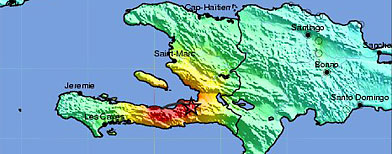
Destroyed communications made it impossible to tell the extent of destruction from Tuesday afternoon's 7.0-magnitude tremor, or to estimate how many were dead among the collapsed buildings in Haiti's capital of about 2 million people.

France's foreign minister said the head of the U.N. peacekeeping mission was apparently among the dead.

Full Story Online

Phi Beta Iota: This is precisely what was briefed recently to the DIA Multinational Intelligence Fellows and earlier in Tampa to the Coalition Coordination Center (CCC) and unnoticed by DIA as well as declined by CENTCOM as a transition model toward a Multinational Decision Support Center.  The US Government does well enough with little things that can be handled by one agency, or one thing that must be handled by multiple agencies, but it does not do well as all with many things that must be handled by many players on a no-notice basis.  The reason: a C4I system that is high-side unilateral expensive and largely useless past one big contingency.  The solution: a global grid that is unclassified (commercial-level security) and open to everyone.  DIA has enormous potential as a hub for Multinational Engagement and defense-rooted open source exploitation that also impacts on the QDR and acquisition while providing Combatant Commanders with relevant unclassified intelligence for COIN and other challenges.

See Also:

Continue reading “Journal: Haiti–Ready for a Rapid-Response Open-Source-Intelligence-Driven Inter-Agency Multinational Multifunctional Stabilization & Reconstruction Mission…”

Journal: Haiti–Twitter Rocks

03 Environmental Degradation, Geospatial, Gift Intelligence, IO Mapping, IO Sense-Making, Methods & Process, Mobile, Peace Intelligence, Tools

Phi Beta Iota: Now imagine a global public fully aware of the value of Twitter photos with geospatial attributes, and a multinational decision support team able to receive and plot all such contributions….  As long as “research” is controlled by secret and ultra-far out organizations like DARPA and IARPA this stuff is not going to be applied practically.   Civil Affairs Brigade (CAB) and its Joint Civil Information Management (JCIM), combined with a United Nations Open-Source Decision-Support Information Network (UNODIN), a Union of South American Nations (UNASUR) Information Network, and a Multinational Decision Support Center (MDSC) would go a long way toward getting an immediate grip on all this, in detail, and then creating a Haiti Needs Table at the household level that could be triaged out (see Graphic: Global Range of Nano-Needs for the idea).

Highlights

Major quake hits Haiti; many casualties expected

Karel Zelenka, a Catholic Relief Services representative in Port-au-Prince, told U.S. colleagues before phone service failed that “there must be thousands of people dead,” according to a spokeswoman for the aid group, Sara Fajardo.

With phones down, some of the only communication came from social media such as Twitter. Richard Morse, a well-known musician who manages the famed Olafson Hotel, kept up a stream of dispatches on the aftershocks and damage reports.

Haiti earthquake — what we're hearing

CNN is monitoring tweets and other messages from people in Haiti and reports from those who said they have been in touch with friends and family. CNN has not been able to able to verify this material.

“If anyone in Haiti is reading this, please go out and help in the streets, it's very ug;y out there if you haven't seen it #haiti” –From Twitter user fredodupoux in Haiti at 8:04 p.m. ET

“Tipap made it home from Carrefour – saw many dead bodies and injured along the way – said most buidings w/more than one story are down” — From Twitter user troylivesay in Port-au-Prince, Haiti, at 8:22 p.m. ET


Fears of major catastrophe as 7.0 quake rocks Haiti

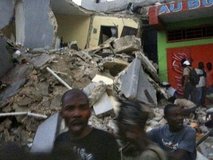
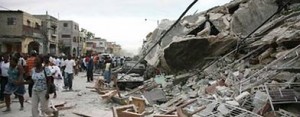
AFP/Twitter – This image obtained from Twitter purportedly shows Haitians standing amid rubble on January 12 in Port-au-Prince. …

A local doctor told an AFP reporter in the city that hundreds of people are feared dead.

A local UN employee said the earthquake had destroyed the headquarters of the United Nations peacekeeping mission in the country.

Seventy percent of Haiti's population lives on less than two dollars per day and half of its 8.5 million people are unemployed.

According to official figures, food insecurity already affects more than a quarter of Haiti's population, some 1.9 million people, with women and children the worst affected.

Twitter Has First Pictures Of Haiti Earthquake

News is still coming in from Haiti even thought night as fallen. Shortly after the quake, our first look at the devastation was given to us via social media websites like Twitter and Facebook.

1st Look At Devastation In Haiti Quake
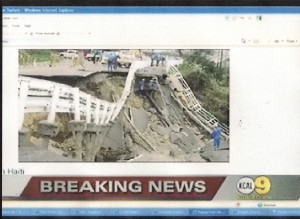
Tue Jan 12, 10:51AM PT – CBS 2 / KCAL 9 Los Angeles 0:54 | 33138 views

Definitions: Spatial Referencing System (SRS)

Definitions, Geospatial
Wikipedia Page

A spatial referencing system (SRS) or coordinate reference system (CRS) is a coordinate-based local, regional or global system used to locate geographical entities. Some of systems in existence are:

Related References:

01 OMB Circular A-16 SUBJECT: Coordination of Geographic Information and Related Spatial Data Activities, August 19, 2002

02  UN Global Map Specifications (2006 Memorandum)

03  OpenGIS® Standards and Related OGC documents

04  OGC Reference Model (ORM)

05  TerraSeer Space-Time Intelligence System™

Continue reading “Definitions: Spatial Referencing System (SRS)”

Worth a Look: Open Sources Database

Handbook Elements, Methods & Process
Online Partial Directory

WHO is behind this is not known to us, and it is a very partial listing but with integrity (they point to our copies of the NATO OSINT Documents that Robert Steele wrote or supported) and a pleasing look and feel.  This has a great deal of potential, especially if it can go multi-lingual, multicultural and add historical reach-back points of access.

Journal: Yemen, Guns, Tribes, & Deja Vu

02 China, 03 India, 04 Inter-State Conflict, 05 Civil War, 05 Iran, 08 Wild Cards, 09 Terrorism, 10 Security, Ethics, Government, Military, Peace Intelligence, Policy

Full Story Online

Three Guns for Every Person

Only Fools Rush Into Yemen

By PATRICK COCKBURN     January 11, 2010

The mounting crisis in the country only attracted notice when a Nigerian student is revealed to have been “trained” in Yemen by al-Qa’ida to detonate explosives in his underpants on plane heading for Detroit. But this botched attack has led to the US and Britain starting to become entangled in one of the more violent countries in the world. The problems of Yemen are social, economic and political, and stretch back to the civil war in Yemen in the 1960s, but Gordon Brown believes solutions can be found by holding  a one day summit on Yemen to “tackle extremism.”

Al-Qa’ida in Yemen is small, its active members numbering only 200-300 lightly armed militants in a country of 22 million people who are estimated to own no less than 60 million weapons. Al-Qa’ida has room to operate because central government authority barely extends outside the cities and because it can ally itself with the many opponents of President Ali Abdullah Saleh, who has been in office since the 1970s.

Continue reading “Journal: Yemen, Guns, Tribes, & Deja Vu”

noble gold