
The truth at any cost lowers all other costs — curated by former US spy Robert David Steele.
Lord James of Blackheath, House of Lords [VIDEO 11:10] from 2010, now circulating
Breaking news Lord James of Blackheath has spoken in the House of Lords holding evidence of three transactions of 5 Trillion each and a transaction of 750,000 metric tonnes of gold and has called for an investigation.
I think there are three possible conclusions that may come from it. I think there may have been a massive piece of money laundering committed by a major government which ought to know better and that it has effectively undermined the integrity of the British bank the Royal Bank of Scotland, in doing so. The second alternative is that a major American department has an agency that has gone rogue on it because it has been wound up and has created a structure out of which they are seeking to get at least 50 billion Euros as a payoff. And the third possibility is that this is an extraordinarily elaborate fraud which has not been carried out but which has been prepared in order to provide a threat to one government or more if they don't pay them off. So there are three possibilities and this all needs a very urgent review.
My Lords, it starts in April and May of 2009, with the alleged transfer to the United Kingdom, to HSBC of a sum of 5 trillion dollars and seven days later, in comes another 5 trillion dollars to HSBC, and then 3 weeks later another 5 trillion. 5 trillion in each case. Sorry. A total of 15 trillion dollars is alleged to have been passed into the hands of HSBC for onward transit to the Royal Bank of Scotland and we need to look at where this came from and what the history of this money is. And I have been trying to sort out the sequence by which this money has been created and from where it has come from for a long time.
http://www.rumormillnews.com/cgi-bin/forum.cgi?read=230593
http://www.publications.parliament.uk/pa/ld201212/ldhansrd/text/120216-0002.h…
Last Monday, after the Pentagon released its 2013 budget materials, just about every news article I read inaccurately reported the totals. These articles did not just miss some significant bits not in DOD's press release; they ignored another $380 billion in spending for US national security spending if you take the time to parse through OMB's far more complete and accurate budget materials.
AOL Defense ran my explanation; it is at
Which Pentagon Budget Numbers Are Real? You Decide!
How do I get to a $1 trillion US small “d” defense budget; real it below:
The Real “Base” Pentagon Budget and the Actual “Defense” Budget
Winslow T. Wheeler
When the Pentagon released its budget materials and press releases last Monday, the press dutifully reported the numbers. The Pentagon's “base” budget for 2013 is to be $525.4 billion, and with $88.5 billion for the war in Afghanistan and elsewhere added, the total comes to $613.9 billion. (See the two DOD press releases ONE and TWO).
Indeed, if you plowed through the hundreds of pages of additional materials the Pentagon released Monday, you would come up with little reason the doubt the accuracy of those numbers as the totality of what Secretary of Defense Leon Panetta was seeking for the Pentagon. It would also seem reasonable that those amounts constitute the vast majority of what America spends on “defense,” defined generically.
You would be quite wrong to think so.
Continue reading “Winslow Wheeler: “Defense” Budget – the Full Enchilada”
Recommended by Paul Craig Roberts, Institute for Political Economy
John Pilger describes the reality hidden behind the cloak of anglo-american “democracy.”
Phi Beta Iota: This describes the crime against humanity, the atrocity, of cleansing the population of the islands now known as Diego Garcia. If We the People do not hold our government accountable, then We the People are complicit in all that is done “in our name.”
January 20, 2012 — Lisette Talate died the other day. I remember a wiry, fiercely intelligent woman who masked her grief with a determination that was a presence. She was the embodiment of people’s resistance to the war on democracy. I first glimpsed her in a 1950s Colonial Office film about the Chagos islanders, a tiny creole nation living midway between Africa and Asia in the Indian Ocean. The camera panned across thriving villages, a church, a school, a hospital, set in a phenomenon of natural beauty and peace. Lisette remembers the producer saying to her and her teenage friends, “Keep smiling girls!”
Sitting in her kitchen in Mauritius many years later, she said, “I didn’t have to be told to smile. I was a happy child, because my roots were deep in the islands, my paradise. My great-grandmother was born there; I made six children there. That’s why they couldn’t legally throw us out of our own homes; they had to terrify us into leaving or force us out. At first, they tried to starve us. The food ships stopped arriving [then] they spread rumors we would be bombed, then they turned on our dogs.”
In the early 1960s, the Labor government of Harold Wilson secretly agreed to a demand from Washington that the Chagos archipelago, a British colony, be “swept” and “sanitized” of its 2,500 inhabitants so that a military base could be built on the principal island, Diego Garcia. “They knew we were inseparable from our pets,” said Lisette, “When the American soldiers arrived to build the base, they backed their big trucks against the brick shed where we prepared the coconuts; hundreds of our dogs had been rounded up and imprisoned there. Then they gassed them through tubes from the trucks’ exhausts. You could hear them crying.”
Continue reading “John Pilger: The War on Democracy Comes Home”

Richard Wright
The Triumph of Tactical Intelligence
The Andrew J. Bacevich article, “Slouching Toward Persistent War” (NYT 19 Feb 2012) points among other things to the rise of Special Operations Forces (SOF) as the instrument of choice to carry out clandestine warfare against individual and groups designated enemies of the U.S. (or close U.S. allies i.e. Israel). It also cited the rise of Michael Vickers to be Under Secretary of Defense for Intelligence as further evidence of the growing importance of SOF.
Vickers is a ten year veteran of the U.S. Army Special Forces and then served three years at CIA as principal logistic manager for support going to the anti-Soviet Taliban resistance fighters in Afghanistan. These experiences along with a PhD apparently were felt to qualify Vickers to head up DOD intelligence.
What Bacevich failed to take note of was a new and successful tactical concept that was developed by the U.S. Forces, mainly Army and Marine infantry, in the course of the counter insurgency (COIN) operations in Iraq and Afghanistan. This concept has been the subject of a careful study by two researchers at the Institute of National Strategic Studies of the DOD’s Defense University: Dr. Christopher Lamb and Mr. Evan Munsing produced a study titled, “Strategic Perspectives entitled “Secret Weapon: High-value Target Teams as an Organizational Innovation.” In the study they examined the repeated successes of the High-value Target Teams in eliminating al Qaeda and insurgent Taliban leaders. The secret according to the two authors was the combination of special operations forces fighters with military and civilian intelligence analysts into tightly net teams in which immediate tactical intelligence was essential to guiding the fighters to their targets. This apparently was not a case of intelligence support being provided by folks sitting far from the action phoning in information, but of intelligence support being very much part of the operation itself with the war fighters. CIA has increasingly become part of this new concept and the move of General David Petraeus to be Director of CIA may reflect this involvement of the agency with real time support to military operations.
Of course this also means that the probability is that CIA will continue to ignore strategic intelligence or what Robert Steele describes as Whole of Government Decision-Support and also multinational information-sharing and sense-making. In other words, CIA has become MIA (pun intended).
See Also:
 Occupy the SEC has submitted a 325 page letter to the SEC, FDIC, the Federal Reserve and the OCC, to comment on the notice of proposed rulemaking for the Volcker Rule. In our comment letter, we answered 244 out of 395 questions asked by the Agencies.
The Agencies involved in the Volcker rulemaking process have an historic opportunity to redress many of the economic wrongs of the past, and create a future that privileges the interests of the many rather than the few. We ask that the Agencies vigorously implement the considerable responsibilities that have been discharged to them by Congress, remain faithful to the statute’s intent and consider the comments contained in this letter.
PDF of our Comment Letter

In my opinion, one of the most important books written in recent years on the subject of the global arms trade and its corrupting effects is Andrew Feinstein's, The Shadow World, Inside the Global Arms Trade. This voluminous book is mind numbing in its detail, but it is thoroughly sourced and, I believe, it will become a standard reference over time. Anyone trying to understand the dark and dangerous corner of the global economy and its politics must read this book. (To be sure, I am biased because I was a minor source in this book and I consider Andrew a good friend.)
Naturally, the arms makers are not too happy with the Shadow World and want to keep it hidden in the musty stacks of your local library. I am attaching two recent essays to help you determine if this book should be forgotten. They were published on the Lexington Institute' Early Warning Blog. Lexington is funded in large part by defense contractors and is hardly impartial on all matters regarding defense spending, so the first essay is quite expected; the second, however, comes as a surprise, to Lexington's credit.
The first essay is a predictable critique of Andrew's book by Robert Trice, a retired Senior Vice President of Lockheed Martin. Think of his effort as an attempt to move Andrew's book to a forgotten corner in the back room.
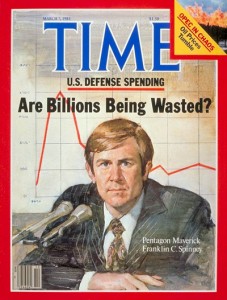
To understand the saliency of Trice's effort, consider his career. Robert Trice is a case study in the quintessential pattern of gorging oneself on cash flow pumped out by the Military – Industrial – Congressional Complex's big green spending machine. Holding a PhD in political science, he began his defense career in the Office of the Secretary of Defense in the Pentagon, where he eventually became Director for Technology and Arms Transfer Policy — or in plain english, a resident shill in the Pentagon for promoting international arms sales — the subject painted in not so flattering terms by Feinstein. Trice then moved to Capital Hill and worked as the defense Legislative Assistant to Senator Dale Bumpers (D-AR) for about three years. I met him in this position because Bumpers was interested in the military reform work my colleagues (Pierre Sprey and John Boyd) and I were doing in the Pentagon. But Trice, as Bumpers' advisor, was clearly a reluctant reformer. (Although Bumpers showed initial and enthusiastic interest in our work, nothing came of it.) In the essay below Trice now slings a little mud, saying the three of us are not just wrong but wrongly motivated, because we are “anti-defense.” Soon thereafter, the presumably pro-defense Trice cashed out of Bumpers office to work in the Defense industry, serving first as a Vice President for Business Development at McDonnel Douglas (in plain english this is a marketing job and in the MICC, marketing, or business development, means greasing the skids in Congress and the Pentagon for your firm's tinker toys — which is a good position for a poly sci type, because he couldn't design airplanes at McAir or Lockheed). Trice then moved to Lockheed Martin where his business development portfolio including shaping L-M's new business strategies and operations for the global market, which of course is the subject of Andrew's book. Obviously a person with his background of bottom feeding so successfully in the MICC's money machine, especially in the international arms trade arena, comes to the reviewing table with … shall we say … a certain amount of bias.
The second essay is Andrew Feinstein's polite repost to Trice's bucket of grease. Andrew's background could not be more different than that of Trice. Whereas Trice gorged himself and became a wealthy ‘pillar of the establishment' by slopping in America's defense trough, Andrew put his ass on the line trying to rein in the excesses of that trough's South African equivalent. In the late 1980s, Andrew, a young white South African, joined Nelson Mandella's African National Congress (ANC), because he opposed Apartheid. In 1994, after the fall of Apartheid, he was elected in South Africa's first democratic election to be an ANC member of parliament. But Andrew took his parliamentary oversight responsibilities seriously, and while in parliament, he set up a kind of one man Truman Committee to investigate allegations of ANC corruption in some international weapons deals. And he hit pay dirt, but rather than shutting up when he was pressured by party elders to close down his investigation into a £5bn arms deal that was tainted by allegations of high-level corruption, he resigned in protest from Parliament. His political memoir, After the Party: A Personal and Political Journey Inside the ANC, was published in 2007 and became a bestseller in South Africa.
With the backgrounds of these two protagonists in mind, I urge you to read Trice's critique of Andrew's latest book first (Attachment 1 below) and then Andrew's repost (Attachment 2 below) and judge for yourself who is closer to being a straight shooter — and read The Shadow World.
Whole Enchilada (Both Articles) Below the Line
Continue reading “Chuck Spinney: The Shadow World of the Global Arms Trade”
