Very inspiring talk, i listened in silence to him and that doesn’t happen often.
As an ex VN soldier i fully support the generals opinion.
Even after losing his own son in Afghanistan he still firmly believes in his ideals and knows how to express them on a way that is understandable and inspiring to allot of people, i can only say general van Uhm made me proud to be Dutch today, and proud i served in the Dutch armed forces.
A new program can find and compare relationships in complicated data without having to be asked specific queries
Are there subtle patterns lurking in data that can foretell of a coming financial-system crash? What can explain the variations in sports-star salaries? How about the complex relationship between genes and certain diseases? Scientists in various fields have been searching for better ways to analyze large piles of data for such patterns, but the difficulty has always been that they need to know what they're looking for in order to find. A new software program, described in the latest issue of Science, is designed to find the patterns in data that scientists don't know to look for.
David Reshef, one of the scientists behind MINE, as the program is called, explains, “Standard methods will see one pattern as signal and others as noise. There can potentially be a variety of different types of relationships in a given data set. What's exciting about our method is that it looks for any type of clear structure within the data, attempting to find all of them. … This ability to search for patterns in an equitable way offers tremendous exploratory potential in terms of searching for patterns without having to know ahead of time what to search for.” MINE compares different possible relationships (including linear, exponential, and periodic) and returns those that are strongest.
On MINE's website, the program is available for download.
Opus machine prints books in minutes at Politics and Prose
The new Opus machine at Politics and Prose bookstore on Connecticut Avenue in Washington can print and bind a book that is indistinguishable from one of the professionally mass-printed books on the shelves at the same store. Public domain works, out-of-print novels, electronic books supplied via publishing houses and personal books can all be printed in minutes while customers wait.
Phi Beta Iota: Price is always an issue. HOWEVER, now that “true cost” economics is converging with Occupy and the 99%, we anticipate that publishers and Amazon are in for an eye-opener. This will also empower authors who choose to by-pass the entire “system” and local book stores who can be liberated from inventory and publisher overhead.
A collection of more than 1500 audiocassettes from Kandahar. The collection is central to understanding al-Qaida's emergence as an organisation before 9/11.
An analysis of Flag Miler can also be found in : J.Deol, Z. Kazmi (Eds) Contextualizing jihadi thought. New York: Horst & Company, Columbia University Press, 2012.
The Unmanned Aerial Vehicle (UAV) rose to prominence in an era of uncontested budget growth (including a borrowed trillion dollars a year) and uncontested airspace. That era is now over.
There will still be a place for mico-UAVs, especially in direct support of small unit operations, but neither the US military nor the US secret intelligence world consider infantry solutions to be “expensive enough” to be worth doing well.
For those who lack the sophistication to hack control over a UAV and force its undamaged landing, Electromagnetic Pulse rays remain the generic counter-measure that will proliferate rapidly.
NIGHTWATCH:
Point and Shoot...
Pakistan: Any unmanned aerial vehicles, including US UAVs, entering Pakistani air space will be treated as hostile and shot down per a new defense policy, a senior Pakistani official said on 10 December.
Comment: Pakistani forces lack the capabilities to execute the directive as announced, but the loss of one or two drones would be enough to curtail the program because of the expense from multiple aircraft losses. The program is not sustainable in contested airspace. This declaration has been coming for a very long time.
Algeria-US-France: For the record. US and French unmanned aerial vehicles (UAV) will not be allowed to fly over Algeria's southern airspace to counter weapons smuggling from Libya, according to El Khabar newspaper. Algeria will increase its reconnaissance of UAV air surveillance operations.
Comment: The Iranians will be quick to disseminate any insights they developed in downing a US reconnaissance drone. Algeria might not yet have Iran's insights but it is showing that it is open to Iranian help.
Although Global Trends 2030 will not be released by the US secret intelligence community until after the November 2012 election, minutes of the 22-24 May 2011 meeting are available and provide a useful panorama of what the group is and is not considering.
2. They are so beholden to status quo science they actually consider the exploitation of shale gas and oil to be a serious positive–lacking a strategic analytic model, it does not occur to them to examine the true cost of such initiatives, e.g. water, environmental degradation, etcetera. They do not “get” the fragmentation of knowledge as being among the chief obstacles to creating strategic intelligence.
3. They are oblivious to the “eight tribes“* while creeping up on government-business collaboration (and clearly also oblivious to the fact that this is actually plutocracy and corporate capture, not collaboration).
* Academia, Civil Society [inclusive of labor and religion], Commerce, Government [all levels], Law Enforcement, Media, Military, Non-Governmental / Non-Profit.
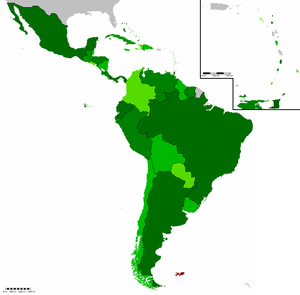
TheCommunity of Latin American and Caribbean States (Spanish: Comunidad de Estados Latinoamericanos y Caribeños, CELAC, Portuguese: Comunidade de Estados Latino-Americanos e Caribenhos, French: Communauté des États Latino-Américains et Caribéens, Dutch: Gemeenschap van de Latijns-Amerikaanse en Caribische landen) is the tentative name[1] of a regional bloc of Latin American and Caribbean nations created on February 23, 2010, at the Rio Group–Caribbean CommunityUnity Summit held in Playa del Carmen, Quintana Roo, Mexico.[2][3] It consists of all sovereign countries in the Americas, except for Canada, France, the Netherlands and the United States. British and Danish dependencies in the Americas are also not represented in CELAC.
CELAC is an example of a decade-long push for deeper integration within the Americas.[4] CELAC is being created to deepen Latin American integration and to reduce the once overwhelming influence of the United States on the politics and economics of Latin America, and is seen as an alternative to the Organization of American States (OAS), the regional body organized largely by Washington in 1948, ostensibly as a countermeasure to potential Soviet influence in the region.[4][5][6]