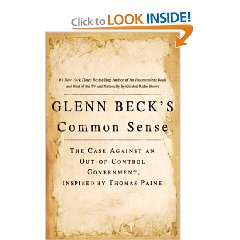
Review: Glenn Beck’s Common Sense–The Case Against an Out-of-Control Government, Inspired by Thomas Paine

5 Star, Congress (Failure, Reform), Consciousness & Social IQ, Crime (Corporate), Crime (Government), Democracy, Executive (Partisan Failure, Reform), Misinformation & Propaganda, Philosophy, Power (Pathologies & Utilization)

Amazon Page
Amazon Page

Minus 1 for Fluff, Plus 2 for Bringing Us Back to Paine: 6 Over-All,

June 27, 2009
As annoying as this book obviously is for so many, it is not only squarely on target, but merits great respect for bringing all of us back to the more developed wisdom of Thomas Paine.

Glenn Beck is not Thomas Paine. He's not even an average American, cf.
The Average American: The Extraordinary Search for the Nation's Most Ordinary Citizen. What he has going for him is a bully pulpit, the right instincts (no pun), and the ability to reach some, but not all and certainly not a majority, of conscious Americans.

The book is squishy, a moderately well-organized rant against “Progressives”; I myself have done better with Election 2008: Lipstick on the Pig (Substance of Governance; Legitimate Grievances; Candidates on the Issues; Balanced Budget 101; Call to Arms: Fund We Not Them; Annotated Bibliography). However, I honor this book, I really do. Below are five books that have the substance this book lacks, without the heart that Glenn Beck delivers:
Obama: The Postmodern Coup – Making of a Manchurian Candidate
Grand Illusion: The Myth of Voter Choice in a Two-Party Tyranny
Running on Empty: How the Democratic and Republican Parties Are Bankrupting Our Future and What Americans Can Do About It
Breach of Trust: How Washington Turns Outsiders Into Insiders
Vice: Dick Cheney and the Hijacking of the American Presidency

My review of that last one (I review all books I link to) itemizes 23 of the 25 high crimes and misdemeanors that make Dick Cheney long overdue for retrospective impeachment and negotiated exile.

My notes from the first half of this double-spaced book (the second half is the original work of the original Thomas Paine, and I loved having a chance to reread that):

+ Principles must displace the two political parties
+ Creative extremists are needed–non-violent *armed* extremists better
+ Government is imposing both sacrifices and intrusive conditions on a public that has been sacrificing since the 1960's
+ Shortcuts have consequences, national debt IS bad
+ Political leaders are parasites (Amen, Brother!–I would add, “and prostitutes uncaring about the public interest.”
+ Social Security and Medicare are a scam because the money is being spent and an IOU put in its place–close to $10 trillion in unfunded future obligations (but see my review of Operating Manual for Spaceship Earth
+ “Smiley-faced fascism” is the order of the day
+ Tax code is a weapon and a scam
+ Election manipulations anti-democratic, need term limits and an end to gerrymandering (see my review of Grand Illusion linked above)
+ “Green Government” is a scam that is radically increasing federal government powers to intervene and impact negatively on private property

Compact Fluorescent Light bulbs (CFL) are the poster child for Congressional and Executive idiocy and hypocrisy, and I give this its own paragraph to emphasize how much I admired this example and the way in which the author presented it. He lines up his facts and I am shocked to learn that they contain six times any “safe” level of mercury and when they break there is a complex clean-up procedure that is required, and they are *seriously* hazardous to children, pets, and adults.

I totally welcome and agree with the author's view that politicians are disdainful of citizens and overly enamored of secrecy for the sake of avoiding oversight.

I learn for the first time that lawful armed citizens were unlawfully disarmed in the wake of Katrina, and I believe the day will come when law enforcement officers are gunned down by citizens resisting unlawful disarming–our government is out of control, is going to issue illegal orders including “martial law” for the “common good,” and they will not be ready for the Harvest Of Rage: Why Oklahoma City Is Only The Beginning.

The author does a fine job of pointing out how the two-party tyranny uses international treaties to end-run common sense and impose addition deprivations on citizens.

A few quotes I especially admired:

p6: “The fastest way to be branded a danger, a militia member, or just plain crazy is to quote the words of our Founding Fathers [about the right to abolish the government].

p6: “It is not time to dissolve the bands that connect us to one another, but it is time to dissolve the ‘political'bands that *separate* us from one another.” I totally agree–look up the Unified Independents, I believe they will capture a third of the seats in 2010 and if Obama does not pass the Electoral Reform Act of 2009, he will be a lame duck President kicked out in 2012 in favor of an Independent President who demands Cabinet level selections and a balanced budget proposal be presented to We the People *prior to* Election Day.

p9: “Through legitimate 'emergencies involving war, terror, and economic crises, politicians on both sides have gathered illegitimate new powers–playing on our fears and desire for security and economic stability–at the expense of our freedoms.” Absolutely right, see the images I have loaded above, Obama is a CONTINUATION of Bush and Goldman Sachs is still helping Wall Street loot the Treasury.

p19: “This isn't a debate aout money, it's a life-and-death struggle for personal freedom and national liberty.

Between the book and the origina Tom Paine materials is a 9.12 project that does not do much for me, I'm sticking with the Boy Scout principles.

See my review of the following books for modest hope:
Fighting Identity: Sacred War and World Change (The Changing Face of War)

My online annotated bibliography at my corporate web site (OSS.Net, Inc.) provides direct links to 500+ of my reviews of relevant non-fiction books organized into groups.

Vote on Review
Vote on Review

Review: The People’s Business–Controlling Corporations and Restoring Democracy The People’s Business: Controlling Corporations and Restoring Democracy

5 Star, Capitalism (Good & Bad)

Peoples BusinessCharming Righteous Book–A Summary for Normal People, June 18, 2009

Lee Drutman

This is a charming righteous book, there is not a single thing lacking from my point of view, and as I made my way through the book my admiration for the authors and the work they put into this grew without reservation.

This is a superb orientation for any adult; a superb assigned reading for any level from undergraduate to graduate; and a truly stellar example of what informed advocacy and public purpose scholarship would be…

As with any book I immediately recognize as being best in class, I started with the index, the bibliography (many book titles I did NOT know), and the six pages of centers and web pages as resources.

I am late to finding this 2004 book, but would suggest that it is the perfect partner for Grand Illusion: The Myth of Voter Choice in a Two-Party Tyranny.

The authors set out to address the corporation within the framework of domestic politics, and they conclude that the corporate charter is a grant of, by, and for We the People, and therefore corporations must be subordinate to the sovereign people, and must not be allowed to harm the public interest.

The first three chapters define the corporate “threat” and attributes; the next two discuss the use of existing tools, the sixth addresses obstacles, and then the conclusion. Although a very broad mature reader could fly through a great deal of this, I was struck by the even pace, the concise sensible organization, and it occurred to me that there was not a word wasted. In my world, it takes a LOT of work to get a book to read this well. The authors strike me as exceptional.

The core concern with the corporation is combination of their being virtually no limits on corporate (mis)behavior, and virtually no liability for investors, owners, and managers.

I like the manner in which the authors review the history, both of the corporation as it systematically disembowels federal and state regulation (with lots of help as the states “race to the bottom”), and of the attempts by Ralph Nader, a Nobel Prize level reformer if ever there was one, who has often been misunderstood as being about safety rather than corporate responsibility, and as a spoiler of elections rather than a champion of honest democracy. The authors meet my high standards for crediting others, doing their homework, and tying it all together.

Page 44 gives us a list of corporate rights claimed, citing Carl Mayer:
+ First amendment guarantees of political speech, commercial speech, and negative free speech rights
+ Fourth amendments safeguards against unreasonable regulatory searchers
+ Fifth amendment double jeopardy and liberty rights
+ sixth and seventh amendment entitlements to trial by jury

Page 76 gives us the list of psychopathic attributes of the corporation, for those that have not seen this often quoted section before, Dr. Robert Hare as explained by lawyer Joel Bakan:
– irresponsible
– manipulative
– grandiose
– lack of empathy
– asocial tendencies
– refuse to accept responsibility for their own actions
– unable to feel remorse
– relate to others superficially

The authors review the disconnects between corporate ownership and management, discuss all the standard aspects of corporate escape from accountability including impotent boards of directors.

I myself learn for the first time about 78 corporate governance reforms itemized by Richard C. Brendon, “Restoring the Trust,” in August 2003. Note 38 on page 290 provides a web URL that I am placing in the comment below.

I learn on page 119 of Robert Hinkley (author of the Cord for Corporate Responsibility) and his view that adoption of the following would be helpful in refining the role of directors and officers, now focused on maximizing shareholder profit: “but not at the expense of the environment, human rights, the public health or safety, the communities in which the corporation operates, or the dignity of its employees.”

Wow. Wal-Mart is toast if that ever comes to pass–along with most corporations.

The authors discuss the consequences of deregulation; the need for anti-trust, and the need to protect inherently governmental functions from being privatized.

I really appreciate the concise detailed overview of what Enron gave to George Bush, and what it got in return, including $7 billion in subsidies, over 50 key positions in the US government, and so on.

As the authors wind toward a conclusion, having discussed funded lobbyists, funded think tanks, legal attacks on regulations, and the 527s that are also a target in Grand Illusion (linked above), the authors made some critical final points:

1. They are at pains to distinguish between corporate crime by the corporation in all its forms; and white collar crime by individuals, noting that difference natures require different responses.

2. They are at pains to point out that financial crime is not the only crime, and cite a litany of others including crimes against humanity.

3. I am fascinated by the estimate of the cost to the public of corporate irresponsibility. The authors cite 1994 estimate by Ralph Estes of 2.6 TRILLION; others add up to at least 1 trillion; and the corporation kills 50,000 to 60,000 people in the USA alone (violent crime kills roughly 16,000). I compare this to the $2 trillion a year that organized crime pulls down within a global economy estimated at 7-9 trillion, and see clearly that corporate crime is every bit as toxic as organized crime. See Illicit: How Smugglers, Traffickers, and Copycats are Hijacking the Global Economy for the other half of global crime.

The book closes with a heartening list of initiatives local communities are taking (page 256), and a call for the labor, environmental, and consumer movements to coalesce around one shared common goal, “a just and sustainable economy [within] a functioning democracy.”

They challenge us all to be citizens rather than consumers, to demand media reform as a means of being empowered with knowledge, and conclude that in a democracy, the rights of citizens to govern themselves must trump the rights of corporations to make money at the expense of the public.

See also:
The Corporation: The Pathological Pursuit of Profit and Power
Wal-Mart: The High Cost of Low Price
The Shock Doctrine: The Rise of Disaster Capitalism
Confessions of an Economic Hit Man
The Global Class War: How America's Bipartisan Elite Lost Our Future – and What It Will Take to Win It Back
Crossing the Rubicon: The Decline of the American Empire at the End of the Age of Oil
Rule by Secrecy: The Hidden History That Connects the Trilateral Commission, the Freemasons, and the Great Pyramids
Election 2008: Lipstick on the Pig (Substance of Governance; Legitimate Grievances; Candidates on the Issues; Balanced Budget 101; Call to Arms: Fund We Not Them; Annotated Bibliography)

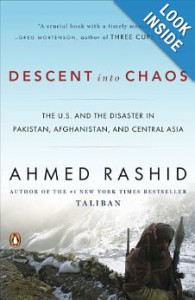
Review: Descent into Chaos–The United States and the Failure of Nation Building in Pakistan, Afghanistan, and Central Asia

5 Star, Cultural Intelligence, Insurgency & Revolution, Peace Intelligence
Amazon Page
Amazon Page

Ahmed Rashid

5 out of 5 stars Broad but Nuanced, Exudes Intelligence,Absorbing Speaking of Truth, June 17, 2009

Among the observations from the author”

1. U.S. has destabilized the world after 9-11, not made it safer.

2. Pakistan is the key to peace in the region, but the US has been totally taken in by Musharraf and his army and ISI colleagues, all of whom have played the US (easily) for the total fool.

3. “No coherence to US tactics and strategy” combined with a collapsed Cabinet system and “ruinous laws” making torture the norm.

4. Pashtuns lacked leadership on the ground for decades, a major reason why they did not counter the Taliban

5. If Pakistan is the key to peace in the region, Uzbekistan is the key to future war, mixing as it does the worst of dictatorial tyranny (I know, tautologically redundant, enjoy) with deep Islamic fundamentalism.

Continue reading “Review: Descent into Chaos–The United States and the Failure of Nation Building in Pakistan, Afghanistan, and Central Asia”

Review: The Real Environmental Crisis–Why Poverty, Not Affluence, Is the Environment’s Number One Enemy

5 Star, Environment (Problems), Peace, Poverty, & Middle Class

real enviro crisisTop-Notch Contribution, Incomplete but Very Much on Target,June 16, 2009

Jack M. Hollander

AMAZON has managed to eradicate virtually all of the voters for non-fiction by labeling them fans. This is so dumb I just shake my head. To find my buried reviews that summarize books in a useful way, use the online free bibliography at oss.net/PIG; just add the three w's.

I got this book at the same time as Eco-Imperialism: Green Power, Black Death and consider both to be very worthwhile. As much as I and others mocked The Skeptical Environmentalist: Measuring the Real State of the World for its data manipulation and unsupported conclusions, I have to say that the push-back has been important, and I am particularly impressed by the devastating critique in the other book (Eco-Imperialism) on the lack of integrity among the non-profits who strive to force their agenda on the public without ethical substance.

The author focuses on challenging the assumption that affluence in the Third World will destroy the environment, and I have a note, “a thoughtful, remarkable review.”

As with other books, DDT surfaces here as the poster issue for claims that it is bad for the environment versus claims that it is good for humanity.

I respect the core point on page 10: “The real enemies of environmental progress are poverty and tyranny, not technology and global markets.” The author was ahead of his time, publishing in 2003, in 2004 the High Level Panel agreed with him and made poverty THE #1 threat to humanity above infectious disease, environmental degradation, and seven other threats. See A More Secure World: Our Shared Responsibility–Report of the Secretary-General's High-level Panel on Threats, Challenges and Change.

There are some great turns of phrase. The author characterizes the current debate as “grains of truth embedded in a sea of exaggeration.”

I am totally impressed by the author's emphasis that for the five billion poor, the crisis is local and the threats within the threat of poverty are:

01 Hunger
02 Dirty water
03 Disease
04 Scarcity
05 Lack of Education
06 Social inequality, especially of women.

On #5, the UN IT folks just announced the opening of a free online university, which is a great start, now we just need for South Africa, China, India, and perhaps Chile to start call centers that offer all the poor education one cell call at a time. [And today Nokia announced a cell phone powered by ambient electro-magnetic waves in the atmosphere, i.e. it can continue running without having to be charged, a huge essential for the poorest of the poor).

On #6 I share the author's view that educating women and empowering women is a major aspect of assuring our future. I was much impressed by A Half Penny on the Federal Dollar: The Future of Development Aid and his emphasis on how the best return on investment for any aid dollar is from the education of women.

The author focuses on technological innovation (e.g. the Nordic hand-held device without energy needs that can filter feces water to produce clean drinkable water) and economic efficiency–this book does not mention corruption or “true costs” but the author is on track.

He is optimistic because of what we know and despite what we do not know, and I also am sharing his optimism as I see books like Blessed Unrest: How the Largest Social Movement in History Is Restoring Grace, Justice, and Beauty to the World and Collective Intelligence: Creating a Prosperous World at Peace.

He briefly discusses how poverty should be freedom of choice not only in economic terms, but in relation to political and other domains, as espoused by (he quotes) Amartya Sen, Nobel Laureate.

He spends a lot of time arguing that population growth is not inevitable and is not the doomsday scenario, capping this with a quote from the UN that suggests that population growth will be static by 2100, accompanying this with a compelling graphic that shows that affluence is the best way to end unreasonable or out of control population growth.

In the food section he extols the benefits of biotechnology while ignoring the crimes against humanity, such as Monsanto selling seed that kills its offspring so that the seed has to be bought again.

From this book I draw out the urgency of ending the sequestration of technology such as is now prevalent among many patent systems that do not have a “use it or lose it” clause in their schema.

There are good discussions of the oceans as the vital commons of the future, of global warming (Al Gore is starting to take a lot of hits for being facile with the truth), on water (water wars, women and water management, underpricing of water negating its efficient use), and on renewable energy.

While the author credit innovation with bringing the price of renewable energy down to a tenth of what it was, his knowledge is a bit dated as presented in this book, and I would add that similar gains have been made with respect to the desalination and purification of water from the sea, down from $10 a cubic meter to under 50 cents a cubic meter.

Moore's Law is going to apply to environmentally-relevant technologies, in my view.

He provides a thoughtful conclusion and lists seven goals on page 194:

01 Freedom and democracy are core foundations for the eradication of poverty
02 Gender equality is essential (I would actually return to matriarchies)
03 The poor must receive the education and the tools (I add: free cell phones, education by the call as espoused by the Earth Intelligence Network)
04 New wealth must be created in sustainable equitable manner that lifts the poor.
05 Massive effort is needed to cut diseases in half
06 World economy must become truly global, instead of current predatory neo-colonialism
07 Foreign aid needs to be targeted at the poor (see my briefing at oss.net/HACK, add the w's).

See also:
The Fortune at the Bottom of the Pyramid: Eradicating Poverty Through Profits (Wharton School Publishing Paperbacks)
The Wealth of Networks: How Social Production Transforms Markets and Freedom
The New Craft of Intelligence: Personal, Public, & Political–Citizen's Action Handbook for Fighting Terrorism, Genocide, Disease, Toxic Bombs, & Corruption
Election 2008: Lipstick on the Pig (Substance of Governance; Legitimate Grievances; Candidates on the Issues; Balanced Budget 101; Call to Arms: Fund We Not Them; Annotated Bibliography)

Review: Eco-Imperialism–Green Power, Black Death

5 Star, Empire, Sorrows, Hubris, Blowback, Environment (Problems)

eco-imperialismImportant contribution, not the whole picture, June 14, 2009

Paul Driessen

I shifted from four to five stars despite the gaps in this book's coverage because on second reading, it does what it set out to do very very well. I will review the other book I bought with this one, The Real Environmental Crisis: Why Poverty, Not Affluence, Is the Environment's Number One Enemy tonight or tomorrow.

What I find especially compelling about this book is that it blows the lid off “non-profits” that are in fact a form of unregulated racketeering, extortion and propaganda (lies). It is completely different from The Skeptical Environmentalist: Measuring the Real State of the World which has its own data quality and analytic integrity issues.

I admire the author's early observation that corporations and non-profits have taken on too many similar characteristics, “to strethc the truth….reinvent relality…substitute hype, spin and clever advertising for honest….and play fast and loose with ethics, the law and the numbers.”

WOW.

The author does a good job of calling into question the applicability and reasonableness of how and when the four pillars of environmentalism are applied:

01) Stakeholder participation (when those representing the poor are not themselves poor and have never talked to a poor person)

02) Sustainable development (as opposed to sustained develop)

03) Preacautionary principle (see my review of Protecting Public Health and the Environment: Implementing The Precautionary Principle

04) Socially Responsible Investing

I am totally impressed by his skewering of specific non-profits (names are named, numbers are provided) that are nothing more than extortion schemes, lacking all academic and scientific credence and relying instead on hit and run lies, orchestrated publicity, etc.

The author impresses with the number of examples and well-cited sources, and two stand out: Greenpeace's lies regarding the Shell oil platform, lies they ultimately apologies for; and Zimbabwe's refusing 26 tons of corn from the USA for the starving poor of Zambia because their dictator was persuaded that the corn was in some manner toxic, genetically modified, and in violation of European trade policies.

I learn the concept of “dead capital” (what our Native Americans would have called a “commonwealth” that could not be deeded), and I see very good discussion of fair trade versus free trade and why wage equivalency may not be the best thing for all concerned.

The author has a fine chapter on the myths of renewable resources but ignored geothermal–the book also ignores nuclear, which may be a non-negotiable intermediate solution for Africa and Central Asia.

The entire discussion of DDT being banned and its consequences in terms of 20 million dead per year from malaria is very worthwhile–I may not buy in to the entire argument, but I certainly respect the author and would want him in the room as a counter-weight to others.

I absolutely love the concluding chapter on investor fraud and the cozy relationships among the non-profit racketeers and the corporations and their CEOs that end up buying into lies for profit and a “bye.”

The bibliography and notes and index are all worth perusing.

I am loading an image of the standard information patholigies that I address (up under the cover of the book being reviewed) and will end with an appreciative note for the importance of truth and morality that the author represents, demanding it from ALL sides. In that he is endorsed by Patrick Moore, a Greenpeace co-founder, who appears mortified at some of the lies and malpractices that Greenpeace today has promulgated or adopted.

Other books I recommend that the author is not really focused on:
The Next Catastrophe: Reducing Our Vulnerabilities to Natural, Industrial, and Terrorist Disasters
Natural Capitalism: Creating the Next Industrial Revolution
The Fortune at the Bottom of the Pyramid: Eradicating Poverty Through Profits (Wharton School Publishing Paperbacks)
The Wealth of Networks: How Social Production Transforms Markets and Freedom
A More Secure World: Our Shared Responsibility–Report of the Secretary-General's High-level Panel on Threats, Challenges and Change
Ecological Economics: Principles And Applications
Collective Intelligence: Creating a Prosperous World at Peace

IO disagree with the author on one point: helping the poor as the expense of the environment is not a given. We spend 2.2 trillion a year on war and violence, when one third of that amount could give every one of the five billion a free cell phone (education one call at a time as advocated by Earth Intelligence Network), shelter, clean water, and a basic diet. (see calculations by Medard Gabel, EO Wilson, and Lester Brown).

This is a fine book, it may be a subsidized book (Heritage Foundation is in the mix) but it passes my smell test. Absolutely a voice to be heard.

Review: Horse Soldiers–The Extraordinary Story of a Band of US Soldiers Who Rode to Victory in Afghanistan

5 Star, War & Face of Battle

Horse SoldiersRead with the Two CIA Books, June 11, 2009

Doug Stanton

Others have provided ample reader substance on the book itself.

I strongly recommend the following two books as contextual reading:
First In: An Insider's Account of How the CIA Spearheaded the War on Terror in Afghanistan
Jawbreaker: The Attack on bin Laden and al-Qaeda: A Personal Account by the CIA's Key Field Commander

Also:
Never Surrender: A Soldier's Journey to the Crossroads of Faith and Freedom
Kill Bin Laden: A Delta Force Commander's Account of the Hunt for the World's Most Wanted Man

For an understanding of what SOF were/are up against in general terms:
Afghanistan's Endless War: State Failure, Regional Politics, and the Rise of the Taliban
Afghan Guerrilla Warfare: In the Words of the Mujahideen Fighters
Phantom Soldier: The Enemy's Answer to U.S. Firepower
Tactics of the Crescent Moon: Militant Muslim Combat Methods

Review: C3I–Issues of Command and Control

5 Star, Decision-Making & Decision-Support

Opened My Eyes to Cost of UNNECESSARY Secrecy, June 11, 2009

Thomas P. Coakley (ed)

This book opened my eyes to the cost of unnecessary secrecy. The following quote from this book is what inspired my advocacy, as a recovering spy, of Open Source Intelligence, and ultimately led to my realization that the secret unilateral intelligence community is “inside out and upside down.” I owe Harvard, the editors, and Rodney McDaniel in particular, an intellectual debt I can never repay.

“Everybody who's a real practiioner, and I'm s ure you're not all naive in this regard, realizes that there are two uses to which security classification is put: the legitmate desire to protect secrets, and the protection of bureaucratic turf. As a practitioner of the real world, it's about 90 bureaucratic turf, 10 legitmate protection of secrets as far as I am concerned.”

Rodley B. McDaniel, then Executive Secretary of the National Security Council, on page 68 of this most helpful book.

Subsequently quoted as above on page 65 of On Intelligence: Spies and Secrecy in an Open World, and again on page 203.

Other books focusing on the non-secret value of intelligence include:
The New Craft of Intelligence: Personal, Public, & Political–Citizen's Action Handbook for Fighting Terrorism, Genocide, Disease, Toxic Bombs, & Corruption
Peacekeeping Intelligence: Emerging Concepts for the Future
Information Operations: All Information, All Languages, All the Time
The Smart Nation Act: Public Intelligence in the Public Interest
Collective Intelligence: Creating a Prosperous World at Peace

All of the above books are also free online. Free online also look for the NATO Open Source Intelligence Handbook, the NATO Open Source Intelligence Reader, and the NATO Intelligence Exploitation of the Internet.

noble gold