Review: Handbook of Intelligence Studies

5 Star, Intelligence (Government/Secret)
Amazon Page
Amazon Page
5.0 out of 5 stars Extraordinary Perfection Properly Priced
January 25, 2007
Loch Johsnon

This is without question the single most important book at the operational level for the study of intelligence. It is not possible to be fully appraised without this book in your library.

It includes my own chapter on Open Source Intelligence (OSINT) at the operational level, available free at Phi Beta Iota the Public Intelligence Blog, as with all my work in the public service.

Vote on Review
Vote on Review

Review: Plan B 2.0–Rescuing a Planet Under Stress and a Civilization in Trouble

5 Star, Environment (Problems), Environment (Solutions)

Plan B 2.0Best Single Book for Both General Public and Broadly Read Specialists,

January 25, 2007
Lester R. Brown
It's a real shame that the publisher did not take the trouble to load the table of contents into the product information section provided by Amazon, because that alone should persuade anyone that gets to this page that the book is a MUST BUY MUST READ MUST SHARE.

Each of the following section titles has six sub-titles that I will not repeat here:
1. Entering a New World
2. Beyond the Oil Peak
3. Emerging Water Shortages
4. Rising Temperatures & Rising Seas
5. Natural Systems Under Stress
6. Early Signs of Decline
7. Eradicating Poverty, Stabilizing Populations
8. Restoring the Earth
9. Feeding Seven Billion Well
10. Stabilizing Climate
11. Designing Sustainable Cities
12. Building a New Economy
13. Plan B: Building a New Future.

Although an updated version of the first edition published in 2003, this version can be said to be both completely new, and finally ready for public consumption now that Al Gore has put Global Warming on the public mind.

I still prefer J. F. Rischard's High Noon 20 Global Problems, 20 Years to Solve Them for the general reader, and I still think E. O. Wilson's The Future of Life is one of the top three in this area, but this book by Lester Brown has the merit of consolidating and structuring detail in a manner I have not seen elsewhere.

I recommend the book be ready in conjunction with books by Herman Daly's Valuing the Earth: Economics, Ecology, Ethics and Paul Hawken's Natural Capitalism: Creating the Next Industrial Revolution, in part because everyone is now starting to realize that green sustainability is in fact the non-negotiable first step for any business to survive into the next decade–natural capitalism.

Most intriguing to me, and the heart of the book on page 257, is the consolidated Plan B budget totallying $161 billion a year needed to meet all of the goals the author postulates.
BASIC SOCIAL GOALS
12B Universal primary education
04B Adult literacy
06B School lunch in 44 poorest countries
04B Assistant to pregnant women and preschool childen in 44 poorest
07B Reproductive health and family planning
33B Universal health care
02B Closing the condom gap (Bill & Melinda Gates can have this one)

EARTH RESTORATION GOALS
06B Reforesting the earth
24B Protecting topsoil on cropland
09B Restoring rangelands
10B Stabilizing water tables
13B Restoring fisheries
31B Protecting biological diversity

As the author points out on the next page, world military expenditures total $975B a year, with the US alone responsible for $492B (this was published before we all knew of the half trillion dollar cost of the Iraq invasion and occupation). Hence, the $161B a year total is a fraction of the total spent on out-dated military systems, and could be funded by the US alone if we had the right leadership and public consensus.

Personally, and based on other readings, I believe that the author is under-estimating the costs, and avoiding a focus on many other factors including the urgent need to eradicate transnational crime and end inter-state and civil war. This is, however, a superb start and ideally suited as a primer for any level of learning.

Readers interested in seeing a broader perspective that places the ten high-level threats (poverty, infectuous disease, environmental degradation, inter-state conflict, civil war, genocide, other atrocities, proliferation, terrorism and transnational crime) in the context of the twelve policies that must be managed as a whole by all nations (agriculture, debt, diplomacy, economy, education, energy, family, immigration, justice, security, society, and water), and that in turn oriented toward the urgency of keeping the eight challengers (Brazil, China, Indonesia, India, Iran, Russia, Venezuela, Wild Cards) from repeating our mistakes, can check in at Earth Intelligence Network.

Rescuing are planet and our civilization is going to be a great deal harder than the author suggests, and is going to need a massive awakening by the public as to the “true cost” of all that we are doing wrong. I expect that we will succeed, in part from top down efforts by Al Gore and this author among others, and in part by bottom up efforts where individuals can get from the Internet the “true cost” of any good or service in terms of water content, fuel content, sweatshop labor content, and tax avoidance status. Noami Klein's books, No Logo: No Space, No Choice, No Jobs and The Shock Doctrine: The Rise of Disaster Capitalism are recommended in this regard.

Over-all an absolutely superb piece of work that caps the author's decades of advocacy on behalf of the planet. There is no other person that has been focused on this topic with due diligence year after year.

I believe this author should be recognized, along with Herman Daly and Paul Hawken and Anthony Lovins and others, for their total commitment over decades.

Vote on Review
Vote on Review

Click Here to Vote on Review at Amazon,

on Cover Above to Buy or Read Other Reviews,

I Respond to Comments Here or There

Review: The Starfish and the Spider–The Unstoppable Power of Leaderless Organizations

5 Star, Best Practices in Management, Change & Innovation, Civil Society, Consciousness & Social IQ, Democracy, Intelligence (Public), Intelligence (Wealth of Networks)

Amazon Page
Amazon Page

Compelling and Sensible, Offers Hope in Face of High-Level Threats,

January 23, 2007
Ori Brafman
I like this book very much and recommend that it be read in conjunction with “Wikinomics” and “Infotopia,” or at least read my reviews there. Each of these three books has its own perspective and the combine well. There are other books, such as Kevin Kelly's and Howard Rheingold's that were ten to fifteen years ahead of what is now “conventional wisdom” and it is important to give credit to the true pioneers.

From a business and governance perspective, the book is valuable in emphasizing that any endeavor based on information will improve with decentralization–more dots will be captured, shared, understood, and acted on in a timely fashion. I have been saying for over a decade that in the age of distributed information, central intelligence is an oxymoron, something the Central Intelligence Agency, my former employer, simply refuses to believe.

I listened to Al Gore last night on Global Warming, in Boise, Idaho–10,000 people who gave him multiple standing ovations, and I plan to listen to George Bush on Iraq tonight. Al gets it, George does not. Centralized systems cannot defeat decentralized systems. Al Gore is leading a massive global campaign to get all of us to change the planet from the bottom up, while George (or Dick Cheney, depending on who you think actually runs the place) is deepening America's loss of global standing and moral stature at the same time that he is bankrupting the treasury and destroying the Armed Forces–and planning a conventional attack on Iran at the same time. One of these guys is sane, the other is a nutcase. The good news is that decentralized morality can triumph over centralized corruption, and that is the back story on Al Gore's emergence as a virtual Earth Leader.

The authors offer us a number of gems and conclude with ten rules I will list below.

The key point is that a distributed brain or organization is more resilient and more likely to pick up weak signals. Distributed consensus is both scalable and sustainable, while centralized coercion is neither.

The authors place great emphasis on the importance of a spiritually-compelling ide[a]ology as the glue that helps decentralized organizations adjust to external and internal challenges much faster and with greater precision (as well as fewer resources) that any centralized system can manage. The “catalyst” model (Al Gore) is compared with the “commander in chief” model (George Bush) and there is no doubt at all which is the superior model for addressing today's complex high-level threats.

Indeed, it may be that between state secessions and popular boycotts of corporations using the federal government to pick people's pockets, that the Internet could create a form of global self-governance that makes the Federal government largely irrelevant, while re-directing funds from waging war to waging peace. That is the next big step. The authors specifically say that the price of software is declining toward zero. It will be content, sense-making, and what IBM calls “services science” that will add value and be marketable.

The authors describe Amazon and E-Bay in very favorable terms, and as hybrids with a centralized infrastructure for delivering services, but a vast decentralized network of customers who are also “prosumers” (Alvin Toffler's term) creating value on the network with their reviews and buying patterns. The authors' phrase “decentralized creativity and centralized consistency” jumped out at me.

The ten “rules” (better described as guidelines) are:

01 Diseconomies of scale
02 Network effect
03 Power of chaos
04 Knowledge at the edge
05 Everyone wants to contribute
06 Beware the hydra response
07 Catalysts rule
08 *Values* are the heart of any organization or network
09 Measure, monitor, and manage
10 Flatten or be flattened

Overall, this is a very fine book. I also recommend the emerging literature on the “true cost” meme and on natural capitalism, demonstrating that a proper understanding of the true and long-term costs of any product or service actually makes businesses more profitable and more sustainable.

I have added an image I created in the 1990's when I first started advocating Open Source Intelligence (OSINT), today I am focused on a non-profit, the Earth Intelligence Network, whose objective is to empower individuals and communities with public intelligence in the public interest. This book gave me hope, gave me a sense that we can indeed come together as a global network, and displace the authoritarian and corrupt governments that have been bribed by corporations to loot our commonwealth.

Vote on Review
Vote on Review

Review: Hannibal Rising

5 Star, Atrocities & Genocide, Philosophy

Amazon Page
Amazon Page

More than Satisfies, Ignore the Nit-Pickers,

January 23, 2007
Thomas Harris
Having read “Silence of the Lambs” first, and then the other two books by this author, I was skeptical but interested when I saw this book at an airport. It is excellent. Having fully engaged me with his earlier books, I was absolutely delighted to have this book fully occupy my flight from Denver to Dulles. It is carefully crafted and completely credible.

Future readers will benefit from being able to read the Hannibal series from start to finish. I am quite eager to see the author craft a book in which Hannibal takes on Wall Street and selectively culls the herd of greedy lying cheats that manage the Enron clones so proud of “exploding the client” (see my review of Michael Lewis' “Liar's Poker” and also “Confessions of an Economic Hit Man,” as well as “Cheating Culture” and “The Manufacture of Evil.”

Although I normally do not read or review fiction, this author has joined John Le Carre (the George Smiley series) and is one of handful of “must read” authors of fiction that is to my personal taste as a former spy and infantry officer.

This author has found his niche. Hannibal must live and love and kill with elegance. Bring on the next one!!!

Vote on Review
Vote on Review

Click Here to Vote on Review at Amazon,

on Cover Above to Buy or Read Other Reviews,

I Respond to Comments Here or There

Review: Infotopia–How Many Minds Produce Knowledge

4 Star, Change & Innovation, Democracy, Education (General), Future, Information Society, Intelligence (Collective & Quantum), Intelligence (Public), Intelligence (Wealth of Networks)

Amazon Page
Amazon Page

Complements Wikinomics, Solid but Incomplete,

January 17, 2007
Cass Sunstein
I was initially disappointed, but adjusted my expectations when I reminded myself that the author is at root a lawyer. The bottom line on this book is that it provided a very educated and well-footnoted discourse the nature and prospects for group deliberation, but there are three *huge* missing pieces:

1) Education as the necessary continuous foundation for deliberation

2) Collective Intelligence as an emerging discipline (see the Innovators spread sheet at Earth Intelligence Network); and

3) No reference to Serious Games/Games for Change or budgets as a foundation for planning the future rather than predicting it.

In the general overview the author discusses information cocoons (self-segregation and myopia) and information influences/social pressures that can repress free thinking and sharing.

The four big problems that he finds in the history of deliberation are amplifying errors; hidden profiles & favoring common or “familiar” knowledge; cascades & polarization; and negative reinforements from being within a narrow group.

Today I am missing a meeting on Predictive Markets in DC (AEI-Brookings) and while I regret that, I have thoroughly enjoyed the author's deep look at Prediction Markets, with special reference to Google and Microsoft use of these internally. This book, at a minimum, provides the very best overview of prediction markets that I have come across. At the end of the book is an appendix listing 18 specific predictions markets with their URLs.

The author goes on to provide an overview of the Wiki world, and is generally very kind to Jimbo Wales and Wikipedia, and less focused on the many altneratives and enhancements of the open Wiki. It would have been helpful here to have some insights for the general reader on Doug Englebart's Open Hypertextdocument System (OHS) and Pierre Levy's Information Economy Meta Language (IEML), both of which may well leave the mob-like open wiki's in the dust.

Worthy of note: Soar Technology is quoted as saying that Wikis cut project development time in half.

The book draws to a close with further discussion of the challenges of self-segregation, the options for aggregating views and knowledge and for encouraging feedback, and the urgency of finding incentives to induce full disclosure and full participation from all who have something to contribute.

This book excels in its own narrowly-chosen domain, but it is isolated from the larger scheme of things including needed educational changes, the importance of belief systems as the objective of Intelligence and Information Operations (I2O), the role of Serious Games/Games for Change, and the considerable work that has been done by Collective Intelligence pioneers, who just held their first convergence conference call on 15 January 2007.

Final note: the author uses NASA and the Columbia disaster, and CIA and the Iraq disaster, as examples, but does not adequately discuss the pathologies of bureaucracy and the politicization of intelligence and space. As a former CIA employee who also reads a great deal, I can assert with confidence that CIA has no trouble aggregating all that it knew, including the reports of the 30 line crossers who went in and then came back to report there were no Weapons of Mass Destruction. CIA has two problems: 1) Dick Cheney refused to listen; and 2) George Tenet lacked the integrity to go public and go to Congress to challenge Dick Cheney's malicious and impeachable offenses against America (see my reviews of “VICE” and of “One Percent Doctrine” on Cheney, and my many reviews on the mistakes leading up to and within the Iraq war). See also my reviews of “Fog Facts” and “Lost History” and Gaddis' “The Landscape of History.”

To end on an upbeat note, what I see in this book, and “Wikinomics” and “Collective Intelligence” and “Tao of Democracy” and my own “The New Craft of Intelligence: Personal, Public, & Political,” is a desperate need for Amazon to take on the task of aggregating books and building out from books to create social communities where all these books can be “seen” and “read” and “understood” as a whole. We remain fragmented in the production and dissemination of information, and consequently, in our own mind-sets and world-views. Time to change that, perhaps with Wiki-books that lock-down the original and then give free license to apply OHS linkages at the paragraph level, and unlimited wike build-outs. That's what I am in Seattle to discuss this week.

Vote for Review
Vote for Review

Click Here to Vote on Review at Amazon,

on Cover Above to Buy or Read Other Reviews,

I Respond to Comments Here or There

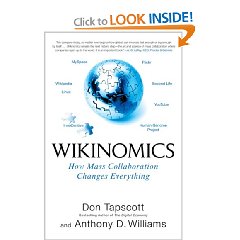
Review: Wikinomics–How Mass Collaboration Changes Everything

5 Star, Economics, Information Society, Intelligence (Collective & Quantum), Intelligence (Public)

Amazon Page
Amazon Page

Solid FOUR, Some Preening, Double-Spaced Overview,

January 16, 2007
Don Tapscott
Out of respect for Laura K. Turner's deeper knowledge of this author, I am integrating some of her observations and correcting myself where appropriate. The edit below raising the book to a four was done immediately after publishing the original review.

EDIT: After reading Cass Sunstein's book, which earned a four, I feel compelled to raise this to a four but Amazon does not allow me to change star ratings. This is a solid four, the preening not-withstanding.

There are a *lot* of platitudes in this double-spaced book, to the point that I felt I was reading a very simplified version of more complex ideas (which is of course a plus when dealing with ill-informed corporate chiefs and policy-makers (see Ben Gilad, “Blindspots” from Infonortics UK, not available via Amazon).

I've read stuff by this primary author (Tapscott) before and he has certainly made sustained contributions to our understanding, am just wondering if this book was a bit too quickly done–it struck me as more simplistic and shallower than I expected. Although Ms. Turner refers to seven distinct business models, neither “model” nor “business model” appear in the book's index, and my original impression, after a second look at the book and my notes, stands: the subtitle says it all: this is about mass collaboration.

There are a few flaws with this book that would normally take it down to three stars, but given the importance of the topic, the quick read, and the known serious past of the author, I have brought it back up to four after comparing it with “Infotopia.” It is double-spaced with a heavy dose of jargon, with a very over-simplified and uncritical view of the unfettered joys of globalization. This author has evidently never heard of “true cost” or “natural capitalism.”

In light of Ms. Turner's comments, I freely admit to lacking the deeper understanding of past books by the primary author, and I suspect that her spirited defense of this book rests more on substance from the past that a reader of this book cannot fathom.

As one who was first educated in the 1970's, I found it a real irritant to have the author appear to invent and be the catalyst for ideas like prosumer (Alvin Toffler, first used in his keynote speech to my annual conference in 1993), importance of external knowledge (Peter Drucker), and the paradigm shift (Thomas Kuhn in “The Structure of Scientific Revolution”). The author says that he “Don” wrote the book on paradigm shifts. Although the author footnotes the first two, not the third, this is in the end-notes and the sense of preening and exaggeration is distinctly annoying, especially when combined with the almost total lack of recognition of any of the 300 or so books by others about wealth of knowledge, infinite wealth, forbidden knowledge, Voltaire's bastards, etc. This struck me as a very self-centered book in more ways than one.

Now, Ms. Turner says a book should be judged on its rigor, coherence, creativity, and readability. B for the first two, A for the second two.

Although the author mentions GoogleEarth on more than one occasion, there is not real development in this book of the importance of the geospatial foundation for sharing all information in historical and cultural context.

A few minor thoughts worth noting:

–Well-done Wikis (the author makes no mention of trolls or all the other problems associated with Wikipedia) cut email by 75% and meetings by 50%. Would that this were so, and properly documented, but it's a start.

–90% of most R&D is internal and therefore lacking in the diversity that might come from the larger open network. This is *very* important. We need to build the World Brain and machine-speed translation and integration. Singapore, the Nordic nations, and even Estonia are ahead of the USA in this area.

–top billion people are believed by some to have 2-6 spare hours a day during which they could be contributing knowledge and mentoring to the larger group. [Bottom five billion desperately need to be connected to the Net for free, and if we did that–for what we have spent on Iraq we could have given out 5 billion free cell phones–they would create infinite wealthy.]

–Bill Gates thinks that Free/Open Source Software is communist. I guess that's the equivalent of me thinking Microsoft is fascist.

–Four things I had *not* heard of: CollabNet, Scorecard, InnoCentive, and TakingITGlobal.

I am posting two customer images here to try to make the point that the world of mass collaboration is a great deal more complicated and also a great deal more exciting, than the author communicates.

Bottom line: if you are not immersed in this topic, and want one book to partly understand your kids and the emerging, this one will do nicely. It was not deep enough to fully occupy me during a five hour trip from coast to coast–take a second book as back-up.

In addition to acknowledging Ms. Turner's helpful and professionally presented observations, I am using the new feature to add links to other books I recommend. You can see my many lists (especially the one on creating infinite wealth and the other on cheating the 90% that do the real work) for many other recommendations, and if you want to see my reviews easily when books have tens or hundreds of reviews, use the selection box in the upper right of your Amazon profile page. I do not list the author's books because of the limit to 10, but certainly Paradigm Shift and The Digital Economy as well as Digital Capital can be considered.

I conclude that I read broadly and Ms. Turner reads deeply, and I hope this review is a useful intersection of our combined paths.

The Structure of Scientific Revolutions
Introduction to Paradigms: Overview, Definitions, Categories, Basics, Optimizing Paradigms & Paradigm Engines
Out of Control: The New Biology of Machines, Social Systems and the Economic World
Powershift: Knowledge, Wealth, and Power at the Edge of the 21st Century
Smart Mobs: The Next Social Revolution
The Wealth of Networks: How Social Production Transforms Markets and Freedom
Infotopia: How Many Minds Produce Knowledge

Three new references (10 May 2008):
Society's Breakthrough!: Releasing Essential Wisdom and Virtue in All the People
Group Genius: The Creative Power of Collaboration
Collective Intelligence: Creating a Prosperous World at Peace


Vote on Review
Vote on Review

Review: Palestine–Peace Not Apartheid

5 Star, Atrocities & Genocide, Empire, Sorrows, Hubris, Blowback, Peace, Poverty, & Middle Class, Politics, Power (Pathologies & Utilization), Religion & Politics of Religion, Truth & Reconciliation

Amazon Page
Amazon Page

Truth is the only thing that will save us,

January 13, 2007
Jimmy Carter
President Jimmy Carter does not have a malicious bone in his body, and is one of the most intelligent Presidents we have ever had. His scholarship is NOT off the mark. What is off the mark is the dogmatic refusal of Zionist Jews to listen to reason.

See my reviews of Fog Facts : Searching for Truth in the Land of Spin (Nation Books) and Lost History: Contras, Cocaine, the Press & ‘Project Truth' for a sense of just how crazy all these people are that are claiming anti-semitism. I have nothing but disdain for the Jews that resigned, for they are disgracing themselves and America by showing so vividly their monstrous disrespect for the truth, for dialog, and for one of the finest Presidents this Nation has ever had (I say this as an estranged moderate Republican).

Reality is not easy. Reality is constantly obscured by corporate media owned by the corporations whose mis-deeds they dare not report, and whose relations with the 45 dictators of the world are beyond cozy–they are self-serving partnerships to loot the commonwealth of nations and leave all publics, not just the Palestinians, in the dirt. See Breaking the Real Axis of Evil: How to Oust the World's Last Dictators by 2025

Reality is also obscured by a US Congress that now has 43 Jews and only 1 Muslim, a Congress that until very recently abdicated its role as the FIRST branch of government and failed to balance the powers of an imperial presidency run amok (see my reviews of The Broken Branch: How Congress Is Failing America and How to Get It Back on Track (Institutions of American Democracy) and Breach of Trust: How Washington Turns Outsiders Into Insiders. America must be very alert to the dual hijacking of its government by corporations and by Zionist Jews who forget that they used terrorism to win their freedom from England, just as our American founders used terrorism to win the War of Independence.

Terrorism is a tactic. Anyone that does not understand that is either stupid (less likely) or maliciously deceptive (more likely).

It is my rare privilege to be the #1 Amazon reviewer for non-fiction (#48 over-all), and it is on that foundation that I stand today in praise of Jimmy Carter, and in demand of the immediate resignation of Dick Cheney, or his impeachment (see my list on books relevant to evaluating Dick Cheney, and on impeachment for those who cannot wait).

Reality is tough. Lying to ourselves is as good as bullet in our heads. See my varied lists for the reality that is the context for this good book by a good man.

Note: the Arabs are just as despicable as the Jews, for they have treated the Palestinians the way India and Japan treat their untouchables. Nothing in this book, or in my review, should be contrued as forgiving of the Arabs. It is my personal view that the US should disengage from the Middle East and also withhold our support to Israel until such time as it will listen to Jimmy Carter's sound advice, and agree to a shared state without walls–partition, as with India and Pakistan, breeds on-going violence. It is only tolerance and a common commitment to creating shared wealth that works. The Saudi ruling royalty are EVIL. See See No Evil: The True Story of a Ground Soldier in the CIA's War on Terrorism and Sleeping with the Devil: How Washington Sold Our Soul for Saudi Crude. For a more elegant view, see Leap of Faith: Memoirs of an Unexpected Life

Gandhi (Widescreen Two-Disc Special Edition) had it right: Palestine is to the Palestinians as France is to the French. Contrary to the dogma and lies that the rabid Jews (as opposed to rational Jews taking the long view) spread, the land *was* occupied by the Palestinians, and the Jews are genociding them the way the early American settlers genocides the Native Americans. No one has clean hands here, but it helps no one at all to demean an honest author and good man, and to falsely claim that this book is anti-semitic. This book is anti-stupid, and I am anti-stupid.

Vote on Review
Vote on Review

Click Here to Vote on Review at Amazon,

on Cover Above to Buy or Read Other Reviews,

I Respond to Comments Here or There

noble gold