Author has created a meme, essential part of a bigger picture,
January 2, 2007
Stacy Mitchell
The author of this book has gone way past good authorship–the business reporting in this book has achieved meme status and “Big Box Swindle” is now a term that leads to all sorts of interesting findings when one searches the web and the literature.
I recommend the other book listed above as part of the literature on “True Cost,” a meme that is resonating with the public much more than is “inconvenient truth.” True cost covers water (4000 liters in a T-Shirt), fuel (hundreds of gallons to move Wal-Wart toys from China), sweatshop and child labor (Wal Mart again), and tax avoidance as well as convictions for breaking various laws.
Although they do not appear in the list above, I recommend the varied books on Wal-Mart, especially the one focusing on the high cost of low price.
This author and the literature surrounding this author will shortly be matched by a point of sale ability for buyers to photograph any bar code, send it to Amazon or other sources, and get back the “True Cost” as well as comparable prices and alternative purchase suggestions.
This book could represent a turning point in the public mind, and is therefore of considerable importance to how we choose to react to its findings so that our children and grandchildren are not swindled–however, and the author would among the first to agree, it is not enough that we eradicate these unethical companies; we must also educate our future generations so that they do not lose sight of the “True Cost” of the “Big Box Swindle.”
I am a publisher, author, and intelligence professional. I was a speaker at the conference from which most of this material is derived.
I wish to respectfully inform all prospective buyers that a book like this, in lots of 2,500, costs a US penny a page to produce. I could produce this book for $34.95, with Amazon paying me $15.75, which after cost of printing and graphics would leave me with a $10 profit.
I am–to put it mildly–outraged at the disgraceful overpricing that the publishers are attaching to this book. This kind of over-pricing urges the violation of copyright and the posting of a pirated copy of this book to the web.
I earnestly hope that Amazon will get into the business of direct publishing to Kinko's and localized delivery by Federal Express, and put such dishonorable publishers completely out of business.
SHAME!
Free peace intelligence at Earth Intelligence Network.
All OSS books, including Peacekeeping Intelligence: Emerging Concepts for the Future are free online at OSS.Net, or reasonably prices on Amazon. We are opening a new edited book on Peace Intelligence (Col Jan-Inge Svensson, SE Ret) as editor and inviting contributions from authors who are not happy having their work buried by publisher greed.
Get Herman or Bozeman or Quiggin or Steele Instead,
December 29, 2006
Peter Jackson
I am a publisher, an author, and an intelligence professional.
This book undoubtedly has good content, but the publisher has been grotesquely irresponsible in pricing it out of reach of individual scholars and citizens and government officials seeking to continue their education.
As a publisher, I am happy to inform the prospective buyer that in lots of 2,500, hard copy books including color jackets and flaps, can be printed for a penny a page. Amazon pays publishers 40%. Hence, this book, sold at $35, would yield the publisher $15.70 or so, minus the printing cost of no more than $5, hence a $10 profit, entirely reasonable for a book.
What price knowledge? What price a lack of ethics among publishers?
See my lists and my many reviews for more honorable affordable knowledge.
All of my books are free online and prices to cover costs at Amazon.
Critical Piece of the Puzzle, Not the Whole Picture,
December 27, 2006
Scott Ritter
Scott Ritter was proven correct about Iraq not having weapons of mass destruction, and this alone demands our respectful attention to his views of the foolishness of attacking Iran.
There are other reviews of the substance of this book that are excellent, so here I just wish to contribute three supporting observations:
1) Endgame: The Blueprint for Victory in the War on Terror by LtGen Thomas McInerney and MajGen Paul Vallely, was published in 2004 and lays out the complete plan for US military domination of the Middle East, with Iran following Iraq, and then Syria etcetera. As lunatic as the plan may be (see my review for more details) it is a plan that will be carried out as long as Dick Cheney remains Vice President and George Bush Junior remains a fool who is clearly in way over his head.
2) Howard Bloom, who understood the coming Sunni versus Shi'ite world war for the soul of Islam, writing about it in The Lucifer Principle: A Scientific Expedition into the Forces of History, now warns of a likely Iranian masterplan that first used Ahmed Chalabi to lure the American neo-cons into Iraq, and now has lured four carriers, two strike groups and an amphibious group within range of the supersonic Sunburn missile that carried a nuclear warhead, can explode a carrier, and travel at 3.0 Mach straight line, or 2.2 Mach when zig-zagging.
3) In addition to Scott Ritter's excellent analysis of how Iran can turn off the oil supply in Iran, portions of Saudi Arabia and the UAE, and Kuwait, it is helpful to consider the extreme vulnerability of the US land supply route from Kuwait to Baghdad. A slide by Webster Tarpley showing this vulnerability is posted above.
Ritter gets a lot of respect from me–his integrity took him from a relatively minor position as a Marine Corps field grade officer, and elevated him to the role of speaker of truth for the public. I think he is right–the US will attack Iran, ostensibly in support of Israel–and this will be the greatest disaster of the 21st century, setting off a true world war between Sunni and Shi'ite in which the Christians are the “collateral damage” while the Jews experience a new form of genocide. I just shake my head, feeling helpless, wondering what it takes to get Scott Ritter's important knowledge in front of Congress.
I concur with all the 5 star reviews with respect to this book presenting a vision for the next level of capitalism nurturing the commons rather than destroying it, but it is not the whole story. It is simple without being simplistic, but the terms “ecological economics” (see my reviews of books by Herman Daly) and “natural capitalism (see my reviews of books by Paul Hawken) are not an integral part of this story. Neither is public philosophy, although the author clearly has an ethical public policy of his own.
Like the work of Paul Hawken, Amory Lovins, Hunter Lovins, and Herman Daly, it does not accuse nor seek repatriation of benefits as much as it seeks to educate and demonstrate why respect for the commons is good for business.
I recommend Michael Sandel's “Public Philosophy: Essays on Morality in Politics,” and Paul Hawken's “The Ecology of Commerce,” in addition to this book, but those deeply interested in this topic might wish to expand their range by browsing some of my lists on democracy, capitalism, and security.
The book ends with numerous ideas, some easy to implement, like time banks (I see a rush to displace banks, money, credit, and interest coming down the pike), and some more difficult but essential, such as reversing the spectrum licenses and land licenses awarded to corporations under Capitalism 1.0, and putting those resources to work for all of the people.
The author spends some time noting that government is not the complete answer, and I not only agree, I am eagerly waiting for a book called Government 3.0 or Democracy 3.0, something that brings together the diverse literature on the need to localize agriculture and energy again, stop the global corporations, e.g. Wal-Mart, from destroying communities, and restore integrity and trust in human transactions. In a sense, this book is a model that could be applied to other areas in need of revitalization.
Superb Personal Effort, Fits in With Other Vital Contributions,
December 23, 2006
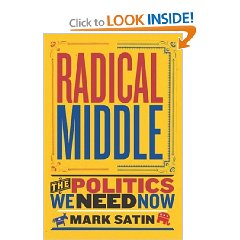
Mark Satin
I like this book very much. It is a cry from the heart–from a very informed heart–and it captures much that needs to be understood. It is not, however, the first effort in this direction. This book was published in 2004. Paul Ray and Sherry Ruth Anderson published “The Cultural Creatives: How 50 Million People are Changing the World” in 2000, coincident with the appearance of Marianne Williamson's extraordinary edited work, “IMAGINE: What American Could be in the 21st Century.” Ted Halstead and Michael Lind published “The Radical Center: The Future of American Politics,” in 2001. In 2002 Ralph Nader capped off decades of activism along these lines with “Crashing the Party: How to Tell the Truth and Run for President.” In 2003 we had Matthew Miller's “The 2% Solution: Fixing America's Problem in Ways Liberals and Conservatives Can Love.” See my reviews of all of those, and my list on democracy, to appreciate this book by this author, in a larger context.
The most important meme to come out to me–an aggressive iconoclast if ever there was one–dealt with the importance of turning away from rebellion for the sake of rebellion, and focusing instead of being a player, on bringing corporations to the table as Paul Hawken and others suggest in “Natural Capitalism” (which the author cites).
Early messages from this book include: Ignore the noise including Moore and Franken; Creative borrowing from all points of view to achieve public policy; Radical middle provides concrete answers instead of platitudes; Work with corporations instead of attacking them blindly; Idealism without the illusions. Four on key values: maximize choices, fair start for all, maximize human potential, help the developing world. The author then gives us four sections, with the highlights listed below.
Maximizing choices:
1) Universal health care that is also preventive and integrative
2) Law reform–affordable, meaningful
3) End oil dependency–parallel energies, seven paths (conservation, renewables, fossil fuels, hydrogen, nuclear, biobased, and values-change path
Fair start
1) great teachers (overlooks two-parent family, serious games, total change to curriculum)
2) affirmative action with teeth, not just letting in black-skinned white minds
3) Job for everyone and a financial next egg as well
Maximize human potential
1) corporations we can be proud of
2) biotech with adult supervision
3) bring back the draft–for EVERYONE (one of the best pieces)
Help the developed world
1) Globalization with savvy and feeling (address poverty, raise standards)
2) Make the WTO transparent
3) Humanitarian intervention in time–no more genocides (great piece)
4) Tough on terrorism and causes of terrorism
Be a player not a rebel
1) professional schools, not radical groups, are our incubators now (compassionate MDs, holistic MBAs, visionary JDs,
2) stay informed
3) join groups that matter and push them to the middle
4) run for office
5) open up the political process (free media, tax credits, proportional representation, instant run-offs, non-partisan redistricting,
Just this morning, a friend in Seattle sent me an email about a new meme that goes beyond the split between “for profit” and “non-profit” to speak of “new profit.” That is the distillation of what Paul Hawken and Herman Daly (“Ecological Economics”) are trying to capture. The old concept of corporate profit loots the commons. The new concept of profit, what I call Communal Capitalism, others call it Capitalism 3.0 or Natural Capitalism, understands that true profit must be perpetual and distributed.
This author has a following and is part of the solution. I recommend all the books I listed above, and this one.
Superb, Of Lasting Value, Next Edition Should Include Some Appendices,
December 18, 2006
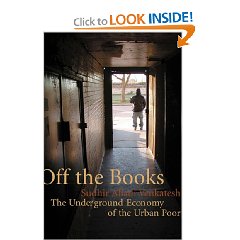
Sudhir Alladi Venkatesh
Robert Daniels review is useful. What stayed with me on this book is that we have let our urban poor down, over and over, and while they have created an underground community and a web of relationships that span the licit and illicit, they will never rise above that bare bones existence in the absence of substantial structured help.
The author draws on others to estimate that this community across the land could be responsible for at least 75 billion a year in unpaid taxes.
A few vital phrases:
“no one took (even) a few dollars for granted.”
this is a community with an intricate set of protocols for survival on the edge of the law and the edge of the economy
clergy plays a critical role as both brokers and clients for services; mothers as single heads of households are part of block committees that can negotiate complex and very specific arrangements with gangs, police, and others.
$50 in food stamps was worth (2001-2003) $75 in car repairs or $30 in beer.
The webs of relationships overcome any differences between licit and illicit. ANY form of income is respected and prized.
Informal credit a necessary social capital that replaced structured credit.
The night spaces are used by traders, regulators, and predators.
The chapter on the priests and block mothers was especially great. The author identified three blocks of preachers doing three different roles: brokering disputes in the illicit and licit local world; serving as part time work or exchange brokers for the working poor; and serving as outreach to the police and other communities, e.g. the adjacent white middle class community whose preachers could pass the word on available service jobs with specific families.
The bottom line is clear: even the most desperate, if they are resilient, can survive and find some form of happiness, but we have let them down. As I write this, Wall Street is giving out tens of billions in bonuses to its employees, the US Government is mounting the worst deficit and combined national debt in history, and the Navy and the Air Force are continuing to demand new carriers and long-range bombers while our troops on the ground lack showers, hot food, comfortable quarters, and safe vehicles–as well as an attentive responsible government (at the top–I never mean to be critical of the good people trapped in this terribly screwed up mess we call the federal government).
This is a serious useful accomplishment. Other books I recommend include ILLICIT by Moises Naim, “The Working Poor” by David Shipler, “Nickled and Dimed” by Barbara Ehrenreich, and “The Global Class War” by Jeff Faux, see my reviews of each for a quick insight into those authors' very valuable complementary views.
My only dismay is that this book is missing the icing. I would have loved to see some figures, maps, charts that visualized the substance. The comparison of the value of food stamps to car repair to beer is priceless. Most of these people barely made $750 a month. I sense that the author was exhausted by this effort and slowed to a walk as the book came to completion–should it be re-issued, and I expect it will be as I consider it to be scholarship of lasting value, I would like to see some really excellent charts, extrapolations, and visualizations.
A really fine piece of work, well worth reading along with the other books mentioned above.