A strange Washington Poststory gives readers the impression that morale is low at the NSA because President Obama hasn't visited to signal his support for the intelligence agency, even as Edward Snowden's leaks are causing many to criticize it.
The headline: “NSA morale down after Edward Snowden revelations, former U.S. officials say.”
The lead:
Morale has taken a hit at the National Security Agency in the wake of controversy over the agency’s surveillance activities, according to former officials who say they are dismayed that President Obama has not visited the agency to show his support.
What these “dismayed” sources told the newspaper:
Supporters of the NSA say staffers are not feeling the love.
“The agency, from top to bottom, leadership to rank and file, feels that it is had no support from the White House even though it’s been carrying out publicly approved intelligence missions,” said Joel Brenner, NSA inspector general from 2002 to 2006. “They feel they’ve been hung out to dry, and they’re right.”
A former U.S. official—who like several other former officials interviewed for this story requested anonymity because he still has dealings with the agency—said: “The president has multiple constituencies—I get it. But he must agree that the signals intelligence NSA is providing is one of the most important sources of intelligence today. So if that’s the case, why isn’t the president taking care of one of the most important elements of the national security apparatus?”
Is this just an attempt to exert pressure on the president and stave off even the mildest criticism of the NSA? The sourcing here seems awfully shoddy. Is a former NSA inspector general who hasn't worked for the agency in seven years really qualified to pronounce upon the current feelings of every employee? Is the proposition that NSA staffers are all of one mind about recent controversies something we'd credit even if a current NSA employee said it? Did the anonymous “former U.S. official” ever work for the NSA? What “dealings” does he or she presently have with the agency, and how remunerative are those dealings?
After reading what these former officials had to say, Marcy Wheeler points out that NSA employees have a reason for low morale that has nothing to do with Obama's support:
Most of the NSA’s employees have not been read into many of these programs … That raises the distinct possibility that NSA morale is low not because the President hasn’t given them a pep talk, but because they’re uncomfortable working for an Agency that violates its own claimed rules so often. Most of the men and women at NSA have been led to believe they don’t spy on their fellow citizens. Those claims are crumbling, now matter how often the NSA repeats the word “target.” [PBI: Emphasis added.]
An article titled The Changing Face of Exploratory Search on Linkedin presents the current trends in search. Exploratory search is distinct from navigational search, the latter searcher-type knows what she is expecting to get in terms of results. An exploratory searcher might know the search criteria but not how many results will meet their criteria, if any. The article claims that while navigational search exploded in the last fifteen years, exploratory search is still nascent.
The trends highlighted in the article include:
1.) Entity-oriented search. Search has moved beyond words as mere strings of text and increasingly focuses on entities that represent people, places, organizations, and topics.
2.) Knowledge graphs. Search is starting to leverage the network of relationships among entities: Google has its knowledge graph; Microsoft has Satori; and networks like LinkedIn and Facebook are fundamentally social graphs of entities.
3.) Search assistance. Google popularized search suggestions nearly a decade ago, using its knowledge of common queries to reduce effort on the part of searchers.
The article goes on to explain what will happen when faceted search (a mixture of entity-oriented and knowledge graph searches) expands, allowing for precision searches. The final step is faceted search combining with search assistance to mold something akin to Facebook’s graph search. The article touts these trends as new, but they sound awfully familiar. Didn’t Inktomi and Endeca approach search in this way in the 1980s? Perhaps this is just old wine in a new semantic bottle.
Infopolicy: There is a number of industries today that are already obsolete, kept alive by sheer inertia or by political subsidies. Many politicians, in an attempt to “save jobs”, are foolishly taking resources from new, viable industries and giving to these obsolete ones. “Saving jobs” in this context means that politicians are rejecting ways of producing the same level of output with a much more competitive and cost-efficient method, and is not to be applauded at all.
The first and most obvious victim industry of the internet was the postal industry, the kind that delivered physical letters. When people want to communicate today, they don’t put ink to paper. Out of sheer inertia, bills and governmental correspondence are still being delivered using this method, but everybody else has moved on. Parcel couriers that ship physical objects live on for the time being, but are threatened by 3D printing.
Austrian Inventor Wilhelm Mohorn has sold thousands of Aquapol units across Europe. The invention has saved customers thousands of dollars that would have been spent on costly basement renovations due to water damage. The device requires no conventional energy input, as it is entirely fueled by what he acknowledges as “Space Energy”. Although the Aquapol is not a generator or motor, it is demonstrative proof that vacuum energy is extractable. Here is a presentation Wilhelm gave at last year's Breakthrough Energy Conference where he describes the theory behind the device:
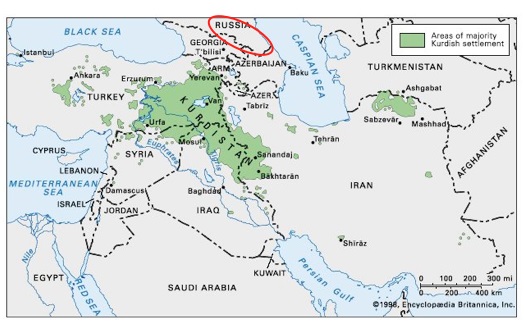
The Kurds are the world’s largest ethnic group (25-35 million) without a nation. As the graphic below shows, Kurds are widely distributed throughout the turbulent regions of Middle East and Central Asia. The green areas are the major areas of heavy Kurdish concentration — but small enclaves exist in areas not marked. (For example, I met many Kurdish Turks in western Anatolia in 2008-9 — my impression was that these urban Kurds were well integrated into Turkish society, unlike their brethren in the East.)
Click on Image to Enlarge
Below is a report analyzing a little known dimension to the Kurdish Question in the turbulent North Caucasus (i.e. the area of red ellipse), where a relatively small number (approximately 64,000) people of Kurdish origin now reside.
The author argues that Russia’s Kurds are sending humanitarian aid to anti-Jihadi Kurds in Syria while Jihadis from Russian Republics of Chechnya and Dagestan (also in the North Caucasus) are flowing into Syria, possibly setting the stage from some kind of blowback in the North Caucasus. (I have no idea of how accurate this report is — and can not vouch for it.)
But if true, Russia’s emerging Kurdish Question could be exceedingly complex, involving internal relations with its turbulent Caucasus Republics and external relations with Turkey, Syria, Azerbaijan, and possibly Iran, among others. These problems may have had something to do with Putin’s tamping down of Obama’s ill-considered efforts to intervene in the Syrian Civil war last August and September — an intervention that would have effectively placed the US on the side of Jihadis we claim to be fighting in the so-called Global War on Terror (GWOT) — and are enemies of the Russians as well.
Maxim A. Suchkov, Ph.D., a former Fulbright visiting fellow at Georgetown University (2010-11), is currently a fellow at the Institute for Strategic Studies at the North Caucasian city of Pyatigorsk, Russia and is a contributor to the Central Eurasian Studies Society Blog.
Yet another story of the failure of austerity policies. The dominant economic philosophy of the Theocratic Right since Ronald Reagan has repeatedly been shown to be a failure. Yet, so far as I can tell, none of these failures have had the slightest effect on wretched Rightist corrupt political prostitutes in the U.S. House of Representatives. We have become a fact-free culture.
This and the next story are so immoral they almost take one's breath away. One out of five children in the United States go to bed hungry. We do not have universal healthcare. Our schools are in shambles. But there are untold billions for war and “nation building” in nations other than our own. You'd think we would be ! ashamed, but shame about thoughtless callous programs that punish people already sorely reduced no longer seems to play any role in our society.





 The first and most obvious victim industry of the internet was the postal industry, the kind that delivered physical letters. When people want to communicate today, they don’t put ink to paper. Out of sheer inertia, bills and governmental correspondence are still being delivered using this method, but everybody else has moved on. Parcel couriers that ship physical objects live on for the time being, but are threatened by 3D printing.