FORT LAUDERDALE, Fla. — Data scientists are the most in demand job for the military, according to Reggie Brothers, the deputy assistant secretary of defense for Research.
The military has a problem with “big data” — the problem being that it collects too much of it. The infatuation with unmanned vehicles and the sensors mounted onto them has spurred a wave of data collected on the battlefield.
Using that data has caused military leaders headaches. Brothers said here at the Association of the U.S. Army’s Winter Symposium on Wednesday that the Army and the other services have placed their focus on PED, or processing, exploitation, and dissemination.
He used the ARGUS-IS as an example of the major advances being made in the world of intelligence sensors. The ARGUS-IS can stream up to a million terabytes of data and record 5,000 hours of high definition footage per day. It can do this with the 1.8 gigapixel camera and 368 different sensors all housed in the ARGUS-IS sensor that can fly on an MQ-9 Reaper.
My Harvard/MIT colleague Todd Mostak wrote his award-winning Master’s Thesis on ”Social Media as Passive Polling: Using Twitter and Online Forums to Map Islamism in Egypt.” For this research, Todd evaluated the “potential of Twitter as a source of time-stamped, geocoded public opinion data in the context of the recent popular uprisings in the Middle East.” More specifically, “he explored three ways of measuring a Twitter user’s degree of political Islamism.” Why? Because he wanted to test the long-standing debate on whether Islamism is associated with poverty.
So Todd collected millions of geo-tagged tweets from Egypt over a six month period, which he then aggregated by census district in order to regress proxies for poverty against measures of Islamism derived from the tweets and the users’ social graphs. His findings reveal that “Islamist sentiment seems to be positively correlated with male unemployment, illiteracy, and percentage of land used in agriculture and negatively correlated with percentage of men in their youth aged 15-25. Note that female variables for unemployment and age were statistically insignificant.” As with all research, there are caveats such as the weighting scale used for the variables and questions over the reliability of census variables.
This report, grounded entirely in facts, is going to upset you. It is a saga of how a nation commits suicide, and if it doesn't leave you concerned, it might be wise to make sure you have a pulse.
Half the population of the U.S. has slipped into poverty or is barely making enough to get by.
Sub-Titles Only:
1. Recovery for the rich, recession for the rest.
2. Half of us are poor or barely scraping by.
3. Unhappy meal (47 million on food stamps)
4. Old age and poverty.
5. Incarceration nation.
6. The cost of gender inequality.
7. College degrees still pay off, big-time.
8. A retired couple needs a quarter million for retirement – just for healthcare.
9. The looting of America.
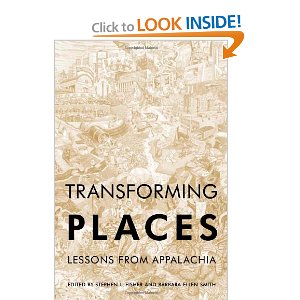
In this era of globalization's ruthless deracination, place attachments have become increasingly salient in collective mobilizations across the spectrum of politics. Like place-based activists in other resource-rich yet impoverished regions across the globe, Appalachians are contesting economic injustice, environmental degradation, and the anti-democratic power of elites. This collection of seventeen original essays by scholars and activists from a variety of backgrounds explores this wide range of oppositional politics, querying its successes, limitations, and impacts. The editors' critical introduction and conclusion integrate theories of place and space with analyses of organizations and events discussed by contributors. Transforming Places illuminates widely relevant lessons about building coalitions and movements with sufficient strength to challenge corporate-driven globalization.
Review
“I cannot recall a book that has excited me more than Transforming Places. This work is a major step forward in the study of social change, our understanding of ‘free spaces,' and local resistance – how people get power and how they can use it to get more.” Richard A. Couto, editor of Political and Civic Leadership: A Reference Handbook “Transforming Places addresses timely issues and tracks changes in political movements in Appalachia, assessing the devastating economic, social, and environmental costs amid hints of optimism for a more sustainable future. This work is significant for Appalachian studies and its overlapping disciplines but also will be useful outside of academia for agencies and organizations focused on sustainable development, strengthening community, and building alliances.” Patricia D. Beaver, co-editor of Tales from Sacred Wind: Coming of Age in Appalachia “The range of topics covered in this volume provides an exciting view of the new directions grassroots activism is taking in Appalachia: immigrants' rights, the history and dissolution of an organizing training program, collaborations between faith-based institutions and labor, coalitions that address farming and hunger, and a variety of analyses of recent activism against mountaintop removal. This is undoubtedly a major contribution to Appalachian studies.” Mary K. Anglin, University of Kentucky
About the Author
Steve Fisher taught for 35 years at Emory & Henry College where he helped create an Appalachian Studies minor, the Appalachian Center for Community Service, and an interdisciplinary service-learning major. He was the 1999 Carnegie Foundation Outstanding Baccalaureate College Professor of the Year and has won a number of other teaching-related awards. He is the editor of Fighting Back in Appalachia: Traditions of Resistance and Change and co-editor of Transforming Places: Lessons from Appalachia, and has written extensively on a variety of Appalachian issues, including identity, resistance, and political economy, and on teaching and community-based education. He has been active in a number of Appalachian resistance efforts including the land study, Appalachian Alliance, and the Pittston strike and has worked to build links between the academic community and activists in the region. He was co-founder and columnist for The Plow, an alternative regional newspaper in the late 1970s. He recently served on the board of the Highlander Center, is an active member of the Appalachian Peace Education Center and the Virginia Organizing Project, and served on his county's Planning Commission from 2000-2012. He was the program chair of the first Appalachian Studies Conference, has served as President of the Appalachian Studies Association (ASA), and has received the ASA's Cratis Williams/James Brown Service Award. He currently hosts a weekly radio show (“Rise Up Singing”) on WEHC 90.7 FM.
An award-winning author explores how the world works in our age of “continuous now”
Back in the 1970s, futurism was all the rage. But looking forward is becoming a thing of the past. According to Douglas Rushkoff, “presentism” is the new ethos of a society that’s always on, in real time, updating live. Guided by neither history nor long term goals, we navigate a sea of media that blend the past and future into a mash-up of instantaneous experience.
Rushkoff shows how this trend is both disorienting and exhilarating. Without linear narrative we get both the humiliations of reality TV and the associative brilliance of The Simpsons. With no time for long term investing, we invent dangerously compressed derivatives yet also revive sustainable local businesses. In politics, presentism drives both the Tea Party and the Occupy movement.
In many ways, this was the goal of digital technology—outsourcing our memory was supposed to free us up to focus on the present. But we are in danger of squandering this cognitive surplus on trivia. Rushkoff shows how we can instead ground ourselves in the reality of the present tense.
Chapters on Narrative Collapse, Digiphrenia – Breaking Up Is Hard to Do, Overwinding, Fractalnoia – Finding Patterns in the Feedback, Apocalypto.
Douglas Rushkoff
About the Author
Winner of the first Neil Postman award for Career Achievement in Public Intellectual Activity, Douglas Rushkoff is an author, teacher, and documentarian who focuses on the ways people, cultures, and institutions create, share, and influence each other's values. He sees “media” as the landscape where this interaction takes place, and “literacy” as the ability to participate consciously in it.His ten best-selling books on new media and popular culture have been translated to over thirty languages. They include Cyberia, Media Virus, Playing the Future, Nothing Sacred: The Truth about Judaism, and Coercion, winner of the Marshall Mcluhan Award for best media book. Rushkoff also wrote the acclaimed novels Ecstasy Club and Exit Strategy and graphic novel, Club Zero-G. He has just finished a book for HarperBusiness, applying renaissance principles to today's complex economic landscape, Get Back in the Box: Innovation from the Inside Out. He's now writing a monthly comic book for Vertigo called Testament.
Phi Beta Iota: Doug is a genius with a gift for perception combined with a gift for articulation. Book will be released 21 March 2013 — can be pre-ordered at reduced price at Amazon now, click on cover above.
Prosecutions of *actual* terrorists in America since 9/11/01 can be counted on one hand (Moussoui, Zazi, Shazad, Abdulmuttalab). All of the rest are bogus, with at least 50 being straight-up entrapment jobs by the FBI and their handsomely paid (by you) informants.
The next time some real terrorists plot to blow something up in America, the FBI will no doubt miss it, being too busy tricking the slowest kid down at the Islamic bookstore into praising Osama for the promise of $20,000.