Discussed this the other day with a couple of like minded folks, one noted that his Apple devices are synched when he walks into the house, his son's is synched with all his school work when he enters a classroom. There is little use of Word or like minded products, the school uses YouTube, Twitter, etc.
With the advent of iPad into the business market (the Air Force just
jettisoned its paper flight manuals for pilots and replaced them with
iPads)…..
Blue screen of death fades into the sunset. Enjoy.
Please join me for the retirement party for the productivity software suite.
Our good friend word/spreadsheet/presentation has been an exemplary employee, even as he gained a few pounds as contact management, calendaring, and all sorts of other bits and pieces of the office routine were piled on. And while we can have fun arguing about which was the first such software product (Framework in 1984, Lotus Symphony at about the same time), we can all agree that Microsoft Office started occupying the corner office in 1989. So thank you very much for your service. Here's your gold watch. Now go play some golf.
It's hard to believe that a nearly 30-year-old product is still synonymous with office productivity during a period that has included the rise of the Internet, smartphones, cloud computing, and Facebook. So with the retirement party over, what's the shape of the new office suite?
Phi Beta Iota: Microsoft is now officially brain-dead. The departure of Ray Ozzie was its final heart attack. OpenBTS, Twitter, Hypothes.is, and Wiki-think Wiki-work are all moving in interesting directions. Microsoft was an industrial-era “stand-alone” approach to human productivity, and it retarded the world for decades because of its hostility to third-party vendors and its constant mutation of Application Program Interfaces (API) as predatory toll-booths.
This is fascinating at multiple levels. Neither Google nor Facebook have been effective at helping humans “make sense,” now it appears that Twitter–perhaps combined with Hypothes.is–just might be a hair away from creating the skeleton of the World Brain.
Twitter is revamping the service with personal Twitter profile pages, a new timeline that includes rich media and other related informationembedded into tweets, and easier search for information based on @ symbols (usernames) and hash tags.
Talking at Twitter's unfinished new headquarters building in San Francisco, founder Jack Dorsey and CEO Dick Costolo explained that the changes are meant to make Twitter more accessible to everybody.
Their three goals:
Expose the “universe within every tweet.” Tweets aren't just 140 characters — there's also context like retweets and replies, and embedded content like videos, images, and songs. Today, accessing this material still feels like opening a “side drawer,” said Costolo.
Make Twitter less obscure to use. Today, the @ and # symbols are too obscure — people don't know what they mean. This contributes to a lot of people visiting Twitter but not really participating actively. The redesign surfaces these symbols and makes them the gateway to find out more infrmation about people and topics on the surface.
Share it with everybody. The world has 7 billion people. Most of those people are “not yet on Twitter,” said Costolo. The redesign will roll out to mobile devices simultaneously, and is streamlined to load up to 500% faster.
The trick is doing this without adding too much complexity. As Dorsey put it, “simplification is the key here.”
While much of the world is in crisis and protests are erupting throughout Europe and the United States, Latin American and Caribbean nations are building consensus, advancing social justice and increasing positive cooperation in the region. Social, political and economic transformations have been taking place through democratic processes in countries such as Venezuela, Bolivia, Ecuador, Nicaragua, Uruguay, Argentina and Brazil throughout the past decade, leading to a massive reduction in poverty and income disparity in the region, and a substantial increase in social services, quality of life and direct participation in political process.
One of the major initiatives of progressive Latin American governments this century has been the creation of new regional organizations that promote integration, cooperation and solidarity amongst neighboring nations. Cuba and Venezuela began this process in 2004 with the founding of the Bolivarian Alliance for the Peoples of Our America (ALBA), that now includes Bolivia, Ecuador, Nicaragua, Dominica, St. Vincent’s and the Grenadines and Antigua and Barbuda. ALBA was initially launched in response to the US government’s failed attempt to impose its Free Trade Agreement of the Americas (FTAA) throughout the region.
Click on Image to Enlarge
Today ALBA is a thriving multilateral organization with member nations that share similar political visions for their countries and for the region, and includes numerous cooperation agreements in economic, social and cultural areas. The fundamental basis of trade amongst ALBA nations is solidarity and mutual benefit. There is no competition, exploitation or attempt to dominate amongst ALBA states. ALBA even counts on its own currency, the SUCRE, which allows for trade between member nations without dependence on the US dollar.
In 2008, the Union of South American Nations (UNASUR) was formally established as a regional body representing South American states. While ALBA is much more consolidated as a unified political voice, UNASUR represents a diversity of political positions, economic models and visions for the region. But UNASUR members share the common goal of working towards regional unity and guaranteeing the resolution of conflicts through peaceful and diplomatic means. UNASUR has already played a key role in peacefully resolving disputes in Bolivia, particularly during an attempted coup against the government of Evo Morales in 2008, and has also successfully moderated a severe conflict between Colombia and Venezuela, leading to the reestablishment of relations in 2010.
Two hundred years ago, South American Independence hero Simon Bolivar, a native of Venezuela, dreamed of building regional unity and creating a “Patria Grande” (Grand Homeland) in Latin America. After achieving independence for Venezuela, Bolivia, Ecuador and Colombia, and fighting colonialists in several Caribbean nations, Bolivar attempted to turn this dream of Latin American unity into reality. His efforts were sabotaged by powerful interests opposing the creation of a solid regional bloc, and eventually, with the aid of the United States, Bolivar was ousted from his rule in Venezuela and died isolated in Colombia several years later. Meanwhile, the US government had proceeded to implement its Monroe Doctrine, a decree first declared by President James Monroe in 1823 to ensure US domination and control over the newly-freed nations in Latin America and the Caribbean.
Nearly two hundred years of invasions, interventions, aggressions, coup d’etats and hostilities led by the US government against Latin American nations shadowed the 19th and 20th centuries. By the end of the 20th century, Washington had successfully imposed governments in every Latin American and Caribbean nation that were subordinate to its agenda, with the exception of Cuba. The Monroe Doctrine had been achieved, and the US felt confident in its control over its “backyard”.
The unexpected turn at the beginning of the 21st century in Venezuela, formerly one of Washington’s most stable and subservient partners, came as a shock to the US. Hugo Chavez had been elected President and a Revolution had begun. A coup d’etat attempt in 2002 failed to subvert the advancement of the Bolivarian Revolution and the spread of revolutionary fever throughout the region. Soon Bolivia followed, then Nicaragua and Ecuador. Argentina, Brazil and Uruguay elected socialist presidents, two of them former guerrilla fighters. Major changes began to occur throughout the region as the peoples of this vast, diverse and rich continent assumed power and made their voices heard.
Social transformations in Venezuela that gave voice to people’s power became exemplary for others in the region, as did President Chavez’s defiance of US imperialism. A powerful sentiment of Latin American sovereignty and independence grew stronger, even reaching those with governments aligned with US interests and multinational control.
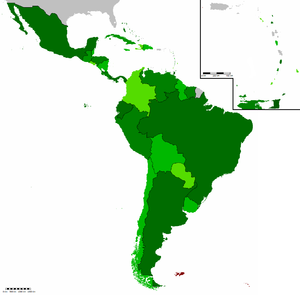
On December 2-3, 2011, the Community of Latin American and Caribbean States (CELAC) was born and the overwhelming force of a continent nearly 600 million strong, achieved a 200-year dream of unity. The 33 member nations of CELAC all agree on the unquestionable necessity to build a regional organization that represents their interests, and that excludes the overbearing presence of the US and Canada. While CELAC will take time to consolidate, the exceptional commitment evidenced by the 33 states present at its launching in Caracas, Venezuela, cannot be underestimated.
CELAC will have to overcome attempts to sabotage and neutralize its expansion and endurance, and the threats against it and intents to divide member nations will be numerous and frequent. But the resistance of the peoples of Latin America and the Caribbean who have resumed this path of unity and independence after nearly two hundred years of imperialist aggression, demonstrates the powerful force that has led this region to become an inspiration for those seeking social justice and true freedom around the world.
Phi Beta Iota: Emphasis added. This is largely a Cuban G-2 puff-piece, but it also represents real potential. A great deal will depend on whether Cuba and Venezuela get serious about creating the M4IS2 capabilities needed to harmonize internal spending while shutting out predatory external influences. We would not be surprised to find CIA Stations shut down across Central and South America in the next few years, as these governments stop tolerating incompetent but active spy units operating from official installations.
Al Martin, former Navy intelligence officer and former Wall Street broker, former Iran-contra co-conspirator with Ollie's Follies, is starting to write about the possible use of the many civil unrest internment camps built in the US by Halliburton and related contractors. In his view, the National Defense Authorization Act (NDAA), makes it possible for expanded use of the US military and expanded powers for law enforcement to “contain” the unemployed in work camps–which might be a good thing, in his view. [The bill passed the Senate but has not passed the House at this time.]
Our government, under a program called REX 84 (Readiness Exercise 84) runs over 800 detention camps nationwide. They are all fully operational and ready to receive prisoners should the US government institute martial law.
Phi Beta Iota: Variants of this stuff are for sale at Brookstone and Best Buy. The US has consistently refused to be serious about emission control, downlink security, and real-time processing. This is a “disaster” only to the degree that it reveals–once again–how immature the US “intelligence” archipelago of fiefdoms actually is.
Iranian TV has shown the first video footage of an advanced US drone aircraft that Tehran says it downed near the Afghan border.
Images show Iranian military officials inspecting the RQ-170 Sentinel stealth aircraft which appears to be undamaged.
US officials have acknowledged the loss of the unmanned plane, saying it had malfunctioned.
However, Iranian officials say its forces electronically hijacked the drone and steered it to the ground.
Click on Image to Enlarge
BBC security correspondent Frank Gardner says the intact condition of the Sentinel tends to support their claim.
Iran's Press TV said that the Iranian army's “electronic warfare unit” brought down the drone on 4 December as it was flying over the city of Kashmar, about 140 miles (225km) from the Afghan border.
Nato said at the weekend that an unarmed reconnaissance aircraft had been flying a mission over western Afghanistan late last week when its operators lost control of it.
Pentagon officials have said they are concerned about Iran possibly acquiring information about the technology.
Phi Beta Iota: Our first impression has been that Iran has downed the UAV with an Electromagnetic Pulse (EMP) beam. This is much cooler. As with the Taliban in Afghanistan able to hijack the downlinks, the Iranians simply hijacked the entire aircraft. From where we sit, the Chinese (who ride electric power circuits into “isolated” computers) and the Iranians [Persians, more PhDs per capita than most] are laughing at us, while the Russians simply ignore us. Newsflash for the Pentagon: our technology is not that great. Classifying the idiot vulnerabilities does not work–something we have been pointing out for twenty years.
Bob Seelert, Chairman of Saatchi & Saatchi Worldwide (New York):When things are not going well, until you get the truth out on the table, no matter how ugly, you are not in a position to deal with it.
The US Air Force dumped the cremated, partial remains of at least 274 troops in a landfill before halting the secretive practice in 2008, the Washington Post reported Thursday.
No matter who is specifically to blame here, this story is certainly a powerful metaphor for what's wrong with worldwide society. Our systems have taken on a life of their own. They've become massive machines that no one is steering. And we've become fodder for them. Some people have more power than others. But mostly these machines are blind collectives that are beyond the control of any single individual or group. According to the article, senior Pentagon officials never authorized this decision and were unaware of it. But anyone who's ever been in the military knows that the culture tends to force underlings to get creative when it comes to fulfilling objectives. Orders are not always doable but they must be done anyway. And the culture is a collective entity.
What's likely is that the person in charge of the US Air Force mortuary at Dover Air Force Base was facing a dilemma created by his superiors. And the bottom line must have been money. I'm guessing that budgetary pressures, time deadlines, and political correctness (not calling attention to piles of body parts) were the motivating forces here. These conflicting forces probably left the head of the mortuary with only one option: dump the remains as quickly and cheaply as possible.
The article goes on to say that “an additional group of 1,762 remains . . . were also disposed of in this manner.” Knee-jerk reaction tends to drive us to search for an individual to blame. The Tea Party will want to blame Obama. The Democrats will want to blame Bush policies. The military will want to blame the lowest man on the totem pole. And the officer who applied all the pressure to the man who actually made the decision, probably has an airtight defense; because he probably never told him exactly how to solve the problem, and he probably said that he didn't want to know, or need to know (all discussed verbally and in private, no doubt); because the military also trains people to cover their asses at all costs! It's a basic survival skill.
The real culprit here is likely to be the collective. And collectives tend to dilute the responsibility of individuals. That's what makes collectives so dangerous. We would become extinct as a species without them, but they have grown so massive and powerful that top-down management no longer works. The solution, of course, is open-source intelligence.
We are no longer driving these collectives. No one is. They are driving us! Even the most powerful leaders are disposable. But the collectives that they manage go on and on without them. And if they try to reform them, they will be quickly ejected and replaced. Our collectives have become blind machines. And only truly open collective intelligence, collective wisdom, and other open-source systems can save us from them.
But we must remember that although this incident can be used as a metaphor for the problem, the incident itself is not a metaphor but a reality. Our collectives have become giant meat grinders. That too is a metaphor. But the networks of cause and effect it describes are all too real. Who did the heroes who were unceremoniously dumped in a landfill serve? Ultimately they served a blind collective and were discarded by the same.
A blame game or a witch hunt can't save future heroes from a similar fate. If the Pentagon wants to do justice to these men and their families, they must blame their own military culture, which is what led to this disgraceful and undignified end. They must start openly challenging the blind aspects of the collective they serve. And citizens (in whose name the collective operates) must support them in the effort.
A good model might be truth and reconciliation, which waives individual culpability in order to get at the truth of the matter. And in this case I think the truth will liberate everyone. The collective can't be tried and sentenced and sent to prison. The collective can't be embarrassed or humiliated. The collective has no need to avoid responsibility or defend itself, because the collective is an abstract entity with no life other than what we give it.
Jon Denn is founder of aGREATER.US an online focus group and virtual National Initiative for Democracy effort to aggregate and rate greater ideas for the US. A convener of conversations. www.aGREATER.US. @jmdenn


 InformationWeek