
 The US military is responsible for the most egregious and widespread pollution of the planet, yet this information and accompanying documentation goes almost entirely unreported. In spite of the evidence, the environmental impact of the US military goes largely unaddressed by environmental organizations and was not the focus of any discussions or proposed restrictions at the recent UN Climate Change Conference in Copenhagen. This impact includes uninhibited use of fossil fuels, massive creation of greenhouse gases, and extensive release of radioactive and chemical contaminants into the air, water, and soil.
Electoral Summit Conference Call Notes
Uncategorized
Electoral Summit Conference Call Notes
12/7/2011
[Draft] Summary
The electoral reform act was discussed and we reached consensus that while the bill is an outstanding effort worthy of passing, it is too complex for the average citizen to support without an extensive education campaign, and therefore not passable in the short run. And, there are also provisions in it that likely would not garner supermajority support.
However, time is of the essence, and now is likely that time. There is angst in the country from a broad spectrum of groups both conservative and liberal. A greater middle seems to be forming—that is pragmatic, centrist, realist and tolerant. And no real change for the 99 will come until the entrenched duopoly the two parties have which is funded by all forms of lobbyists is broken up.
If all the aspects of electoral form were subjected to a focus group, real, researched, and/or blinked, and the items that had supermajority support were found and packaged, there could be a pledge crafted that would be “bulletproof” for passage. Something a vast supermajority of people could go viral on.
Patrick Meier: Amplifying Somali Voices Here and Now
08 Wild Cards, Advanced Cyber/IO, Blog Wisdom, Civil Society, Cultural Intelligence, Methods & Process, Mobile, Technologies
Amplifying Somali Voices Using SMS and a Live Map: #SomaliaSpeaks
Posted on December 8, 2011 | Leave a comment
[Cross-posted from my post on the Ushahidi blog]
Somalia has been steadily slipping from global media attention over the past few months. The large scale crisis is no longer making headline news, which means that advocacy and lobbying groups are finding it increasingly difficult to place pressure on policymakers and humanitarian organizations to scale their intervention in the Horn of Africa. I recently discussed this issue with Al-jazeera’s Social Media Team whilst in Doha and pitched a project to them which has just gone live this hour.
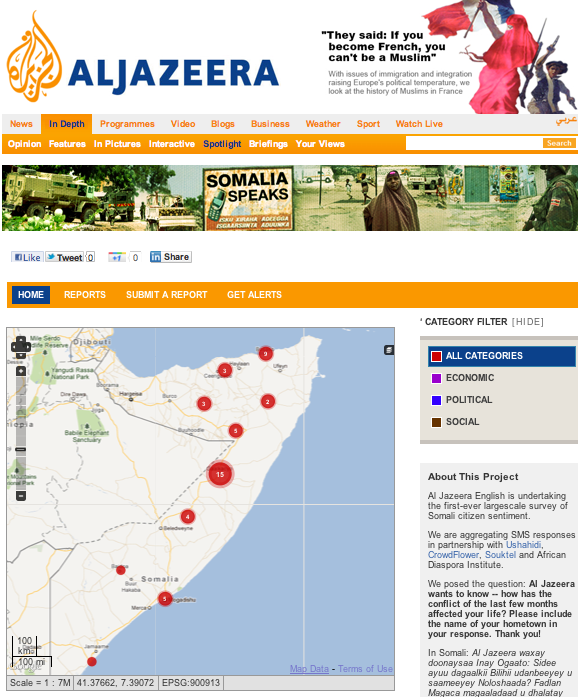

The joint project combines the efforts of multiple partners including Al-Jazeera, Ushahidi, Souktel, Crowdflower, the African Diaspora Institute and the wider Somali Diaspora. The basis of my pitch to Al-jazeera was to let ordinary Somalis speak for themselves by using SMS to crowdsource their opinions on the unfolding crisis.
. . . . . . .
I am often reminded of what my friend Anand Giridharadasof the New York Times wrote last year vis-a-vis Ushahidi. To paraphrase:
They used to say that history is written by the victors. But today, before the victors win, if they win, there is a chance to scream out with a text message, a text message that will not vanish, a text message that will remain immortalized on a map for the world to bear witness. What would we know about what passed between Turks and Armenians, Germans and Jews, Hutus and Tutsis, if every one of them had had the chance, before the darkness, to declare for all time:
“I was here, and this is what happened to me”?
David Swanson: History of Corporate Personhood — How Lewis Powell & US Chamber of Commerce Bought the US Supreme Court
03 Economy, 07 Other Atrocities, 11 Society, Civil Society, Commerce, Commercial Intelligence, Corruption, Government, Money, Banks & Concentrated Wealth, Power Behind-the-Scenes/Special Interests
The real history of today's excessive corporate power starts with a tobacco lawyer appointed to the Supreme Court.
By Jeffrey Clements, Berrett-Koehler Publishers, AlterNet
The following is an excerpt of Jeffrey Clement's Corporations Are Not People: Why They Have More Rights Than You Do and What You Can Do About It.
In 1971, Lewis Powell, a mild-mannered, courtly, and shrewd corporate lawyer in Richmond, Virginia, soon to be appointed to the United States Supreme Court, wrote a memorandum to his client, the United States Chamber of Commerce. He outlined a critique and a plan that changed America.
Complete excerpt below the line — real history killing real people.
John Robb: Technology, Corruption, & Depressions
03 Economy, 09 Justice, Blog Wisdom, Commerce, Corruption, Government, Methods & Process, Technologies
Technology Shifts and Economic Depression
Joseph Stiglitz (the Nobel prize winning economist) has a great new article: “The Book of Jobs“(behind Vanity Fair's paywall, sorry). In it, he makes a convincing case that the first global depression was caused by a process similar to what we are seeing today (I'm very happy somebody in the social sciences is actually attempting to show how technological change was a driver of the first depression, it's about time). Here it is in a nutshell:first depression, it's about time).
- Technological change in the form of the internal combustion engine (cars, tractors, trucks) improved transportation and farm productivity. This led to an agricultural revolution that impacted a huge percentage of the US population.
- Farm productivity soared and prices dropped. This forced many farmers into bankruptcy and led to a steady migration of people from rural to urban locations driving down incomes/demand.
- The downward pressure on incomes this caused resulted in a protraced economic depression that only ended when the US and Europe mobilized/nationalized every segment of the economy during WW2 (put everyone to work, trained them, etc.).
At this point in the article Stiglitz stumbles.
Continue reading “John Robb: Technology, Corruption, & Depressions”
Review: Britain’s Empire – Resistance, Repression and Revolt
5 Star, Asymmetric, Cyber, Hacking, Odd War, Capitalism (Good & Bad), Civil Society, Consciousness & Social IQ, Corruption, Country/Regional, Culture, Research, Empire, Sorrows, Hubris, Blowback, Environment (Problems), History, Insurgency & Revolution, Justice (Failure, Reform), Military & Pentagon Power, Misinformation & Propaganda, Nature, Diet, Memetics, Design, Peace, Poverty, & Middle Class, Politics, Power (Pathologies & Utilization), Religion & Politics of Religion, Secrecy & Politics of Secrecy, Security (Including Immigration), Strategy, Terrorism & Jihad, Threats (Emerging & Perennial), True Cost & Toxicity, Values, Ethics, Sustainable Evolution, Voices Lost (Indigenous, Gender, Poor, Marginalized), War & Face of Battle, Water, Energy, Oil, Scarcity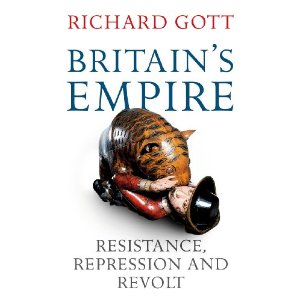
Richard Gott
5.0 out of 5 stars Preliminary Review: Understanding the Trade-Offs & True Cost of Empire,December 8, 2011
I have ordered this book and am very much looking forward to providing readers (and myself, this is how I keep notes) with one of my more detailed reviews. The publisher is to be scolded for not using Inside the Book, one of Amazon's best features, and for failing to provide the best possible use of the Book Description and Editorial Reviews section. While the existing review is good and I have voted for it, it does not do this book justice. My decision to buy was based on the easily found review in The Guardian (UK) by Richard Drayton, “Britain's Empire: Resistance, Repression, and Revolt by Richard Gott — review,” published 7 December 2011.
Where I am going to go with my review is toward an in-depth articulation of what has never been done before that I know of, an examination of the trade-offs of Empire and the opportunity costs of Epoch A hierarchical “rule by secrecy.” I have reviewed many books on Empire, Class War, Elite Rule, all easily found in master list online, Worth a Look: Book Review Lists (Negative). I also recommend the observe, Worth a Look: Book Review Lists (Positive).
Russell Ackoff would say that Empire represents centuries of doing the wrong thing righter–and at greater expense across the political-legal, socio-economic, ideo-cultural, techno-demographic, and natural-geographic domains. As we approach the Mayan calendar's start date for Epoch B, 12 December 2012, many of us are conscious that we must abandon old ways and rethink how we organize society. Occupy is a sympton of this – organized people against organized money, organized consciousness against organized violence.
Continue reading “Review: Britain's Empire – Resistance, Repression and Revolt”
Penguin: The Heart of Darkness is Empire
01 Poverty, 03 Environmental Degradation, 04 Inter-State Conflict, 07 Other Atrocities, 08 Wild Cards, 09 Justice, 10 Security, 10 Transnational Crime, 11 Society, Book Lists, Corruption, Counter-Oppression/Counter-Dictatorship Practices, Cultural Intelligence, Government, IO Impotency, Military, Money, Banks & Concentrated Wealth, Power Behind-the-Scenes/Special Interests, Strategy
Britain's Empire: Resistance, Repression and Revolt by Richard Gott – review
The violence at the heart of colonialism is exposed in Richard Gott's history
Richard Drayton
Guardian, 7 December 2011
Amazon Page for Reviewer's Book Nature's Government
“We insisted on reserving the right to bomb niggers.” So David Lloyd George explained the British government's demand at the 1932 World Disarmament Conference to keep the right to bomb for “police purposes in outlying places”. Airpower had shown its value in spreading what Winston Churchill, when defending in 1919 the use of poison gas against “uncivilised tribes”, had called “a lively terror”. Richard Gott shows how a hundred years earlier more hands-on means were used to similar ends: the heads of rebel slaves in Demerara in 1823 and Jamaica in 1831 were cut from their bodies and placed on poles beside the roads. The mutilation of the corpses of the defeated never quite goes out of fashion.
Empires have always depended on violence. Killing, torture and the destruction of property are essential to those tasks of destroying resistance, extracting information and collaboration, and demonstrating dominance that underly all conquest. But it is the privilege of conquerors to tell stories that flatter their own past. It is, thus, rare to find the historians of any imperial power describing the ugly business of the frontier as more than unfortunate exceptions to an otherwise honourable enterprise. Britain is no exception: from the Victorians until the 1950s, its historians mainly saw in the British empire a great engine for diffusing liberty and civilisation to the world. If such Whig piety declined in the era after Suez, later scholars, studying particular places and times, never connected all the episodes of massacres, rebellions and atrocities. Popular historians continued profitably to sell happy stories of the empire to the British public – always marketed as daring revisionist accounts.
Gott's achievement is to show, as no historian has done before, that violence was a central, constant and ubiquitous part of the making and keeping of the British empire.
. . . . . . .
What Gott loses by this focus on resistance, however, is any subtlety in understanding the meanings of collaboration. He repeatedly imposes the lens of 20th-century nationalism, and even anti-fascism, so that those who did not rebel become traitors or “fifth columnists”. He does not examine with care or sympathy the varieties of loyalism, and the motives and experiences of those who chose, however mistakenly, to throw in their lot with the British. Neither does he explore how the economic and technological bases of British power changed between 1750 and 1850. For the revolution that science and industry brought to production, transport, communication and war made Britain able to attract and to extort indigenous collaboration more easily, and changed how the British understood themselves as a nation and their rights in the wider world. The empire was made by more than violence.
See Also:
Worth a Look: Book Reviews on Class War (Global)
Worth a Look: Book Reviews on Corporate & Transnational Crime
Worth a Look: Book Reviews on Empire as Cancer Including Betrayal & Deceit
