Paul Jacob is president of Citizens in Charge, a non-profit, non-partisan group working to protect and expand voter initiative rights, and the Citizens in Charge Foundation, a charitable foundation conducting research on the initiative process, educating the public and litigating to defend the petition rights of Americans.
Early last week, insider Republican and CNN columnist David Frum lashed out at the GOP’s Tea Party wing, writing: “You can’t save the system by destroying the system.” I responded on This is Common Sense:
If the system has put America on a crash course with disaster, then that system must be replaced. With a better one.
When I wrote that I had not yet fully comprehended the full import of the goofy creation (by the debt deal) of what Rep. Ron Paul calls a Super Congress — the select committee of senators and representatives to be put in charge of budgeting, with the rest of Congress not allowed to amend their proposals, just vote yea or nay.
Paul Jones arrived in a Chevy pickup, dust clouds billowing as he crossed the desert. He had set out soon after first light from his base in southern Afghanistan, an encampment that, thanks to his employer’s logistics savvy, had an ample supply of Pabst Blue Ribbon. Almost everything there had been sent by sea from California or Oregon, and then trucked up from Pakistan.
The 63-year-old, khaki-clad engineer came that February morning to observe a massive development project aimed at transforming the valley along the Helmand River into a modern society.
Irrigation canals would feed farms that would produce so much food that the country would export the surplus for profit. New schools, modern hospitals and recreation centers would rise from the sand. So, too, would factories, fed by electricity from a generator at a dam upriver. Jones had seen a similar transformation near his home on the outskirts of Sacramento, and he was certain it would materialize here, too. In the desert expanse, he saw “the beginning of a new civilization — a new way of life abounding in the riches of worthy endeavor.”
A member of Facebook's data infrastructure engineering team, recently took a sample of about ten million pairs of friends from Facebook's data warehouse and plotted out their relationships. The result? A stunningly beautiful—and accurate—map of the world.
Phi Beta Iota: What really matters in the above is not the light, but the darkness. Facebook–and capitalism–focus on the one billion rich. When we focus on the five billion poor, we will unleash infinite entrepreneurship and rapidly increasing wealth. OpenBTS is “root” for doing this.
The significant problems we have cannot be solved at the same level of thinking with which we created them.
Albert Einstein
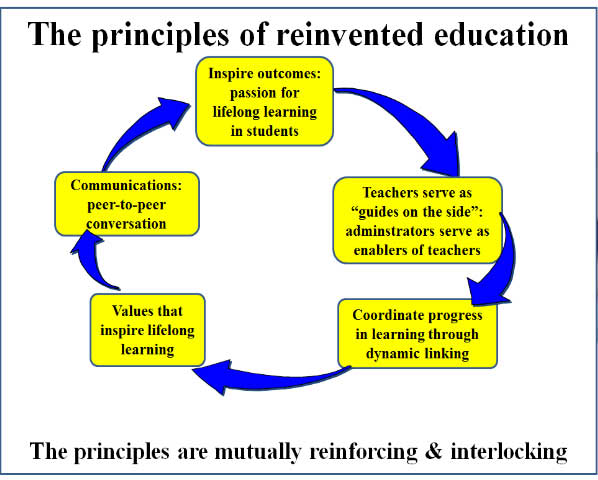
The US education system is in crisis, putting the long-term future of the economy in question. The evidence is well-known. A root cause of the crisis is the application of the factory model of management to education, where everything is arranged for the scalability and efficiency of “the system”, to which the students, the teachers and the parents have to adjust. “The system” grinds forward, at ever increasing cost and declining efficiency, dispiriting students, teachers and parents alike.
“The truly creative mind in any field is no more than this: A human creature born abnormally, inhumanly sensitive.” […] “…by some strange, unknown, inward urgency they are not really alive unless they are creating.” — Pearl Buck, Winner of a Nobel Prize in Literature in 1938.
In a blog post last year entitled “Marijuana and Divergent Thinking”, Jonah Lehrer explains that many creative
tasks require the cultivation of an “expansive associative net, or what psychologists refer to as a “flat associative hierarchy.” What this essentially suggests is that creative people should be able to make far-reaching connections among all sorts of seemingly unrelated ideas, and to not dismiss one possible connection just because it seems far-fetched.
Creativity and insight almost always involve an experience of acute pattern recognition: the eureka moment in whicwe perceive the interconnection between disparate concepts or ideas to reveal something new.
The Imaginary Foundation says that “to understand is to perceive patterns” and this is exactly what all great thinkers have done throughout the ages: they have provided a larger, dot-connecting, aerial view of things that subsumes the previous paradigm. As Richard Metzger has written:
What great minds have done throughout history is provide an aerial view of things. A larger more encompassing view that often subsumes the previous paradigm and then surpasses it in completeness with the vividness of its metaphors. Consider now how the evolving notions of a flat earth, Copernican astronomy and Einsteinian physics have subsequently changed how mankind sees its place in the cosmos, continuously updating the past explanations with something superior.
My good friend Pierre Sprey took issue with my characterization of Steven Walt's critique of US grand strategy as being excellent subject to two omissions. Attached herewith are Pierre's comments — they are spot on, and I stand corrected on my characterization of “excellent” … or perhaps more accurately … I stand clearly and fairly skewered. 😉
Chuck Spinney
Cap Ferrat, France
Comments by Pierre Sprey:
Chuck,
Although I appreciate that Mr. Walt's heart is in the right place–particularly regarding his admirably staunch opposition to the malign influence of the Israelis, the neocons and “W”–his essay's concept of US grand strategy for the last two decades is just as shallow as the crap from the NYT, the WSJ, the Post and the Council on Foreign Relations. He commits the two fundamental errors common to nearly all foreign policy pundits, errors that inevitably reduce their beard-stroking discussions of “grand strategy” to silliness:
1. He assumes that the US has a foreign policy or a grand strategy when in fact it has none. The US government's actions, like every other country's, are dominated by its domestic politics. And those politics dominate every move made with regard to other countries.
2. He ignores the three most powerful–and most permanent–domestic influences on America's actions abroad: Big Oil, Wall Street and the MICC. Anybody who ignores these three in recounting U.S. actions abroad is either a) hopelessly out of touch, or b) is serving the interests of the defense, financial or oil establishments, or all three.
Aside from these two crippling errors in his reasoning, Mr. Walt's fulsome praise for the success of the USG's “offshore balancing”–that is, the Big Oil (and MICC) inspired policy of setting Iran and Iraq at each other's throats since the 1940s–shows either profound ignorance or profound Kissingerian cynicism.
One last piece of silliness in the Walt essay, quite common to journalists and historians seeking a “hook” for their American Empire story, is the idea of the August 2, 1990 “turning point”, a date that marks the beginning of the decline in our allegedly successful empire. Such hooks only mask the inescapable spread of rot within empires, usually starting at birth.
With Mr. Walt's help, I am coming to believe all public discussions of grand strategy should be greeted with howls of derisive laughter.