Intentional Community is an inclusive term for ecovillages, cohousing communities, residential land trusts, communes, student co-ops, urban housing cooperatives, intentional living, alternative communities, cooperative living, and other projects where people strive together with a common vision.
This web site serves the growing communities' movement, providing resources for starting a community, finding a community home, living in community, and creating more community in your life.
Robert Gates has been called the best secretary of defense in recent memory. On the other hand, he has a reputation with some as a slick career bureaucrat with a knack for avoiding blame but pocketing credit. Both are true.
“Best in recent memory?” It would have been hard for Gates to have been a bigger tower of ego, bluster and incompetence than Donald Rumsfeld, more of a non-entity than William Cohen, or a more fervent technology huckster than William Perry. Nonetheless, with a very small number of worthwhile decisions that he had the smarts to make stick, Gates has won himself the swooning accolades of the vast majority of the media, most (but not all) think tank Pooh-Bahs from the left, right and center, and just about every politician in the country.
Why would I be negative about a respected personality who did, indeed, exercise some very long overdue discipline on the recalcitrant military services? They had, for example, busied themselves running around Donald Rumsfeld and his predecessors to keep alive sacred – but outrageously expensive and under-performing – hardware programs like the F-22 (lately priced at over $400 million per copy). They also had tried to stiff much needed reforms to improve wounded veterans care at dysfunctional facilities like Walter Reed Army Medical Center. Gates fired the malefactors and stuffed the porkers in Congress when they tried to resuscitate the F-22. Those actions alone earn him the “best in recent memory” accolade.
The negativity comes – at least to me – when I realize the authority Gates achieved for himself with those actions and a few well-worded policy journal articles and speeches. Then, I compare that power to what he accomplished, or just tried to accomplish. Having won for himself recently unprecedented power as secretary of defense, what did he use his power to do?
Here is my list of important things that Robert Gates didn't fix and didn't even try to fix.
I’ll be writing a lot about the presidential election over the next 16 months, but at the outset I would just like to remark that I’m opining on this whole campaign under protest. I’m registering a protest because for someone of my Hamiltonian/National Greatness perspective, the two parties contesting this election are unusually pathetic. Their programs are unusually unimaginative. Their policies are unusually incommensurate to the problem at hand.
The election is happening during a downturn in the economic cycle, but the core issue is the accumulation of deeper structural problems that this recession has exposed — unsustainable levels of debt, an inability to generate middle-class incomes, a dysfunctional political system, the steady growth of special-interest sinecures and the gradual loss of national vitality.
The number of business start-ups per capita has been falling steadily for the past three decades. Workers’ share of national income has been declining since 1983. Male wages have been stagnant for about 40 years. The American working class — those without a college degree — is being decimated, economically and socially. In 1960, for example, 83 percent of those in the working class were married. Now only 48 percent are.
Intelligence and Security Informatics (ISI) research is an interdisciplinary research field involving academic researchers in information technologies, computer science, public policy, bioinformatics, medical informatics, and social and behavior studies as well as local, state, and federal law enforcement and intelligence experts, and information technology industry consultants and practitioners to support counterterrorism and homeland security missions of anticipation, interdiction, prevention, preparedness and response to terrorist acts. The annual IEEE International ISI Conference series (http://www.isiconference.org) was started in 2003.
Al Fateh University (Arabic: جامعة الفاتح) is the largest and most important institute of higher education in Libya, providing undergraduate, graduate and post-graduate levels of study. It is located in the capital Tripoli. The university was founded as an independent university in 1973 as the University of Tripoli when the University of Libya was divided up. It is home to more than 45,000 students with a faculty of more than 2,500. TUITION IS FREE.
On June 14, NATO bombed this civilian university, damaging the library and disrupting the end term preparations for final exams. Several buildings suffered serious structural damage, and much of the library's stock was ruined. Students and university staff pitched in to do a major cleanup of black dust and smoke damage. If it weren't for a last-minute scheduling change, two of the damaged buildings would have been packed with students, and hundreds, if not thousands, would have been killed. Fortunately, no one was killed.
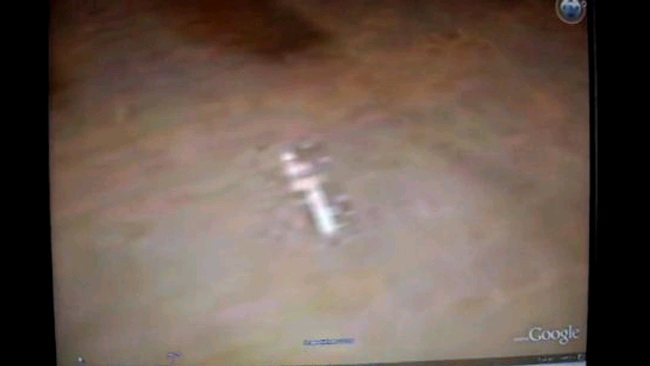
This could be the most important discovery on Mars yet! This structure is 700′ x 150′, and is colored white with blue and red stripes against the red Martian soil. This is not a rock or mountain. It is a manufactured structure. This is not something that I created, this is something that is currently on Google Mars. NASA wont talk to me about it. I've sent them a few emails, and no reply. Go see for yourself. The coordinates are: 71 49'19.73″N 29 33'06.53″W
Please don't steal this. embed, or ask me for permission. Thanks.
Click on Image to Enlarge
Phi Beta Iota: Comments above are the original post at YouTube, not from Phi Beta Iota or Mario Profaca.
Years after American auditors said they had lost track of vast sums of reconstruction cash for Iraq in the wake of the ousting of Saddam Hussein they are now admitting for the first time that much of it was almost certainly stolen.
In a revelation that is stirring anger both on Capitol Hill and among Iraqi officials in Baghdad, the office that was created by the Bush administration to monitor efforts to get Iraq on its feet after the 2003 invasion is saying that $6.6bn (£4bn), all delivered in cash, cannot be accounted for.
Just how much of the missing money was pocketed either by US contractors or Iraqis is not clear, nor is it likely that a full picture of what happened will ever be painted. Even so, Stuart Bowen, who runs the monitoring office, says that the errant billions may represent the “largest theft of funds in national history”.
Phi Beta Iota: This is old news and it was much more. By one account, Paul Bremer was unable to account for over $10 billion in shipped cash (12 airplanes, $2 billion each, rough estimate $24 billion. That is completely apart from the fact that we paid tens of millions to US contractors when local engineers who built the originals were asking for hundreds of thousands.