Cynthia Kurtz is an independent researcher, writer and software designer who consults in the field of organizational and community narrative for decision support, conflict resolution and collective sensemaking. Her free online book at workingwithstories.org helps people use narrative techniques to benefit their own communities and organizations. She is building open source software at rakontu.org to help small groups share and work with their stories to achieve common goals. Her blog is at storycoloredglasses.com. Cynthia's original background is in ethology and evolutionary biology.
There are a set of documents at the DOT&E website which offer DOT&E insights into the reason for why about 40 programs have experienced delays — and costs. These documents relate to a Tony Capaccio story in today's Bloomberg News (below).
The document titled “Updated DOT&E Input on Program Delays” (at the DOT&E link shown above) identifies various specific reasons for the problems programs experience — different from most of the explanations from contractors and other system advocates in and out of the Pentagon. (Eg. for the F-35: Fly rates per month lowered to more realistic projections (from 12 max for all variants and venues to 10 max for CTOL/CV flight sciences, 9 max for STOVL flight sciences, 8 max for all mission systems); increased planning factors for re-fly and regression (up 15% for flight science, 10% for mission systems); more time required for software development and incremental builds.”)
Beyond the F-35, the various systems described in the analysis are typically more obscure programs (eg. AIM-9X 8.212 Software Upgrade) but there are also a few better known ones, such as LCS, which is described in “fly before buy,” Congress and the Navy want to rush ahead of testing to buy 4 LCS in the 2012 HASC DOD Authorization bill for $1.8 billion in production costs.
Availability of complete mission packages will be delayed until at least 2015.
Instead of withholding production of untested systems with clear and obvious development problems, Congress and the Pentagon are intent on business as usual. The LCS is a good example: instead of “fly before buy,” Congress and the Navy want to rush ahead of testing to buy 4 LCS in the 2012 HASC DOD Authorization bill for $1.8 billion in production costs.
Some will think the DOT&E analysis and documents to be obscure and too “in the weeds” to pay much attention to. Instead, they offer a major part of the explanation for why hardware costs and delays are so out of control, and they offer a stunning view into how little is being done about that.
Dan Gillmor observes that the two top New York Times headlines this morning “sum up the Obama administration”:
EXTRACT: As Yale Professor Jack Balkin recently put it to Jane Mayer about the Obama presidency: “We are witnessing the bipartisan normalization and legitimization of a national-surveillance state.” This state, as much as anything, is devoted to gathering as much intrusive data as possible about as many citizens as possible without a shred of oversight or suspicion of wrongdoing: exactly that which has proven to create inevitable abuse and exactly that which the Fourth Amendment sought to bar.
The tension between protecting true national security secrets and ensuring the public’s “right to know” about abuses of authority is not new. Indeed, the nation’s founders faced this very issue.
. . . . . . .
Later that month, without any recorded dissent, Congress enacted America’s first whistle-blower-protection law: “That it is the duty of all persons in the service of the United States, as well as all other inhabitants thereof, to give the earliest information to Congress or any other proper authority of any misconduct, frauds or misdemeanors committed by any officers or persons in the service of these states, which may come to their knowledge.”
. . . . . . .
Nearly two centuries later, the Supreme Court justice William O. Douglas, praising the founders’ commitment to freedom of speech, wrote: “The dominant purpose of the First Amendment was to prohibit the widespread practice of government suppression of embarrassing information.”
Phi Beta Iota: This is not about Barack Obama–he sold out, get over it. This is about a two-party tyranny that hides its prostitution to Wall Street behind secrecy–chasing down whistle-blowers benefits both these parties all those they have shaken down for kick-backs. This is about a system that is inherently corrupt, in which 63 of 65 parties–and all Independents–are shut out, disenfranchised, and cheated.
Is there a new anti-intellectualism? I mean one that is advocated by Internet geeks and some of the digerati. I think so: more and more mavens of the Internet are coming out firmly against academic knowledge in all its forms. This might sound outrageous to say, but it is sadly true.
Robert David STEELE Vivas: Digerati are not geeks. They are adept at social media, a process, rather than the substance of any discipline. Their scorn for the mandarins of knowledge would not be possible if academia had not lost its soul, sanctioned massive intellectual corruption, and fragmented itself to the point of irrelevance. The serious educational literature (not something the digerati read) is clear: inspiration and innovation
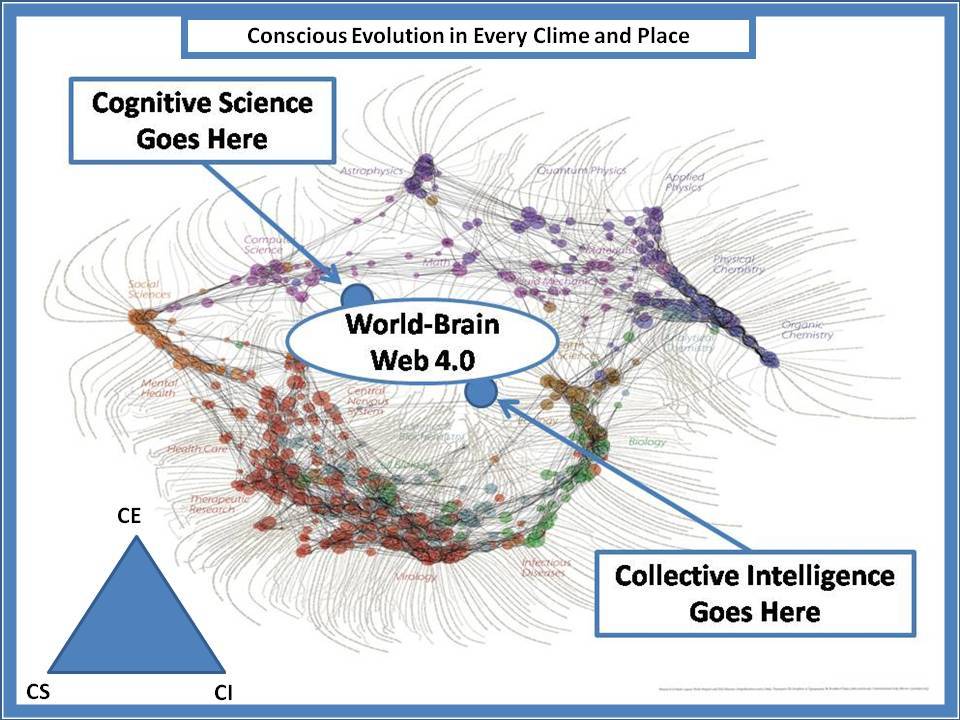
Click on Image to Enlarge
emerge faster, better, and cheaper from minds that are prepared, to include a foundation of memorization and a deep familiarity with the thinking of those who have come before. The digerati point of view half-right and is embodied in Smart Mobs, Wisdom of the Crowd, Everything is Miscellaneous, and Maria Popova's latest thought, that “information curation is the new authorship.” The digerati approach splits the roles of originator of an idea and connector of an idea down, and assumes that “the collective” can replicate and even surpass the individual human brain, without recognizing that the whole is only as good as the sum of the part foundation plus whatever the collective adds. My own finding re Wikipedia is that the mob destroys intellectuals. My own efforts to enhance the Open Source Intelligence page there were destroyed by idiots that “assumed” that because I pointed to oss.net so much (to many of the 800 people whose work is there including the 144 that received Golden Candle Awards) I was “self-promoting.” The digerati are fragile and very shallow, and by Larry Sanger's very interesting account, a new form of neo-Luddite. The academy is corrupt and fragmented–we are in an era where all forms of organization have lost their soul and whatever semblance of philosophical context they may once have possessed. We are suffering from the Paradigms of Failure that I discussed in the pre-amble to ELECTION 2008: Lipstick on the Pig (EIN, 2008). There is only one option leading to stabilization & reconstruction: INTEGRITY. The digerati aren't–as a general rule–very appreciative of holistic thinking or in-depth expertise–they are a spoiled generation badly in need of some personal suffering and exposure to global reality–IMHO.
An organization uses structure and resources and power to make things happen. Organizations hire people, issue policies, buy things, erect buildings, earn market share and get things done. Your company is probably an organization.
A movement has an emotional heart. A movement might use an organization, but it can replace systems and people if they disappear. Movements are more likely to cause widespread change, and they require leaders, not managers. The internet, it turns out, is a movement, and every time someone tries to own it, they fail.
A philosophy can survive things that might wipe out a movement and that would decimate an organization. A philosophy can skip a generation or two. It is often interpreted, and is more likely to break into autonomous groups, to morph and split and then reunite. Industrialism was a philosophy.
The trouble kicks in when you think you have one and you actually have the other.