I live twenty miles south, down the coast from Point Mugu Air Station—where fleets of giant C-5 cargo planes transport our west coast boys from Camp Pendleton and other bases to the Middle East for war. Ronald Regan used to fly into Mugu on Air Force One from the White House when he vacationed up in these Ventura hills and mountains. From time to time, when I drive up to Oxnard to get my generator or other off grid mechanisms serviced or repaired, I see the volunteer boy-soldiers of the underclass standing in line, slowly disappearing like a string of spaghetti being slurped up by the dark gray aircraft monsters.
For years, Alison and I have been hearing glowing reports of Tunisia from fellow sailors. We finally sailed there and spent five weeks in Tunisia last summer (August and early September). To our surprise, the local people struck us as the least welcoming of those in the Arab countries we have visited over the last five years (which included Morocco, Syria, Jordan, and Lebanon).
In general, the living conditions in the towns seemed poorer and in some cases more squalid than in the other countries we visited. Syria, for example, is much poorer than Tunisia, with half the per capita GDP, but I did not sense the widespread squalidness in 2008 that we saw in Tunisia in 2010. But, we were only in Syria for a few days and saw only the western part north of Damascus. Tunisian people seemed more religious and mosques seemed more crowded than in the other Arab countries we visited, but I saw nothing suggesting radicalization. In retrospect, it did seem that there were more police in evidence in Tunisia than in the other Arab countries and that people were more fearful of the police, although I did not draw that conclusion at the time. Bottom line: I saw nothing that suggested Tunisia was on the cusp of a political meltdown — I simply did not like the place as much as the other Arab countries I visited — which was quite surprising, given our expectations.
But, as the attached report by Professor Juan Cole shows in Attachment #1 below, there there was a lot of discontent bubbling beneath the surface. Moreover, as opposed to this dumb tourist, our diplomats on the scene appreciated the drivers of the discontent. But, once again, the US government in Washington chose to ignore the warning signs and support a corrupt status quo. And once again our government was blindsided by an inordinate fear of radical Islamism, and in so doing, may have helped to create conditions favoring its spread.
Robert Fisk, in Attachment #2 below, The Brutal Truth About Tunisia, places the American and European propensity to ignore warning signs, and then being blindsided by developments, into a regional perspective. He is, therefore, not sanguine about the future.
The Norwegian newspaper Aftenposten released a series of US diplomatic cables from 2006 on massive and pervasive corruption and nepotism in Tunisia and its effect on economic development and social problems. The cables show that the United States government was fully aware of the dangerous and debilitating level of corruption in Tunisia, and its anti-democratic implications.
Bloodshed, tears, but no democracy. Bloody turmoil won’t necessarily presage the dawn of democracy
By Robert Fisk, Middle East Correspondent
Independent, 17 Jan 2011
The end of the age of dictators in the Arab world? Certainly they are shaking in their boots across the Middle East, the well-heeled sheiks and emirs, and the kings, including one very old one in Saudi Arabia and a young one in Jordan, and presidents – another very old one in Egypt and a young one in Syria – because Tunisia wasn't meant to happen. Food price riots in Algeria, too, and demonstrations against price increases in Amman. Not to mention scores more dead in Tunisia, whose own despot sought refuge in Riyadh – exactly the same city to which a man called Idi Amin once fled.
Phi Beta Iota: For some time now, since reading Ambassador Mark Palmer's superb inventory of all the dictators on the planet, we have been concerned about the degree to which the US Government, “in our name,” actively collaborates with and even funds dictators, not just in the Middle East but everywhere. In fact, only two are criticized: North Korea and Cuba. It can fairly be said that US diplomacy and national security are neither strategic nor moral, at the same time that both are arguably not in the best interest of We the People.
Douglas Holtz-Eakin is the former Director of the Congressional Budget Office (CBO), in the 2003-2005 timeframe, coincident with the term of David Walker, Comptroller General at the General Accountability Office.
Just now Douglas Holtz-Eakin made two statements on the record on television:
1) CBO is required by law to accept all assumptions directed by Congress. This includes blatantly false and totally unjustified assumptions about future circumstances.
2) The Obama Health Care bill is “the greatest money grab in history,” seeking to loot the young and leave them with a future debt they cannot handle.
This is the kind of truth the public has a right to expect from the President and his staff. Evidently not.
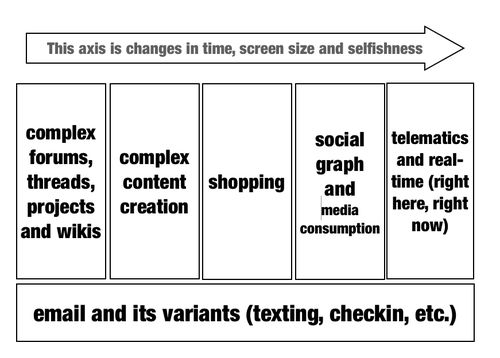
It might be about the size of the screen and whether or not you're standing up.
Start at the bottom. For the first five years of the Internet, the most used function was email. Email remains a bedrock of every device and system that's been built on top of the internet, though sometimes it looks like a text message or a mobile check in. This is the layer for asynchronous person to person connection, over time.
Moving from left to right, we see how the way we use the thing we call the internet has evolved over time. We also see how devices and technology and bandwidth have changed the uses of the net and, interestingly, how a growth in mass has led to a growth in self-motivated behavior.
Early online projects were things like Archie and Veronica and checking in changes to the Linux code base. You needed patience, a big screen and a sense of contribution.
Layer on top of this a practice that is getting ever more professional, which is creating content for others to consume. Sometimes in groups, sometimes using sophisticated software and talented cohorts.
Click on Image to Enlarge
As we move to the right (and through time) we see the birth of online shopping. Still to this day, most online shopping happens on traditional devices, often sitting down.
The sitting down part is not a silly aside. Ted Leonsis theorized twenty years ago that the giant difference between TV and the internet was how far you sat from the screen. TV was an 8 foot activity, and you were a consumer. The internet was a 16 inch activity, and you participated. I think the sitting down thing is similar. You're not going to buy an armoir while standing on the subway.
Moving over in time and device and intent, we see the idea of consuming content. While tablets get their share of shopping, this is where they really shine. I think 2011 is going to be the year of the tablet, from the Kindle to the iPad to the thing we used to call a phone.
It's in the last two categories that these other devices, things that don't involve sitting down, are superior, not just a mobile substitute. The social graph is a very low bandwidth, peripheral attention interaction, perfect for this audience and this medium. And the last category–tell me where I am, where to eat, who's near me, what's the weather, get me a cab right now–is all about me and now and here.
I don't believe this is a winner take all situation, any more than one bestselling book makes all other books obsolete. I think different pillars work for different devices, and there will continue to be winners in all of them.
Barack Obama is pushing a NAFTA-Style Korea Free Trade agreement that would undermine America's sovereignty, laws and economy. This deal would:
Allow foreign corporations to drag the U.S. before U.N. and World Bank tribunals to enforce special trade privileges and to demand compensations from the U.S. Treasury.
Undermine states rights with hundreds of state laws and regulations subject to review and alteration.
… in the Hall of Mirrors that is Versailles on the Potomac
ps … good report, notwithstanding the fact that Politico is one of those slimy publications that thrives on the bottom-feeding cocktail circuit of Washington, which is funded by … who?
Candidate Barack Obama repeatedly pledged on the campaign trail that working in his administration would not be “about serving your former employer, your future employer or your bank account.”
But with his administration at its midpoint, a traditional time for personnel turnover, it’s clear that despite Obama’s avowals, a longtime truism of Washington life — that a prestigious-sounding administration post can be a lucrative career enhancer — remains unchanged.