Journal: Newspaper Extinction Timeline

04 Education, 11 Society, Augmented Reality, Collective Intelligence, info-graphics/data-visualization, InfoOps (IO), Methods & Process, Tools
0Shares
DefDog Recommends...

« Keynote on the Future of Global Media in New York | Main | The role of BRIC in the future of global media »

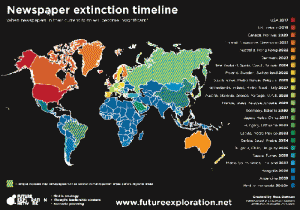
Launch of Newspaper Extinction Timeline for every country in the world.
Ross Dawson, October 31, 2010 10:47 PM US PT

Back in August I predicted that newspapers in their current form will be irrelevant in Australia in 2022. That received significant international attention including from The Australian, The Guardian, Editor & Publisher (which called me the ‘Wizard of Aussie') and many others.

Part of the point I wanted to make was that this date is different for every country. As such I have created a Newspaper Extinction Timeline that maps out the wide diversity in how quickly we can expect newspapers to remain significant around the world. First out is USA in 2017, followed by UK and Iceland in 2019 and Canada and Norway in 2020. In many countries newspapers will survive the year 2040.

The Australian has again covered this in a story title Deadline for newspapers as digital publications rise. There may be some more coverage in coming days.
Two Graphics and More

Phi Beta Iota: Certainly worth reflecting on, this misses two big realities.  First, newspapers could still convert themselves into honest citizen intelligence networks and focus on sense-making.  Second, five billion poor people are not yet digital and while the dumb cell phone has a bright future, the smart phones and pads do not, in part because of raw earth shortfalls, in part because of embedded toxicity of materials, and in part because even with call centers, there is a very big space that “smart analog” newspapers could fill.  The latter is particularly true if one factors in the fact that five billion poor people need alternatives to rote education including primers that can be passed around and do not need power sources.


Community Collaboration Soot-Busting Dirty Diesel for “Freight Transport Justice”

03 Environmental Degradation, 05 Energy, 07 Health, Strategy
0Shares
link to 111 pg report

Pacific Institute's Community Strategies for Sustainability and Justice (CSSJ) Program has produced Gearing Up for Action: A Curriculum Guide for Freight Transport Justice (pdf), an important advocacy tool to build the power and capacity of  communities to participate in decision making around freight transport  issues. The guide contains popular-education-style activities that CSSJ developed and piloted in partnership with community groups and  coalitions including the West Oakland Environmental Indicators Project  and the “Ditching Dirty Diesel” Collaborative.This  user-friendly curriculum guide is designed to help communities  grappling with freight transport issues share their experiences, explore  the root causes of freight transport impacts, identify those  responsible for dealing with these causes, and develop a plan for  advocacy to advance their solutions.

Reference: Al-Qaeda Statements Index

09 Terrorism, Analysis, Methods & Process, White Papers
0Shares
Berto Jongman Recommends...

This paper is written in correlation with a project that aims to provide a distinctly new perspective to current trends in terrorism research by allowing for a new and more nuanced study of statements made by al-Qaeda. This project, the Al-Qaeda Statements Index (AQSI) database project at Haverford College in Pennsylvania, is one example of how new innovations can continue to provide new insight.

2010 Thesis Online

Unlike previous projects, the Al-Qaeda Statements Index project, when complete, will aid researches in developing a more thorough understanding of al- Qaeda's rhetoric by creating a searchable network to show complex connections among the web of various statements, keywords and ideas professed by al-Qaeda, spanning a period from the 1990s up to the present day. The AQSI will serve as both an advanced annotated bibliography for scholars seeking a starting point to study specific statements more in depth, while at the same time allowing for a quantitative analysis of the intricate connections and relationships among statements which would otherwise not be readily quantifiable or apparent.

Phi Beta Iota: A senior thesis within one of the more intelligent schools in America.  Something to be proud of, and good indicator that the emerging generation can think.

Reference: Internet Governance

Monographs
0Shares
Berto Jongman Recommends...

In this Council Special Report, Robert K. Knake briefly examines the technological decisions that have enabled both the Internet's spectacular success and its troubling vulnerability to attack. Arguing that the United States can no longer cede the initiative on cyber issues to countries that do not share its interests, he outlines an agenda that the United States can pursue in concert with its allies on the international stage. This agenda, addressing cyber warfare, cyber crime, and state-sponsored espionage, should, he writes, be pursued through both technological and legal means. He urges first that the United States empower experts to confront the fundamental security issues at the heart of the Internet's design. Then he sketches the legal tools necessary to address both cyber crime and state-sponsored activities, including national prohibitions of cyber crime, multilateral mechanisms to prevent and prosecute cyberattacks, and peacetime norms protecting critical civilian systems, before describing the bureaucratic reforms the United States should make to implement effectively these changes.

Report Online

Phi Beta Iota: This is an Epoch A report that is state-centric, does not demonstrate knowledge of the code-level and open-source challenges and opportunities, and lacks any sense of how a strategic analytic model with burden sharing among the varied stakeholders (e.g. eight clouds, twelve modalities) could resolve the problem at a fraction of the cost of the “traditionalist” “solutions” proposed here.  This report is about doing the wrong things righter, not about doing the right things in the first place.

Journal: Digital Outsourcing By the Task

Augmented Reality, Budgets & Funding, Communities of Practice, Earth Intelligence, InfoOps (IO), Methods & Process, Mobile, Policies
0Shares
DefDog Recommends...

How crowdsourcing will change the way the world works.

As the amount of digital work increases and the amount of physical work
decreases, our notions of employment and work change profoundly. Digital work doesn't require roads and factories; it requires a laptop and an Internet connection–equipment that people have access to in their homes.  The need for offices, supervisors and rigid employment arrangements
diminishes.

As technology improves, companies should theoretically be able to access in real-time the perfect person for a given job–the one who will do the job the best, enjoy it the most or do it the fastest. All these factors combine in a way that will change the landscape of work. Here's what I think that will look like:

–Within a decade résumés will become less important as we continue to adopt newer, multifaceted ways to measure the quality of a candidate's work. Current hiring processes often involve online research about candidates on sites like LinkedIn and Facebook. Articles, portfolios, presentations and papers by potential job candidates are increasingly
found online. Companies like oDesk and Elance rate workers based on past work rather than on what college they attended.

Full Story Online

Phi Beta Iota:  This is of course precisely what OSS.Net, Inc. has been doing since 1993, in sharp contrast to the beltway bandit “butts in seats” high overhead approach.  HOWEVER, the world will be divided into three workforces:

A.  Digital work done from anywhere by high end digital workers.

B.  Analog work done from anywhere by low end physical workers with a simple cell phone–e.g. eyes on observations.

C.  Analog work done at a fixed place because the tools or the raw materials or other factors demand a fixed location.

The five billion at the bottom of the pyramid are at C and need to be moved toward B in order to create infinite wealth.  That is the insight that governments and corporations refuse to grasp, despite the fact that the annual income of the five trillion is FOUR TIMES the annual income of the one billion rich.

Reference: Cultures of Resistance–A Look at Global Militarization

04 Inter-State Conflict, 07 Other Atrocities, 10 Security, 11 Society, Money, Banks & Concentrated Wealth, Movies, Power Behind-the-Scenes/Special Interests, Secrecy & Politics of Secrecy
0Shares
Fri, Oct 22, 2010 4:32pm EST

In 2009, the United States government spent some $650 billion on its military. This is more than the next 46 highest-spending countries combined. Much of this treasure ended up in the hands of profit-driven weapons manufacturers. In the following short film, Cultures of Resistance takes a brief look at the current state of what President Eisenhower famously called the “military industrial complex.” With the U.S. waging two wars overseas at the same time that millions of people are out of work at home, those pushing to reel in government spending and balance the budget would be wise to look carefully at bloated and unchecked military spending.

Watch 4 Minute Video

See Also:

Graphic: Medard Gabel’s Cost of Peace versus War

Worth a Look: Book Reviews on Corruption

Worth a Look: Book Reviews on Dereliction of Duty (Defense)

Worth a Look: Book Reviews on Empire as Cancer Including Betrayal & Deceit

Worth a Look: Book Reviews on Institutionalized Ineptitude

Worth a Look: Book Reviews on Intelligence (Lack Of)