Source Home PageTowards a Curriculum for the Teaching of Jihadist Ideology aims to provide an introduction to the intellectual infrastructure of the jihadist phenomenon and the process of radicalization, and to furnish materials for a textbook primer to what is still largely an ideological terra incognita for the western reader. It is designed for the use of academics, security professionals, policy-makers and the general reader alike.
– – – – – – –
[T]he work’s conclusions emphasize the need to avoid making assumptions based on old analytical habits, to study the wealth of open source information available on the ideology – which should be taken seriously and at face value – and to understand that the ‘Jihad’ is primarily a re-education endeavour and therefore very much a war of ideas. It calls for the improvement of both the quality and spectrum of research and analysis, preferably through a multi-disciplinary approach that can accommodate the return of the religious dimension to international affairs.
Phi Beta Iota: In our view, cyber-security must be a pervasive endeavor that begins with solid code and goes from there. That is not how the US is approaching the problem, hence the US will fail, at great expense, to achieve the outcome we all require. The latter article also highlights Gandhi's observation that idle minds will make mischief. Full employment for all is a huge part of making security for all achievable.
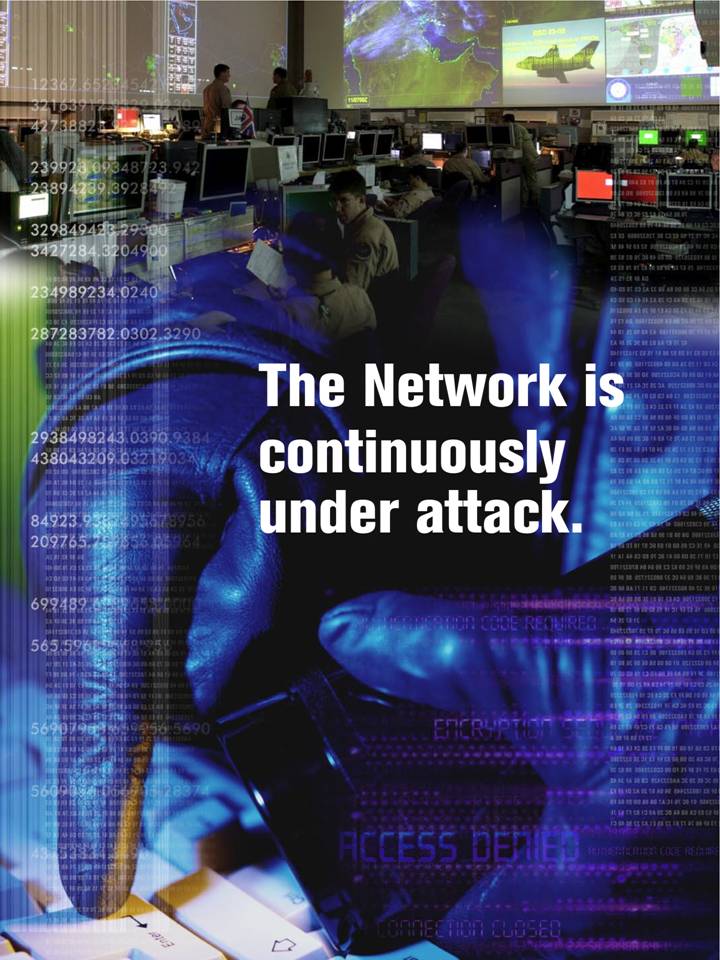
Listen to the generals speak, and you’d think the Pentagon’s networks were about to be overrun with worms and Trojans. But a draft federal report indicates that the number of “incidents of malicious cyber activity” in the Defense Department has actually decreased in 2010. It’s the first such decline since the turn of the millennium.
Click on Image to Enlarge
In the first six months of 2010, there were about 30,000 such incidents, according to statistics compiled by the U.S.-China Economic and Security Review Commission. Last year, there were more than 71,000. “If the rate of malicious activity from the first half of this year continues through the end of the year,” the commission notes in a draft report on China and the internet, “2010 could be the first year in a decade in which the quantity of logged events declines.”
The figures are in stark contrast to the sky-is-falling talk coming out of the Beltway.
“Over the past ten years, the frequency and sophistication of intrusions into U.S.military networks have increased exponentially,” Deputy Defense Secretary William Lynn wrote in a recent issue of Foreign Affairs.
Mikhail Gorbachev, who has been neutralized by the succession of Russian rulers, especially Putin) has just advised President Obama to get out of Afghanistan. Jonathan Steele suggests here (also attached below) that Obama ought to heed that advice, because Obama is in a similar albeit somewhat worse position than Gorbachev was in 1985-6.
Analogies are dangerous, because they can capture your thinking and take you off the cliff. But here goes.
If Steele's analogy is accurate, it suggests some pregnant ramifications that are not addressed directly by Steele: Russia (Putin and Medvedev) appear to be helping US/Nato in Afghanistan with training programs and by providing access routes for northern logistics lines of communication. This cooperation serve both parties by improving relations in the short term, but it also helps US/Nato stay on its disastrous course in Afghanistan. Are there other reasons why would Putin, an ardent nationalist, would what the US to remain stuck in Russia's backyard?
Russia needs help in staunching spillover of Sunni radicalism into its Moslem areas and its Central Asian sphere of influence (a variation of the original reason USSR invaded Afghanistan in 1979). The US war on the Taliban serves that interest. So from Putin's point of view, keeping US/Nato bogged down in Afghanistan serves Russian national interests for free.
Putin, a former member of the KGB and an ardent nationalist, certainly knows the US fomented Sunni extremism in Afghanistan to sucker the Soviets into invading Afghanistan with the aimed of bogging the USSR down in its own VietNam-like quagmire (a policy proudly acknowledged by President Carter's National Security Advisor,Zbigniew Brzezinski in his notorious interview in Le Nouvel Observateur, January 1998). Putin must also know that the US/Nato engagement in Afghanistan, is (1) a huge resource drain that is weakening US economically and militarily, as well as (2) weakening the bonds giving the US political control over its Nato allies. From his point of view, these two outcomes would certainly improve Russia's relative power with respect to Europeans (especially Germany) and in the world, at the expense of the US. Moreover, in Putin's eyes, these outcomes might seem to be justified as payback to the US. After all, did not the US unleash the Islamic radicalism with its efforts to maneuver the USSR into Afghanistan in 1979 and did not the US humiliate Russia by the exploiting Russia's economic misery and military weaknesses, after Gorbachev had done the the US and the West a huge favor by precipitating collapse of the Soviet Union and ending the Cold War without bloodshed?
So, who should Obama and his advisors listen to? Putin the nationalist and go for a short term political gain at expense of remaining stuck in the quagmire that serves Russia's interests, or Gobachev the statesman who advises Obama to bite the bullet and absorb short-term political pain to gain long term benefits of exiting a quagmire that is weakening the US economically and militarily?
Of course the war advocate could counter by saying this is based on an analogy run amok. We are not making the gross mistakes the Soviets made in Afghanistan, and besides, it is cutting and running that weakens us. After all, Gobachev is just an old man who refuses to see that his time has past and is struggling futilely to remain relevant.
Designed to press the “reset” button after east-west tempers flared over the war in Georgia, the meeting ended with several agreements, the most dramatic of which was Russia's nod for the US to send military supplies across Russian territory to its forces in Afghanistan. Dmitry Medvedev and Vladimir Putin wanted to give Obama a reward for taking a calmer view of Russia than George Bush, in particular for accepting Georgia's share of blame in the South Ossetian crisis and for cancelling the most provocative aspects of Bush's missile defence scheme which Moscow viewed as a threat.
Those Planning to Attend Fed Up By American Politics, Want to Laugh
By MAYA SRIKRISHNAN and JENNIFER SCHLESINGER
ABC News Oct. 28, 2010
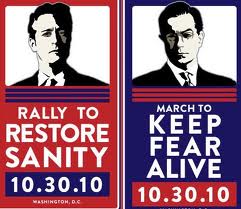
From across the country – and Canada – thousands of supporters are expected in Washington to attend Jon Stewart and Stephen Colbert's “Rally to Restore Sanity” and “March to Keep Fear Alive” this Saturday.
More than 220,000 people have RVSP'd that they are attending on the event's official Facebook page. The National Park Service application, however, only estimated 25,000 people would attend the event, which is scheduled to last from noon to 3 p.m.
The rally is billed as a chance for people to voice their frustrations with American politics and the media, and, of course, be entertained.
– – – – – – –
“I don't think people are going to the rally because they are liberal or conservative,” Wilford said. “It's not about political ideology, but about the way politics are being sold.”
– – – – – – –
“Coming from an outsider, it sounds like Americans are constantly being told to be afraid, but they aren't being told what to be afraid of. Despite the fact that Jon Stewart is a TV host and the rally is based on a platform on comedy, I feel that Jon Stewart has more to say about politics than any pundit.”
– – – – – –
“I personally have been frustrated with what I view as a lot of hypocrisy in politics,” Miko Wilford, a 24-year-old psychology graduate student from Iowa State University said. “I feel ‘The Daily Show' and the ‘Colbert Report‘ do a good job of pointing out the hypocrisies.”
– – – – – – –
“I think it's time we restored truth and civility in this country. Our politicians need to acknowledge that this generation is beyond right-left categories.”
– – – – – – –
“The rally appeals to me because I agree with the underlying premise, that the tiny percentage of people screaming at each other on television should not be the only voices we're paying attention to,” said Alexis Sigger, a 32-year-old television producer who is coming from Brooklyn for the rally.
Phi Beta Iota: We cannot say enough good things about these folks. This is righteous good stuff–eight times cheaper than industrial offerings, virtually no “true cost” externalities, interchangeable parts, human scale, the whole enchilada.






 Thousands to Voice Frustrations at Stewart and Colbert Rally