This book loses one star for failing to be open about the special prison built for Nesenko at “The Farm,” and the extraordinarily abusive treatment he received at the hands of the Soviet Division in the CIA's Directorate of Operations (DO). Old timers are still shaking their heads in dismay.
Recognizing that this book is a profound and detailed telling of the story from the side of those who destroyed Nosenko, I give it a four over all for detail from a particular perspective, a 3 for the general reader.
There is nothing in this book that would lead anyone to believe that the DO was anything less than quite good, and while I was tempted to drop it to a 3 for that reason, I left it at 4 for what I call special purpose reading. Deeper details than most desire, and details that cannot be evaluated alone, but must be considered in the light of many other accounts and context–don't bother if you only want to read one book.
In passing, the author confirms CIA's persistent inability to field officers with language skills, even against the “main enemy,” the Russians. The author also touches on the groupthink mentality of the cult of intelligence.
Most reviewers are missing what insiders would recognize as a very credible scenario for the various assassinations that have taken place in America. I found this movie compelling and I certainly do not subtract anything for any of what others found to be “bombs, babes, and booze.” News flash: that's what it's like.
The movie kept me guessing until the end, and I like it so much I am adding it to my list of “Great Spy DVDs” and palcing it second after only Breach. This movie has a real message that most miss: privatizing our spies and our military is absolutely the fastest way to out-source and lose our national honor.
Four books I especially recommend, for those who want to reflect on just how ugly it can get when money or ideology rather than honor talks:
Former Spy and Top Amazon Non-Fiction Reviewer Loves This Movie
July 26, 2007
Wesley Snipes
This is a *grerat* movie and a feel-good film to boot. Ignore the negative reviewers, they don't have a life.
Bottom line is that this movie combines an excellent depictiion of the amorality of US covert operations, with a lovely juxtaposition of Wesley Snipes at his best, and two English lovlies, one a Scotland Yard inspector whose father is murdered by the Americans “on official business” and the other a lost young lass who is a good liar, loves horses, and saves the day.
Wesley Snipes is in my top ten action heros, and I am adding this DVD to my list of Great Spy DVDs.
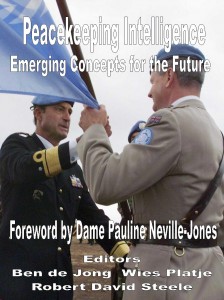
Senator General Franklin E. van Kappen was a transitional and tranformational figure as Military Advisor to the Secretary General of the United Nations, setting the stage for General Patrick Cammaert and the campaign to implement the Brahimi Report recommendations and establish intelligence (decision-support) as an acccepted term of art in UN circles.
Senator van Kappen was born in 1941 in Semarang, the former Dutch East Indies (Indonesia). He is married and has two sons.
In 1964 he graduated from the Naval Academy in Den Helder and was commissioned as a 2nd Lieutenant in the Royal Netherlands Marine Corps.
In the course of his career he completed Special Forces (Commando) training with the Green Berets in the Netherlands and the United Kingdom and was trained as a Mountain and Arctic Warfare Survival Instructor in Norway. He was also trained as a Naval communications and warfare officer and is a graduate of the U.S. Naval War College in Newport, R.I.(USA). During his career he served in numerous operational and staff billets in the Netherlands and abroad.
His two last postings are listed below.
In July 1992 he was promoted to Brigadier-General and assumed command of the Netherlands Forces in the Caribbean and of a joint US/Netherlands Task Group working Counter Drug operation in the Caribbean. He is also one of the founders of the Coast Guard for the Netherlands Antilles and Aruba.
In 1995 he was promoted to Major-General and served simultaneously as the top Military Adviser to the Secretary General of the U.N. and as the Director of the Military Division in the Department of Peacekeeping Operations at U.N. headquarters in New York. He provided daily input into the management of all active UN peacekeeping operations. He also directed the planning process to field new operations as mandated by the Security Council.
In August 1998, Major-General van Kappen returned to the Netherlands and retired from the Marine Corps. From 2004 until 2008 he worked as a Senior Mentor for NATO and the Multinational Planning Augmentation Team (MPAT) programme sponsored by US Pacific Command to enhance regional cooperation and multinational force readiness for Crisis Response in the Asia Pacific Region.
From 2007 until to date he works as Senior Concept Developer for NATO/ACT. He is a Senior Policy Advisor for the Netherlands Organisation for Applied Scientific (Defence) Research (TNO) and the The Hague Centre for Strategic Studies (HCSS). He is the chairman of the supervisory board of the Institute for Security, Experimentation and Transformation Institute (ISETI). In 2007 he was elected to take a seat in the Senate of the Kingdom of the Netherlands. He lectures internationally as an expert on security issues.
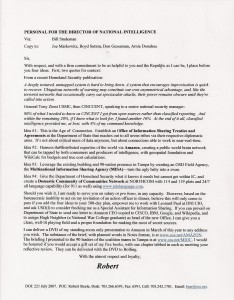
The US Intelligence Community does not lack for well-intentioned leaders, but somehow, despite the efforts of Jim Schlesinger in the 1970's and many others through the 1980's and 1990's and into the new century, transformation eludes us. We speculate that secrecy has a great deal to do with it–and one leader commented, the only person who could brief him on a program he wanted to terminate was the person who stood to lose their fiefdom if he did. Below is the single page summing up 20 years of endeavor, as delivered to the DNI. It remains valid today (6 August 2009).
The two short-cut links no longer work. They are provided below in full title mode.
Should Be a Four, But Overly Harsh Review Calls for Balance
July 22, 2007
Tim Weiner
While I would normally take away one star for a failure to provide useful policy context (the Presidents and their staffs were as much to blame for all these fiascos, and in his eagerness to do primary research, he appears to have completely missed some very important facts as stated in the varied memoires), on balance this is a tour d'force. See my lists for a diversity of other recommended reading.
In two specific instances, the lack of context casts the CIA more negatively than it merits. The Indian nuclear test was missed in large part because the Pentagon was controlling the satellites and focusing them almost full time on Iraq. In Afghanistan, CIA not only performed heroically in establishing the geospatial foundation for precision air strikes, but it also had eyes on Bin Laden for four days, with Rumsfeld in one instance allowing the Pakistanis to evacuate 3000 Taliban and Al Qaeda, and General Franks in another refusing to put Rangers around Bin Laden, claiming it would take weeks. With such idiocy (or deliberate support for Al Qaeda) at the policy level, CIA can hardly be blamed for everything.
On Dick Cheney, who escapes notice in this book, but whose disdain for the CIA is now somewhat more understandable to me, see my review and explicit list of 23 impeachable offenses that the book documents, offenses that should have seen Cheney removed from office two years ago. I refer to Vice: Dick Cheney and the Hijacking of the American Presidency.
While Eisenhower's condemning “legacy of ashes” is in the title, the better bottom line comes in the body of the book: “A harvest of lies and a complete lack of intelligence.” Elsewhere the book abounds with hubris and arrogance, blindness, a propensity to slander and assassinate (ineptly). The CIA was “ham-handed and free-wheeling.”
The author draws on varied sources to characterize the clandestine service as skilled at “gross overstatement joined with grotesque incompetence.” The essence of the book and CIA's continuous record of bluster and failure is ably captured on page 126, “Cloaked yet flamboyant–that was the CIA under Allen Dulles. It was a place ‘where truly clandestine practices were compromised” while ‘analysis was clothed in an atmosphere of secrecy that was unnecessary, frequently counterproductive, and in the long run damaging,' Cline thought.”
A few gems:
* Truman wanted a global newspaper, not a cloak & dagger
* Truman was trumped by his own Pentagon, which wanted a spy service
* CIA directors routinely lied to presidents
* Most DCI's left CIA worse off than before
* FBI has more agents in NYC than CIA has case officers around the world
* From the beginning CIA repressed democracy, loved dictators and corruption
* Russians and Cubans have consistly broken all CIA efforts to penetrate (indeed, when all Cubans were doubled, two of my clandestine classmates had the pleasure of appearing on Cuban TV after being covertly filmed “in the act”)
* Thousands (sic) I believe hundreds of thousands, have died because of CIA complicity, errors, incompetence, or plain amorality.
* CIA brought into the USA 100 Nazis every year, the maximum allowed them
* CIA delusional, failed mission after failed mission (but all got promoted)
* P 53: “At CIA, an order is a departure point for a discussion.”
* CIA funded hundreds of “morally reprehensible suicide missions.”
* CIA constantly fell for fabricators, con men, and double agents
* CIA's scorecard in penetrating Manchuria: 101 killed, 111 captured. ALL.
* CIA has had clandestine prisions in Germany, Japan, and Panama, “like Guantanamo only worse.” Now they have others elsewhere.
* CIA all too quickly adopted the tactics of its enemies.
* Never, ever, has CIA had a sufficiency of linguists.
* When Iran took the Embassy, the CIA Station consisted of four officers, not one of whom spoke Farsi. The Iranians were offended.
* It was CIA that put the Bathists and ultimately Saddam Hussein in power.
* CIA's support for “strongmen” inspired populist insurrections.
* CIA suffered from cultural myopia, complete lack of languages, and antiquated information technology
This book destroys Allen Dulles for all time.
There is more but I recommend buying and purchasing this book, because as I write this America is in the midst of what may be the gavest Constitutional crisis of our time–an impotent Congress is allowing Dick Cheney to operate “without limits” in ways that are absolutely and unquestionably in clear violation of the Constitution in multiple ways.
As I put the book down, ignoring some of my notes for lack of word count, I saw two with which to end this review.
Robert Gates: “Adjust or die.” This book puts the final nail in the CIA coffin.
The author did not say, but my reading of the book creates the following note:
US Government a Ship of Fools, with immoral Presidents asking incompetent spies to be equally immoral, while pathetically inept Members of Congress stood idly by, the occasional commission notwithstanding.
Good people trapped in a very bad system where the pathologies of power nurture ideological fantasy and treason against the Republic.
You Can Read This More Than Once, and Learn Each Time
July 22, 2007
Ralph Peters
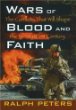
Ralph Peters is one of a handful of individuals whose every work I must read. See some others I recommend at the end of this review. Ralph stands alone as a warrior-philosopher who actually walks the trail, reads the sign, and offers up ground truth.
This book is deep look at the nuances and the dangers of what he calls the wars of blood and faith. The introduction is superb, and frames the book by highlighting these core matters:
* Washington has forgotten how to think.
* The age of ideology is over. Ethnic identity will rule.
* Globalization has contradictory effects. Internet spreads hatred and dangerous knowledge (e.g. how to make an improvised explosive device).
* The post-colonial era has begun.
* Women's freedom is the defining issue of our time.
* There is no way to wage a bloodless war.
* The media can now determine the war's outcome. I don't agree with the author on everything, this is one such case. If the government does not lie, the cause is just, and the endeavor is effectively managed, We the People can be steadfast.
A couple of expansions. I recently posted a list of the top ten timeless books at the request of a Stanford '09, and i7 includes Philip Allott's The Health of Nations: Society and Law beyond the State. Deeper in the book the author has an item on Blood Borders, and it tallies perfectly with Allott's erudite view that the Treaty of Westphalia was a huge mistake–instead of creating artificial states (5000 distinct ethnic groups crammed into 189+ artificial political entities) we should have gone instead with Peoples and especially Indigenous Peoples whose lands and resources could not be stolen, only negotiated for peacefully. Had the USA not squandered a half trillion dollars and so many lives and so much good will, a global truth and reconciliation commission, combined with a free cell phone to every woman among the five billion poor (see next paragraph) could conceivably have achieved a peaceful reinvigoration of the planet with liberty and justice for peoples rather than power and wealth for a handful.
The author's views on the importance of women stem from decades of observation and are supported by Michael O'Hanlon's book, A Half Penny on the Federal Dollar: The Future of Development Aid, in which he documents that the single best return on investment for any dollar is in the education of women. They tend to be secular, appreciate sanitation and nutrition and moderation in all things. The men are more sober, responsible, and productive when their women are educated. THIS, not unilateral militarism, virtual colonialism, and predatory immoral capitalism, should be the heart of our foreign policy.
The book is organized into sections I was not expecting but that both make sense, and add to the whole. Part I is 17 short pieces addressing the Twenty-First Century Military. Here the author focuses on the strategic, lambastes Rumsfeld for not listening, and generally overlooks the fact that all our generals and admirals failed to be loyal to the Constitution and instead accepted illegal orders based on lies.
In Part II, Iraq and Its Neighbors, we have 24 pieces. The best piece by far in terms of provocative strategic value is “Blood Borders: How a Better Middle East Would Look.” Curiously he does not address Syria or Lebanon, but I expect he will since the Syrians just evacuated Lebanon and Syria and Iran appear to be planning for a pincer movement on Baghdad after they cut the ground supply line from Kuwait.
A handful of pieces, 5 in all, are grouped in Part III, The Home Front. The best two for me were “Our Strategic Intelligence Problem” in which he points out that more money and more technology are NOT going to make us smarter, it is humans with history, culture, language, and eyes on the target that will tease out the nuances no satellite can handle. He also points out how easily our satellites are deceived. I share his anguish in the piece on “Lynching the Marines.” I called and emailed the Colonel at HQMC in charge of the defense, and offered a heat stress defense that I had just learned about from a NASA engineer helping firefighters. If the body gets too hot, the brain starts to fry, and irrational behavior is the norm. The Colonel declined to acknowledge. That told me all I needed to know about how the Marines were all too eager to hang their own.
Part V was the most unfamiliar to me, covering Israel and Hezbollah. In 17 pieces, the author, an avowed supporter of Israel, pulls no punches, tarring and feathering the Israelis for being corrupt (selling off their military supplies on the black market (to whom, one wonders, since the only people in the market are terrorists?) confident the US will resupply them) and militarily and politically incompetent. To which I would add economically stupid and morally challenged–Stealing 50% of the water Israel uses to do farming that is under 5% of the GDP is both nuts and short-sighted. See the brief by Chuck Spinney at OSS.Net.
Part V, The World Beyond, is a philosophical tour of the horizon, from water wars and plagues (see my lists for books on each of the ten threats, twelve policies, and eight challengers), to precision knifing of Russia, France, and Europe. Darfur, one of over 15 genocides being ignored right now (Darfur because Sudan pretends to be helping on terrorism and the US does not have the will or the means to be effective there) is touched on.
The book ends marvelously with a piece on “The Return of the Tribes,” a piece that emphasizes the role of religion and the exclusivity of cults and specific localized tribes. They don't want to be integrated nor do they want new members.

 Not for the General Reader