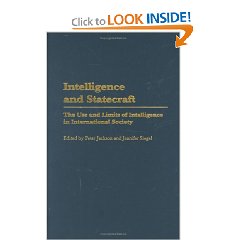
Review: Intelligence and Statecraft–The Use and Limits of Intelligence in International Society

5 Star, Diplomacy, Intelligence (Government/Secret)
0Shares

Amazon Page
Amazon Page

Get Herman or Bozeman or Quiggin or Steele Instead,

December 29, 2006
Peter Jackson
I am a publisher, an author, and an intelligence professional.

This book undoubtedly has good content, but the publisher has been grotesquely irresponsible in pricing it out of reach of individual scholars and citizens and government officials seeking to continue their education.

As a publisher, I am happy to inform the prospective buyer that in lots of 2,500, hard copy books including color jackets and flaps, can be printed for a penny a page. Amazon pays publishers 40%. Hence, this book, sold at $35, would yield the publisher $15.70 or so, minus the printing cost of no more than $5, hence a $10 profit, entirely reasonable for a book.

What price knowledge? What price a lack of ethics among publishers?

See my lists and my many reviews for more honorable affordable knowledge.

All of my books are free online and prices to cover costs at Amazon.

Instead of this book, whose author is being abused, buy:
Intelligence Power in Peace and War
Strategic Intelligence & Statecraft: Selected Essays (Brassey's Intelligence and National Security Library)
Seeing the Invisible: National Security Intelligence in an Uncertain Age
The New Craft of Intelligence: Personal, Public, & Political–Citizen's Action Handbook for Fighting Terrorism, Genocide, Disease, Toxic Bombs, & Corruption

Vote on Review
Vote on Review

Click Here to Vote on Review at Amazon,

on Cover Above to Buy or Read Other Reviews,

I Respond to Comments Here or There
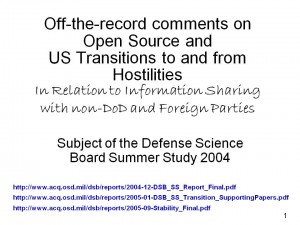
2006 Markowitz (US) Open Source Information and US Transitions to and from Hostilities (Defense Science Board Report, December 2004), in Relation to Information-Sharing with non-DoD and Froeign Parties

10 Security, Analysis, Budgets & Funding, Collaboration Zones, Communities of Practice, Historic Contributions, Legislation, Policy, Strategy, Threats
0Shares
Joe Markowitz
Joe Markowitz

NOTE: By “off the record” Dr. Markowitz has clarified that this information may be shared as we are sharing it, but those benefiting from our sharing should treat the knowledge as if they had acquired it “off the record,” as personal views that should not be attributed nor accepted as anything other than background perceptions.

Joe Markowitx
Joe Markowitx

PLATINUM LIFETIME AWARD, Dr. Joseph Markowitz

Dr. Joseph Markowitz is without question the most qualified Open Source Intelligence (OSINT) pioneer in the ranks of those presently in or retired from U.S. government service.  As the only real chief of the Community Open Source Program Office (COSPO) he tried valiently to nurture a program being systematically undermined by both the leadership and the traditional broadcast monitoring service.  When he moved on to advise the Defense Science Board, he served America well by helping them fully integrate the need for both defense open source information collection and exploitation, and defense information sharing with non-governmental organizations.  His persistent but diplomatic efforts merit our greatest regard.

2006 Morville (UK) Ambient Findability Massive Scale Beyond Your Imagination A Recommedned Approach to Creating the World Brain with Instant Recall

Briefings (Core), Collaboration Zones, Communities of Practice, Historic Contributions, Topics (All Other)
0Shares
Morville
Peter Morville

Peter Morville, resident in the US, is an information architect, pathfinder (we lose as much as we create), and visualizer of how best to connect dots to dots, dots to people, and people to people in the context of sharing information.

Below are the slides from his presentation to OSS '06.

Peter Morville
Peter Morville

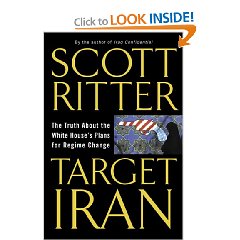
Review: Target Iran–The Truth About the White House’s Plans for Regime Change

4 Star, Asymmetric, Cyber, Hacking, Odd War, Congress (Failure, Reform), Diplomacy, Empire, Sorrows, Hubris, Blowback, Impeachment & Treason, Intelligence (Government/Secret), Intelligence (Public), Military & Pentagon Power, Misinformation & Propaganda, Power (Pathologies & Utilization), Secrecy & Politics of Secrecy, Terrorism & Jihad, Threats (Emerging & Perennial), War & Face of Battle, Water, Energy, Oil, Scarcity
0Shares

A,mazon Page
A,mazon Page

Critical Piece of the Puzzle, Not the Whole Picture,

December 27, 2006
Scott Ritter
Scott Ritter was proven correct about Iraq not having weapons of mass destruction, and this alone demands our respectful attention to his views of the foolishness of attacking Iran.

There are other reviews of the substance of this book that are excellent, so here I just wish to contribute three supporting observations:

1) Endgame: The Blueprint for Victory in the War on Terror by LtGen Thomas McInerney and MajGen Paul Vallely, was published in 2004 and lays out the complete plan for US military domination of the Middle East, with Iran following Iraq, and then Syria etcetera. As lunatic as the plan may be (see my review for more details) it is a plan that will be carried out as long as Dick Cheney remains Vice President and George Bush Junior remains a fool who is clearly in way over his head.

2) Howard Bloom, who understood the coming Sunni versus Shi'ite world war for the soul of Islam, writing about it in The Lucifer Principle: A Scientific Expedition into the Forces of History, now warns of a likely Iranian masterplan that first used Ahmed Chalabi to lure the American neo-cons into Iraq, and now has lured four carriers, two strike groups and an amphibious group within range of the supersonic Sunburn missile that carried a nuclear warhead, can explode a carrier, and travel at 3.0 Mach straight line, or 2.2 Mach when zig-zagging.

3) In addition to Scott Ritter's excellent analysis of how Iran can turn off the oil supply in Iran, portions of Saudi Arabia and the UAE, and Kuwait, it is helpful to consider the extreme vulnerability of the US land supply route from Kuwait to Baghdad. A slide by Webster Tarpley showing this vulnerability is posted above.

Ritter gets a lot of respect from me–his integrity took him from a relatively minor position as a Marine Corps field grade officer, and elevated him to the role of speaker of truth for the public. I think he is right–the US will attack Iran, ostensibly in support of Israel–and this will be the greatest disaster of the 21st century, setting off a true world war between Sunni and Shi'ite in which the Christians are the “collateral damage” while the Jews experience a new form of genocide. I just shake my head, feeling helpless, wondering what it takes to get Scott Ritter's important knowledge in front of Congress.

Vote on Review
Vote on Review

Click Here to Vote on Review at Amazon,

on Cover Above to Buy or Read Other Reviews,

I Respond to Comments Here or There

Review: Capitalism 3.0–A Guide to Reclaiming the Commons

4 Star, Capitalism (Good & Bad)
0Shares
Amazon Page
Amazon Page

Coherent and Simple, Not the Whole Story,

December 27, 2006
Peter Barnes
I concur with all the 5 star reviews with respect to this book presenting a vision for the next level of capitalism nurturing the commons rather than destroying it, but it is not the whole story. It is simple without being simplistic, but the terms “ecological economics” (see my reviews of books by Herman Daly) and “natural capitalism (see my reviews of books by Paul Hawken) are not an integral part of this story. Neither is public philosophy, although the author clearly has an ethical public policy of his own.

Like the work of Paul Hawken, Amory Lovins, Hunter Lovins, and Herman Daly, it does not accuse nor seek repatriation of benefits as much as it seeks to educate and demonstrate why respect for the commons is good for business.

I recommend Michael Sandel's “Public Philosophy: Essays on Morality in Politics,” and Paul Hawken's “The Ecology of Commerce,” in addition to this book, but those deeply interested in this topic might wish to expand their range by browsing some of my lists on democracy, capitalism, and security.

The book ends with numerous ideas, some easy to implement, like time banks (I see a rush to displace banks, money, credit, and interest coming down the pike), and some more difficult but essential, such as reversing the spectrum licenses and land licenses awarded to corporations under Capitalism 1.0, and putting those resources to work for all of the people.

The author spends some time noting that government is not the complete answer, and I not only agree, I am eagerly waiting for a book called Government 3.0 or Democracy 3.0, something that brings together the diverse literature on the need to localize agriculture and energy again, stop the global corporations, e.g. Wal-Mart, from destroying communities, and restore integrity and trust in human transactions. In a sense, this book is a model that could be applied to other areas in need of revitalization.

Public Philosophy: Essays on Morality in Politics
The Ecology of Commerce
Ecological Economics: Principles And Applications
Natural Capitalism: Creating the Next Industrial Revolution
Blessed Unrest: How the Largest Movement in the World Came into Being and Why No One Saw It Coming
Wal-mart: The High Cost of Low Price
Wal-Mart: The High Cost of Low Price

Vote on Review
Vote on Review