This is a very worthy and serious documentary. As one who spends a lot of time thinking about “strategic communication” and public diplomacy and public perception, I cannot think of a more important reference point for any US official interested in understanding where we are going wrong in the Arab and Muslim worlds.
Bottom line up front: Al Jazerra gets 5 points from me, in comparison with CENTCOM 1 (for naive earnestness), and Western journalists 0 (just generally stupid).
There are some spectacular flashes of insight in this documentary. My favorite is when one of the Al Jazeera editors says that the US cannot have it both ways–it cannot be the most powerful nation in the world, exercising that power (implicitly, capriciously and dangerously and harmfully) and at the same time expect the world to love it for doing so.
Over-all–and I am perhaps not the norm, having lived overseas most of my life as the son of an oilman, as a Marine Corps infantry officer, and as a clandestine case officer–I have to say that in the real world, Al Jazerra is wiping the deck with our ass. You may not like my opinion, but there are a couple of billion people that probably agree with that opinion, and most of them, right now, are not very respectful of the old USA.
It is not possible to be effective as a strategic communicator, or to practice public diplomacy, without first understanding what your target audience is seeing, hearing, and thinking. This DVD is a superb starting point and I have total respect for what has been presented here.
I never understood nor really liked baseball. I bought the book mostly to read about the inspired use of statistics, and the creative thinking that went into looking for the real keys to victory. I can safely say that while I may not have fallen in love with baseball, I will never find it boring again. If you have someone you want to turn into a fan, this book a superb gift option. The amount of detail in this book–for example, just the description of the strike zone and what different pitches and batters do to narrow the zone, what can be known about specific individual propensities and vulnerabilities associated with that little box, are truly inspirational.
This is a really excellent book. If we managed the national security budget the way Billy Bean managed the Oakland A's, we'd have faster better cheaper military hardware, and a lot more plowshares. I was also impressed by the way in which Billy Bean built a team, in which players who might not have been individual stars excelled at setting up others in a true team effort where the group as a whole is stronger than the sum of the parts. Others have written better reviews from a baseball fans point of view–as a non-baseball fan, I can attest to this book's being an “aha” experience.
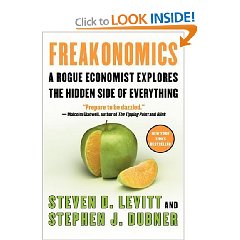
This book is about 75% solid thinking and 25% hyped up marketing and clever packaging. I certainly do not begrudge the award winning authors their success, but I was truly expecting something a little deeper and more broad-reaching. One sixth of the book is about children's names correlating with success and scores–I was reading about that in the 1970's, when folks were proving that the same paper by a David would get a half point better score than one attributed to Moonbeam.
Bottom line: an excellent airplane book, by all means worth the time it takes to read (lots of white space), but over-sold.
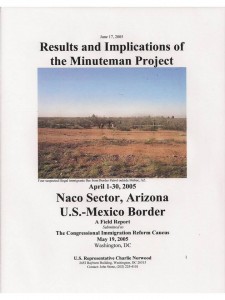
A successful immediate replication of the Minuteman Project would require an average 12 –24 enforcement personnel per mile, or around 36,000 total additional personnel to adequately secure the entire 2,000 mile southern border. An additional 12,000 support personnel may be necessary to provide services over an extended deployment.
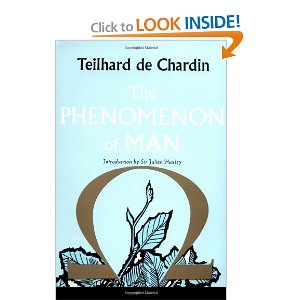
Pierre Teilhard de Chardin (1881-1945) was a Jesuit Priest, theologian, philosopher, and paleontologist who expanded on the concept of the noosphere originated by the Russian mineralogist and geochemist, Vladimir I. Vernadsky (1863-1945) who also originated the concept of the biosphere- the “life zone” where all biological life exists between the crust of the earth to the lower atmosphere or the “life envelope” surrounding our planet.
The “noosphere” or “thinking layer”, according to Chardin, comes about at that point in time when humans evolve to the realization of a global human consciousness and is totally aware of itself and then headed for the ultimate destination- the “Omega Point” or “Kingdom of God”. At this point, the earth is enveloped by a collective human consciousness.
Chardin uses both science and theology to support this theory and his dissertation on this is fascinating and thought provoking. Unlike most of his religious peers, he was a proponent of directional evolution and that Darwin had hit upon the proof of God's intent, that final destination of the human conscious evolution where the Creator is realized. Darwin, of course, preferred to distance himself from theological assumptions of species evolution, especially so with us humans and his religious wife.
Chardin distinguishes humans from all other life-forms because of our abilities to contemplate our existence, hence, the uniqueness of or the “phenomenon of man”. Hopefully, he concludes, that the human family will evolve to be totally conscience, intelligent and loving, cooperative, and rising far above our current chaotic existence. Amen to that lofty, but desirable goal!
The evolutionary path of the noosphere is laid out in Chardin's earth evolution and stated as: “We have been following the successive stages of the same grand progression from the fluid contours of the early earth. Beneath the pulsations of geo-chemistry, of geo-tectonic and of geo-biology, we have detected one and the same fundamental process, always recognizable-the one which was given material form in the first cells and was continued in the construction of nervous systems. We saw geogenesis promoted to biogenesis, which turned out in the end to be nothing less psychogenesis.” (p 181). And leading therefore, to “noosgenesis” or global consciousness. Finally, and due to the interconnectedness and seemingly intentional direction of life on earth, Chardin gives Earth a soul: Gaia thinking- Earth “intentionally” supports life.
No wonder then that Chardin is referenced and quoted in a mountain of science and religious works. His theories have influenced such great thinkers as: Lewis Thomas (“The Lives of a Cell”), Buckminster Fuller (“The Dymaxion Map”), the Gaia Theory- Earth as a conscious, intentional, self-regulating life-support system and expounded upon by Guy Murchie (“The Seven Mysteries of Life”) and later by James Lovelock (Gaia: The Practical Science of Planetary Medicine”), Thomas Berry (“The Dream of the Earth”) and many, many more.
Chardin traveled the world on his scientific investigations and he was present at the discovery of the Peking Man in China. Some historians have intimated that much of Chardin's travels were at the behest of the Catholic Church for they were not thrilled with his attempts to blend science and religion and the farther away from Rome he was, the better.
The church cautioned him not to publish any of his works and faithful to that edict, he left them to a friend in the U.S. to publish posthumously to avoid further conflict and retaliation from the Church- bad memories of the history of the Catholic Church's terrible treatment of scientist and thinkers whose musings drifted from repressive, suffocating church dogma, i.e., Galileo Galilei, et al.
No matter where one's leanings are on religion or science, this is a potent dissertation on bringing science and religion together for awe and respect of life and eventual peace on Earth through global consciousness.
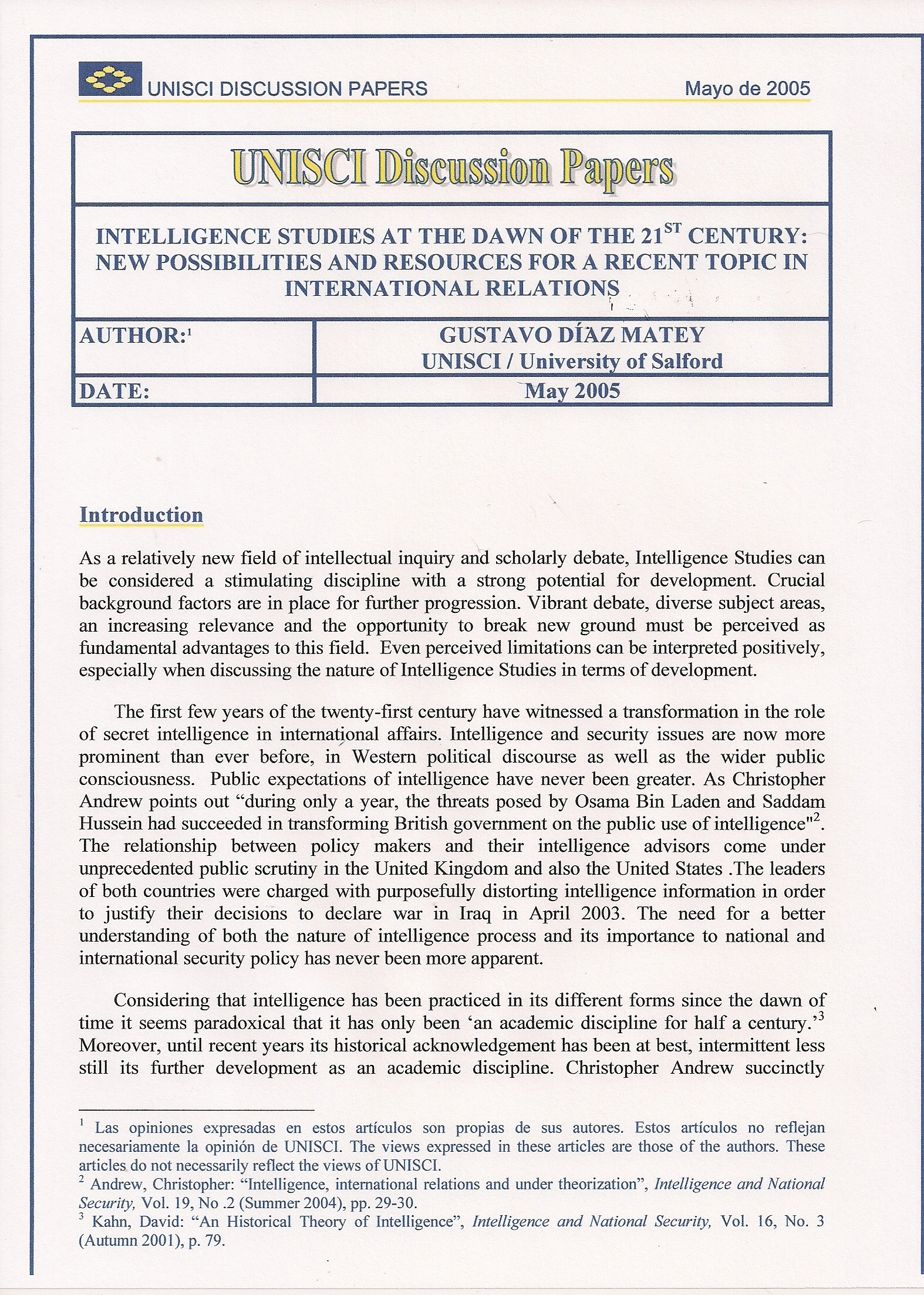
Phi Beta Iota: Gustavo Diaz Matey is the author of the two definitive modern works on intelligence out of Spain,
pending citations from author
Among many strong observations in the reference are his statement on page 2,
Intelligence is all but absent, in the work of most international relations theorists and it does not figure in any key International relations theory debates between realist, liberal, institutionalism, constructivist and postmodernist approaches.
Contents:
1. Intelligence and the study of International Relations
2. A Starting Point. What is intelligence?
3. Popular Culture and Intelligence
4. Is secrecy the main characteristic of intelligence and the main limitation of intelligence studies?
Jim Wallis for National Chaplain–Extraordinary Book,
May 4, 2005
Jim Wallis
Jim Wallis has my vote to be Chaplain to the Nation. This is an extraordinary book. Indeed, if the President has a Science advisor, I have to ask myself, why doesn't he have a Faith advisor?
I recommend this book be read together with “Faith-Based Diplomacy” by Douiglas Johnson, and “The Soul of Capitalism” by William Greider. This hard-hitting book is full of both common sense and scholarship. Over-all it slams both Right and Left–the Right for claiming that Jesus is pro-war, pro-rich, and a selective moralist; the Left for not embracing faith and God as part of the politics of America.
Early in the book I am immediately won over by the author's preliminary manifesto in his preface: we who have faith are not single-issue voters; we believe that poverty is a religious issue; that caring for God's earth is a religious issue; that war–and making peace–is a religious issue; that truth-telling is a religious issue; that human rights are a religious issue; that our response to terrorism is a religious issue; and finally, that a consistent ethic of human life is a religious issue.
Throughout this book the author returns again and again, to a theme that I am now seeing everywhere: morality matters. The author is superb at relating the power of faith and the morality of religion (not pretentious morality, but practiced morality) to the real world. On pages 105-107, if you are glancing through the book in a bookstore, he repeats key points he made a year after 9-11 on how to defeat terrorism–among his ten points a few simply leap off the page: 4. Let's define terrorism the right way, and allow no double standards. 5. Attack not only the symptoms, but also the root causes of terrorism. 6. The solutions to terrorism are not primarily military. And so on.
Poverty, economic justice, and *moral* capitalism are the underlying challenges that confront the author, and he does a really fine job in this book of showing how America will never be safe if we fail to address global as well as homeland poverty. (In this regard, see my reviews of “Working Poor” by David K. Shipler, and “Nickled and Dimed” by Barbara Ehrenreich.)
The book ends with an extraordinary list of 50 predictions for the future. This list, by itself, is worth the price of the book. #45 is consistent with the eight movements centering around collective intelligence: “All our media will be owned by two or three corporate conglomerates unless and effective movement rises up to stop this trend and restore a genuinely democratic public discourse.” I have the strong feeling that the author's faith is being tested by both the Right and the Left–indeed, in the social and economic policy arena, the author, from a religious point of view, is a perfect counter-part to the Chairman of the Council of Foreign Relations, Peter Petersen, whose book, “Running on Empty: How the Democratic and Republican Parties Are Bankrupting Our Future and What Americans Can Do About It,” is the practical counterpart to “God's Politics.”