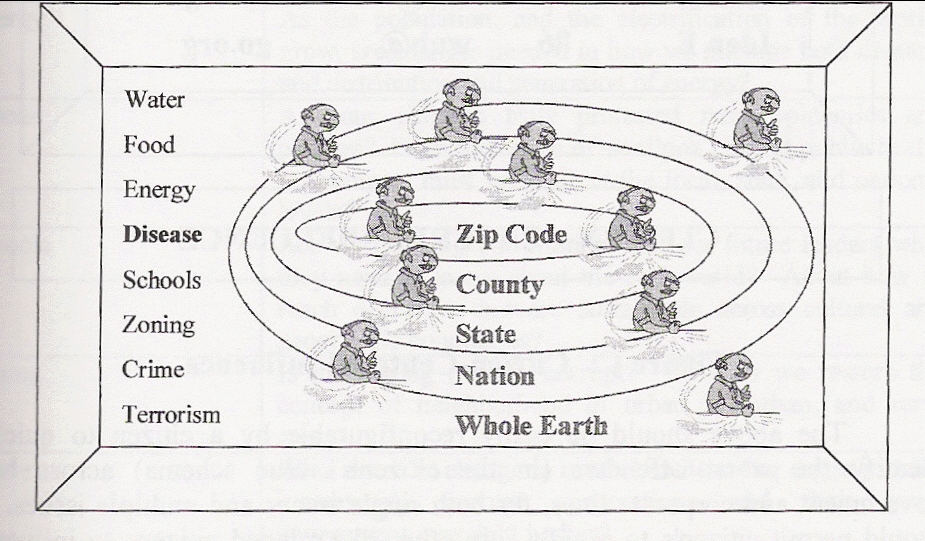
Graphic: Citizen-Centered Intelligence I

Citizen-Centered
0Shares
OSINT for Citizens I

This was created for THE NEW CRAFT OF INTELLIGENCE and has yet to be realized, in part because Google is busy claiming ownership of everything it can touch while offering nothing in the way of sense-making.  Similarly, Amazon is focusing on Kindle (and will reach in and delete all your electronic books if your subscription ever lapses) while completely ignoring the World Brain and “mico-sale” opportunities that were pointed out to them in a standing-room only conference for their developers.  What we have learned from this is that top-down companies will never invest in bottom-up needs–IBM, Oracle, CISCO, all of the big companies are blind to the leverage attendant to empowering the single individual human brain.  Only Nokia appears to be properly focused, and even there, they lack the call center and cloud aspect partnerships that Brazil, China, India, Indonesia, and Russia could provide.

Graphic: OSINT NATO Documents

Analysis, Collection, Innovation, Multinational Plus
0Shares
OSINT NATO
OSINT NATO

These remain the three core documents for OSINT available to the public. Any White OSINT training document that is restricted and cannot be shared with multinational individuals is not pure OSINT and is suspect.  Similarly, any White OSINT that is “classified” is not OSINT and reflects no credit on those producing it.  See them and others useful compilation in the Handbook section of this Public Intelligence Blog.

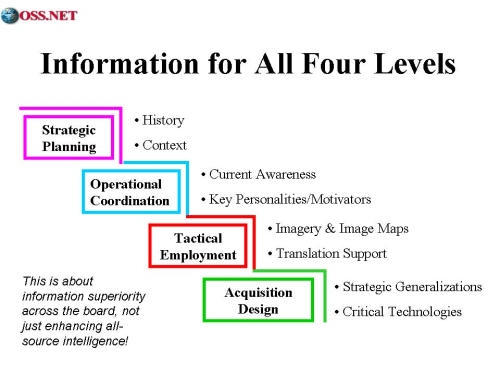
Graphic: OSINT Support to Four Levels of Analysis

Advanced Cyber/IO, Analysis, Balance, Innovation, Leadership-Integrity, Multinational Plus, Reform, Strategy-Holistic Coherence
0Shares
Click on Image to Enlarge

This is the slide that grabbed General Peter Schoomaker, USA (Ret), the ONLY Army flag officer that has ever understood OSINT in detail.  General Schoomaker's intelligence and integrity are the sole reason the U.S. Government has today exactly ONE serious OSINT capability as represented by J-23 at the U.S. Special Operations Command (USSOCOM).  Everything else is fluff, lip service, and broken promises.

Review: Osama’s Revenge–THE NEXT 9/11 : What the Media and the Government Haven’t Told You

4 Star, 9-11 Truth Books & DVDs, America (Anti-America), Executive (Partisan Failure, Reform), Media, Misinformation & Propaganda, Security (Including Immigration), Terrorism & Jihad
0Shares

Amazon Page
Amazon Page

4.0 out of 5 stars Third of Three “Must Reads” on Bin Laden and Threat to USA,

August 13, 2004
Paul L. Williams
This is the third of three books that I am reviewing today and that I strongly recommend be read by every adult in America. The first two, in order of priority, are Mahmood Mamdani's Good Muslim, Bad Muslim: America, the Cold War, and the Roots of Terror and CIA Anonymous Executive Analyst, Imperial Hubris: Why the West Is Losing the War on Terror. I should add that terror is a tactic, not an enemy, it is impossible to win a war against a tactic.

What this book does is piece together all of the English-language reports over the past ten years or so regarding the probabilities and specifics of Bin Laden and Al Qaeda's having acquired several forms or portable nuclear devices. Although some reviewers have slammed this book for being fictional, they do not know what they are talking about. The FACTS are that the Soviet general officer responsible for the 100 suitcase nuclear bombs designed for Spetznatz use, some pre-positioned in the USA, has said publicly, in writing, and on more than one occasion that 66 of those are unaccounted for.

I took one star off for excessive reliance on two secondary sources, both excellent but never-the-less cited too often, and the commensurate lack of attention to foreign language materials that could have deepened this study considerably, especially when one takes into account the CIA executive analyst's comments in IMPERIAL HUBRIS regarding the straight truth-telling that can be found in Bin Laden's Arabic-language postings. “Nuclear hell storm” is out there (the author does cite this), and we had better take this more seriously than our government has.

The author opens with a notional “letter to America” from Bin Laden that is based on Bin Laden's actual statements (as itemized in IMPERIAL HUBRIS) and is alone worth the price of the book. If we don't take a long hard look at ourselves and correct the misbehavior that is radicalizing over a billion Muslims, we will not (not!) win this war.

The author does a really fine job, not just of amassing and stringing together a coherent story of Bin Laden's likely possession of nuclear capabilities, but also of showing the inter-relationship between the Afghanistan drug fields that the U.S. Government has stupidly allowed to flourish, the Pakistani production facilities that take the opium to a “Number 4” level of quality, and criminal organizations as well as corrupt governments everywhere that facilitate Bin Laden's operations. The roles of Russia, Iran, North Korea, and Pakistan (especially Pakistan) in facilitating the storage, refurbishment, and technical maintenance of the purchased nuclear elements are covered in a manner that persuades me–this is a very real threat.

The book is a useful compilation of both mistakes by the US, and events taking place from 2002-2004, and it ends with full translated copies of the 23 Aug 96 Fatwa and the related 23 Feb 98 World Islamic Statement. Within the book are some extracts from Al Qaeda training manuals, one portion of which make it clear that the “sleepers” now in the US are specifically forbidden to go to mosques or appear Islamic in any way.

Bottom line, totally consistent with the other two books I recommend: the US needs to meet Bin Laden's reasonable demands, and redirect its focus from occupying Islamic countries toward cleaning up its own homeland. [I realize that calling Bin Laden's demands “reasonable” in going to infuriate many people, but I have to say, based on all three books taken as a whole, that all three authors agree on this point, and they have persuaded me. We cannot win if we persist in supporting 44 dictators, occupying Muslim lands, demanding cheap oil at the expense of the Muslim populations, and supporting an Israel that is racist as well as terrorist in nature toward the Palestinians. It is what it is–the sooner we stop deceiving ourselves, and demand that our government get back to the ideals of moral capitalism and truly representative democracy, the sooner we have a chance to avoid this “nuclear hellstorm” that I believe this book credibly documents as a very real possibility.]

See also, with reviews:
Breaking the Real Axis of Evil: How to Oust the World's Last Dictators by 2025
Blood Money: Wasted Billions, Lost Lives, and Corporate Greed in Iraq
Open Target: Where America Is Vulnerable to Attack
America the Vulnerable: How Our Government Is Failing to Protect Us from Terrorism
Vice: Dick Cheney and the Hijacking of the American Presidency
Running on Empty: How the Democratic and Republican Parties Are Bankrupting Our Future and What Americans Can Do About It

Vote on Review
Vote on Review

Imperial Hubris: Why the West is Losing the War on Terror

5 Star, Empire, Sorrows, Hubris, Blowback, Executive (Partisan Failure, Reform), Iraq
0Shares

Amazon Page
Amazon Page

5.0 out of 5 stars Finds Legitimacy in Bin Laden's Strategic Goals, Ignorance & Ideology in Ours,

August 13, 2004
Michael Scheuer
Edited 18 Sep 07 to respond to comment and add links to other books.

The author, who has the advantage of being a senior CIA analyst with access to what secrets we do have, has produced what may well be the single most important book in terms of getting this country back on track in relation to the rest of the world. This is the second of three “must read” books I am reviewing today. The first, which sets the stage for this book by providing a truly inspired, informed, extraordinary, and nuanced review of the “just causes” for Muslim radicalization against the USA, is by Mahmood Mamdani, Good Muslim, Bad Muslim: America, the Cold War, and the Roots of Terror The third, best read last, is Paul L. Williams' Osama's Revenge: THE NEXT 9/11 : What the Media and the Government Haven't Told You The latter books paints a compelling portrait, using only open sources of information, on how likely it is that Bin Laden not only has a number–perhaps 20 or more–nuclear devices of one sort or another–but is also receiving technical assistance from Pakistan, Iran, North Korea, and certain Russians in refreshing and maintaining those devices for use within the US homeland to create a “nuclear hellstorm” (Al Qaeda's words).

This book, the second of two by the same person, but easily the most relevant to the salvation of the American dream and homeland, is a tour d'force. It is an incredibly thoughtful, well-ordered accounting of both our mistakes and both the rationality and inevitability of Bin Laden's victory over the US. The endnotes are world-class.

As Congress prepares to confirm a new Director of Central Intelligence, the author's frequent and articulate damning of the U.S. Intelligence Community leadership for its moral cowardice (specifically slamming George Tenet and also Richard Clarke, who is labeled “blusterer in chief”) must, in my view, require that the nominee for the position of DCI promise to clean house as a condition of his confirmation. Above the rank of GS-15, every Senior Intelligence Service officer should be put on probation by the incoming DCI, and half of them should be retired within 2-3 years. The author of this book knows what he is talking about.

The author very usefully slams (on page 175) Michael O'Hanlon from the Brookings Institute, William Hawkins from the Army War College, and Anthony Davis of Jane's Intelligence Review for their absolute misreading of the situation in Afghanistan. it is helpful to emphasize that these and other so-called experts that Congress tends to rely on, are absolutely superb when they do their homework (O'Hanlon is top notch on the non-revolution in military affairs, for example), and very dangerous when trying to milk the issue of the day without doing their homework (on intelligence reform, for example).

I do not want to conclude without highlighting the author's praise for the Foreign Broadcast Information Service (FBIS). They appear, in this one instance, to have excelled at finding and translating every word uttered by Bin Laden and his key aides, in public and in Arabic, and the author–whom I respect completely–is profuse in his detailed thanks to FBIS. Although I and my leading military colleagues consider the FBIS model to be rotten at the core (marginal remote collection, not doing tribal languages or in-country gray literature, broadcasting generic reports largely useless in operational decision making) I do affirm that FBIS can and should be saved, if it can be re-oriented to do for all of its clients what it did for the Bin Laden task force.

In conclusion, I want to focus on what I believe is a misreading by many of the author's recommendation of a “scorched earth” campaign against Al Qaeda as a global insurgency (rather than a law enforcement challenge). Although the author is correct to suggest that such an approach is necessary if we wish to continue doing the six things that Bin Laden wants us to stop, I believe that most readers of this book go into instant denial and fail to see the author's logic, especially when he points out (page 17) that Bin Laden has explicitly stated that he does not desire to expand Islamic dominance beyond existing Muslim countries, and that he will follow us in DE-escalation just as quickly as he is following us in escalation.

What we need to do, according to Bin Laden:

1) End US aid to Israel and support a Palestinian state
2) Withdraw US/Western military forces (not business) from the Arabian Peninsula and all Muslim countries worldwide
3) End US engagement in Afghanistan and Iraq
4) End US support for oppression of Muslims by Chinese, Russian, Indian, and other governments (e.g. Philippines)
5) End US manipulation of oil prices through corrupt dictators
6) End US support for corrRogue Nation: American Unilateralism and the Failure of Good Intentionsupt Muslim regimes

I think this all makes sense, especially when you add the insights from the other 479+ books that I have reviewed, books such as Clyde Prestowitz's , Jonathan Schell's The Unconquerable World: Power, Nonviolence, and the Will of the People Derek Leebaert's “The Fifty Year Wound” and on and on and on. If our policy makers were willing to read and think for themselves, and not spend endless hours trying to leverage their perks and manipulate their more honest constituencies, it seems to me that we could a) get ourselves out of this mess; b) redirect half the national security budget toward global stabilization instead of selective occupation; and c) restore morality to both our global business practices and our global foreign policy.

Probably will not happen until two nuclear devices go off in America–one will be in a shipping container, the other in a Central Park. Just how stupid can America get? We'll have to wait and see–I don't see us getting any smarter.

The Looming Tower: Al Qaeda and the Road to 9/11 (Vintage)
The Road to 9/11: Wealth, Empire, and the Future of America
The Sorrows of Empire: Militarism, Secrecy, and the End of the Republic (The American Empire Project)
Failed States: The Abuse of Power and the Assault on Democracy
Confessions of an Economic Hit Man
Sleeping with the Devil: How Washington Sold Our Soul for Saudi Crude

Vote on Review
Vote on Review

Review: Good Muslim, Bad Muslim–America, the Cold War, and the Roots of Terror

5 Star, America (Anti-America), Culture, Research, Diplomacy, Empire, Sorrows, Hubris, Blowback, Religion & Politics of Religion
0Shares

Amazon Page
Amazon Page

5.0 out of 5 stars Inspired, Disciplined, Nuanced, Nobel-Level Thinking,

August 13, 2004
Mahmood Mamdani
This is an inspired, disciplined, nuanced, Nobel-level book, and if it ends up saving America from itself, then it would surely qualify the author for the Nobel Peace Prize.

This is the first of three “must read” books that I am reviewing today, and it is first because the other two are best appreciated after absorbing this one. The other two books are “IMPERIAL HUBRIS” and “OSAMA'S REVENGE.”

The main weakness of this book is the author's lack of strong criticism of Pakistan, Egypt, and Saudi Arabia, and of other states that are corrupt, repressive, and therefore a huge part of the problem. Having said that, here are some of the key points:

– “West” pioneered genocide, expulsions, and religious wars, with Spanish genocide of Indians in Americas, and Spanish expulsion of first the Jews and then the Muslims as critical starting points in understanding Muslim rage today
– America adopted terrorism as a preferred means of fighting proxy wars in both Central America and Africa, when Reagan began “rollback” with the same neo-conservative advisors that guide Bush II today.
– West has four dogmas as summed up by Edward Said (who is admired by the author): 1) that Orient is aberrant, undeveloped and inferior; 2) that Orient is inflexibly tied to old religions texts, unable to adapt; 3) that Orient is inflexibly uniform and unable to do nuances; and 4) Orient is either to be feared (Green or Yellow or Brown Peril) or controlled.
– Fundamentalism actually started in the US among the Christians seeking to insert religion into the state's business and ultimately demanding faith and loyalty as the litmus tests for acceptance.
– Earlier generations of Islamic reformists disavowed violence, but ended up adopting violence after being in state prisons (e.g. Egypt).
– Earlier incarnations of a Muslim revival were in the open literature in the 1920's and then in the 1960's, and lastly in the 1980's to date–our national “intelligence” agencies appear to have missed the importance of all three
– Viet-Nam, Africa, and Central America all fostered extremely unhealthy connections between CIA covert operations and the drug trade, with CIA routinely condoning and often actively enabling massive drug operations and related money laundering, as the “price” of moving forward on covert operations.
– The obsession with winning the Cold War at all costs essentially destroyed U.S. foreign policy and set U.S. up as the enemy of the Third World [see Derek Leebaert's “The Fifty-Year Wound”].
– Morality in the US has been perverted, as the extreme right, joining with extreme Zionists, has “captured” the U.S. government in both Congressional and Executive terms. Orwellian “spin” together with the labeling of all dissent, made possible by media corporations “going along”, has destroyed any possibility of informed, objective, or actually moral dialog.
– The Central American campaign pioneered the privatization of terrorism and proxy war by the US, with secrecy and deception of the US public being the principal role of the US government.
– The US Government is explicitly accountable for introducing bio-chemical weapons into the Iraqi arsenal, and thus accountable for the genocide and war crimes attendant to their use.
– US (AID) sponsored textbooks, such as those created by the University of Nebraska, routinely used terrorism against Russians as examples in the mathematic and other textbooks being distributed in Afghanistan.
– CIA's main contribution to the destabilization of the world has been in its Afghan-related privatization of information about how to produce and spread violence, and its training of tens of thousands of jihad warriors from all over the world who have now returned home and are teaching and leading others.
– Under US leadership, Afghanistan has gone from providing 5% of the global opium production in 1980, to 71% in 1990, and even more today–much of which comes to the US.
– America not only accepts massive drug activities as part of the “cost of doing business”, but also ignores human rights in its rush to cozy up to corrupt dictators.
– From an Iraqi point of view, the 1.5 million or so children that died in Iraq due to the sanctions, must be seen as a major war crime and a form of terrorism, together with the air war with its indiscriminate murder of thousands if not tens of thousands civilians including women and children. The US has killed more civilians in Iraq than it did in Japan with two atomic bombs. Napalm and depleted uranium are disabling US troops as well as Iraqi civilians long after their use in the field.
– Economic sanctions, when they have the impact they did in Iraq, must be considered weapons of mass destruction, their application terrorism, and their results war crimes.
– The US Government's general disdain for the rule of law, but the incumbent Administration's particular focus on ignoring treaties and refusing accountability (e.g. for war crimes) sets a new low standard for immoral behavior by nation-states.
– The UN Secretary-General was forced by the US to ignore the Rwandan genocide because of a US desire to keep everyone focused on Sarajevo, and continues to us its veto power to prevent UN from being effective against racist Zionism, which is routinely committing crimes against humanity with its Palestinian campaign.

The author concludes, without sounding inflammatory, that America was built on two monumental crimes: the genocide of the Native Americans, and the enslavement of African Americans. His point: the US is in denial over this reality, while the rest of the world is completely aware of it. He agrees with Jonathan Schell, concluding as Schell does in “Unconquerable World,” that the challenge of our times is in “how to subdue and hold accountable the awesome power that the United States built up during the Cold War.” The last sentence is quite powerful: “America cannot occupy the world. It has to learn to live in it.”

Vote on Review
Vote on Review

Review: The Path of Least Resistance for Managers

5 Star, Best Practices in Management, Change & Innovation
0Shares

Amazon Page
Amazon Page

5.0 out of 5 stars Not Just For Managers–Presidents and Teenagers Also,

August 8, 2004
Robert Fritz
I read this book because it is one of those recommended to the Commanding General of the U.S. Special Operations Command. After reading it, I think the Cliff Notes version would be useful to any President, and I have marked a number of pages for my teenager.

Sadly, the precursor to this book, written in 1984, was largely ignored by mainstream managers, just as proposals for intelligence reform were defeated in 1992 because the Pentagon was unwilling to give up budget authority for the good of the Nation. My point: better late than never. Grab this book and go with it.

I get two core points out of this reading: first, strive to balance opposites rather than going to one extreme or the other; and second, don't focus on resistance, but rather on opportunities. In the military this known as “going for the gap”–instead of pouring your reserve forces into the weakest point in *your* line, that is at risk of collapsing, you focus instead on finding the “gap” in the enemy line, you pour through that, and whip their ass from behind.

Much of this book is critical of both our current educational and our current managerial systems—both spend too much time teaching people what NOT to do, and very little time empowering people to think for themselves and create new “impossible” dreams.

The book has direct application to today's national security environment, when it points out that “pre-emptive strikes” are a form of avoiding reality and being reactive in advance rather than proactive and integrative, or transformative.

The emphasis on starting with the current reality (what my world would call “commercial intelligence”) may not be fully understood by most middle managers. When I started my company to do global commercial intelligence, our evaluation of the “competition” produced a surprising result: fully *half* of our competition came from our clients themselves, middle managers who thought they knew everything there was to know about their business, and were absolutely oblivious to the out-sourcing, privatization, plastic for steel substitution and the myriad of other threats that the Internet, Federal Express, tax laws, and Dutch and Chinese investment represented. Any manager reading this book who does not have a corporate “intelligence” capability (visit the Society of Competitive Intelligence Professionals for a fast read in), should be shocked into starting one immediately.

Visualization of perfection is in direct competition with rote performance and old metrics. Managers today are still largely “Cold War” managers focused on the traditional metrics of cash flow, cost reduction, short-term profit margins, and so on. Imagine what a difference it might make if the metrics could change, to include a focus on the health and knowledge of the individual employees, the health and knowledge of the community being supported and supporting the company, on changing the industry with standards and shared best practices, etc. In order words, managers need to move from a bunker mentality, where there is only one winner, to a network mentality, where multiple winners actually increase the totality of the profit over all and across previously unrelated communities of interest.

The last point that really struck me was the emphasis on transcendence (alluded to above) but interpreted by me, at least, as “born anew.” Whatever cost cutting measures we may have condoned in the past, whatever unethical practices including reductions in employee health benefits, etc. there is nothing standing in the way of any company's rebirth or any manager's resurrection and “rebirth” as a decent human being who can factor in human and ecological economics values (see my reviews of Herman Daly's various books).

We're killing America by killing our workers, and we are killing the world with predatory and immoral capitalism. This book is a valuable wake-up call for all managers, both in business and in government.

Vote on Review
Vote on Review