This is the second best of several books on environmental policy I have reviewed, and it merits careful scrutiny in part because it brings together a number of expert authors and there is in essence “something for everyone” in this edited work. What is lacks, though, is a good summary chapter that lists how the “precautionary principle” should be applied across each of the top ten environmental areas of concern–something that could circulate more easily than the book, and perhaps have a beneficial policy impact at the local, state, and national levels–and I suggest this because the meat of the book is good, it needs an executive summary.
The chapter that was most meaningful to me, the one that I think needs to be migrated into business education, international affairs education, science & technology policy education, is by Gordon K. Durnil, Chapter 16, and it deal with “How Much Information Do We Need Before Exercising Precaution.” This is a brilliant piece of work that dissects our current environmental policy information collection, processing, and analysis system, and finds it very deceptive, disingenuous, and consequently seriously flawed.
For the best on the environment, read Pandora's Poison. For the best on public health, read Betrayal of Trust. For a very fine cross-over book that has good chapters from various good people, this is the book to buy and enjoy.
4.0 out of 5 stars All About Rights–Very Little About Loyalty or Duties, June 2, 2001
I have mixed feelings about this book. On the most positive side, it is the only, and therefore the best, treatment of the issues of citizenship that I could identify, and that is why I bought it. The range of authoritative essays that have been brought together is very worthy, and anyone contemplating this topic must take this work into account.
On the other hand, as I went through chapter after chapter, what I tended to see was an awful lot of academic whining about how the world is getting too complex and too multi-cultural to be able to pin someone down to just one citizenship, let them have many. Reality check needed here. Governments exist to preserve and protect very specific moral, ideological, and cultural values, and governments are the means by which a Republic finances what are called external diseconomies–those things that are needed for the common good but not profitable for the private sector to do.
There are glimmers here and there of how one might better integrate new immigrants and otherwise promote good citizenship, but overall what this book is missing is a major commitment to thinking about how one draws the line between nationalized citizens truly loyal to their newly chosen nation-state, and those who choose to retain another primary citizenship and simply enjoy the bounty of the land they have chosen to VISIT….
Of all the contributions, the one that stood out for me was by Adrian Favell, on “Integration Policy and Integration Research in Europe: A Review and Critique.” Despite the title, the heart of this chapter concerns the information “sources and methods” that underlie conclusions about citizenship and the policies on citizenship. There is a great deal of meat in this chapter, and it could useful guide the next book in what I hope will become a series.
I like this book. It forced me to think and it certainly opened my eyes to how we are letting a whole bunch of people debate the nature of citizenship without ever really being committed to the idea that an oath of loyalty is fundamental–as universal service should be fundamental, not to flesh out the military, but rather to provide a common foundation for knowing one another intimately, for respecting one another from that common ground. How one defines citizenship is fundamental to the future of every nation–this book both enlightens and frightens.
Double Value: on Environmental *and* Information Strategy
June 2, 2001
Joe Thornton
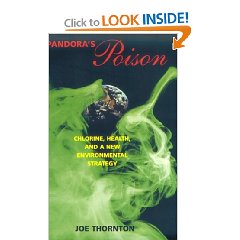
This is the best of the several environmentally-oriented books I have reviewed recently, and it offers a double value: not only does it lay out a persuasive social, economic, and political case for abandoning the Risk Paradigm of permissive pollution in favor of an Environmental Paradigm of zero pollution; but it also provides a very fine–really excellent–case for why the current government and industry approaches to information about the environment and threats to the environment are severely flawed. In a nutshell, the current approach divorces “good science” (code for permitting what you can't prove will kill the planet today) from social consciousness and good policy; and the current approach insists on studying risk one contaminant at a time, rather than as a whole.
This book is persuasive; I believe author has the right stuff and should be consulted on major policy issues. I believe the underlying moral values and intellectual arguments that this book makes, about both science and social policy, should be adopted by the Cultural Creatives and the independent voters of America, and that the recommendations of this book are so serious as to warrant country by country translations and promulgation.
This book is exceptional in that is combines a readable policy essay for the non-technical citizen, with deeply documented technical appendices and notes that support a middle ground series of chapters relating scientific findings to long-term policy issues.
From many small actions come revolutionary change–this book is a necessary brick in the road to environmental reform. The bottom line is clear: every year more and more toxins are building up in our blood streams, and this is going to have an overwhelmingly negative impact on the humanity, capability, and survivability of our great grandchildren three generations down–we have not have grandchildren seven generations down if the insights from this book fail to reach the people, and through the people, the policy makers and legislators.
Carol Dumaine was for a few years allowed to manage an internal revoslution in intelligence affairs that ultimately failed, but left its mark. She is still standing, and we expect to see her at the finish line when we finally do achieve a revolution in intelligence affairs and create both a Smart Nation and a World Brain.
Above, with a full title of Are You Ready?: Implications of a Changing Global Information Environment for Open Source Intelligence, was published in June 2001. It remains a precious point of reference.
The internal revolution failed, Global Futures Partnership was transferred to the Department of State where it has been stuffed in a closet, and Carol Dumain marches on professionally.
Deeply Researched Facts About the Secret Signals War,
May 12, 2001
James Bamford
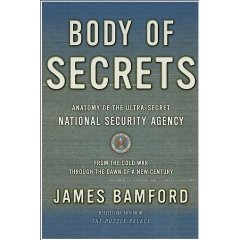
I like this book because it is a deeply researched investigation of the National Security Agency, a part of the U.S. government that is always “in harms way”, and because it offers up over 15 genuine journalistic investigative “scoops”, shows how much can be learned about secret matters through persistent and professional exploitation of open sources, and paints a compelling dramatic picture of the honorable and courageous NSA employees, the less capable senior officers in the Joint Chiefs of Staff who risk their lives and do not provide them with emergency plans and air cover, and the man in the middle, LtGen Mike Hayden, whom the book portrays as a truly competent person who “gets it.” This is the stuff of history and a very well-told tale.
Among the “scoops” that I as a professional intelligence officer will list for the sake of showing how wide and deep the book goes, are:
#1. Extremely big scoop. Israel attacked U.S. military personnel aboard the USS Liberty with the intent of simulating an Egyptian attack on US forces that would permit a joint US and Israeli retaliation. Even after the ship was destroyed, with very clear evidence from NSA tapes that the Israeli's deliberately attacked a US ship while the ship was flying US colors, President Johnson is reported to have betrayed his military and his Nation by covering this up, intimidating all survivors, and saying he would “not embarrass our allies.” In consultation with my naval colleagues, I am satisfied that the author has it right.
#2. US SIGINT failed as North Korea invaded South Korea. Our lack of preparedness, in both systems and linguists, was dereliction of duty at the highest levels. Fast forward to Sudan, East Timor, Burundi, Yugoslavia, Somalia, and Haiti.
#3. US “Operations Security” (OPSEC) is terrible! Bad in World War II, bad in Korea, bad in Viet-Nam, bad in Somalia and bad today. This book is a stark and compelling indictment of the incompetence of U.S. military and political leaders who refuse to recognize that the rest of the world is smart enough to collect our signals and predict our intentions with sufficient effectiveness to neutralize our otherwise substantial power.
#4. Eisenhower, as President, controlled the U-2 operations over Russia and lied to the world and the people about his individual responsibility for those missions.
#5. US SIGINT failed in Arabia and against Israel. “The agency had few Arabic or Hebrew linguists and it was not equipped to eavesdrop on British, French, or Israeli military communications.” We are often unable to sort out the truth in conflicts between Arabs and Israel, and this allows Israel to deceive and manipulate American policy makers.
#6. In the early years of the Cold War, the US was the aggressor, and ran incredibly prevocational full bombing runs into northern Russia, simply to test for defenses and to see if it could be done. Young American military personnel were sent as expendable cannon fodder, with the ultimate result that Russia spent billions more on its defenses than it might have if America have been a “good neighbor.”
#7. The Joint Chiefs of Staff was “out of control” during our confrontations with Cuba, and proposed to the President of the United States that U.S. military capabilities be used to murder Americans in order to provide a false cover for declaring war on Cuba.
#8. The most senior military officers serving under Kennedy did not have the moral courage to tell him that the Bay of Pigs was a doomed operation. They allowed hundreds to die and be captured rather than “speak truth to power.” NSA provided ample SIGINT.
#9. Imagery intelligence beat signals intelligence in answering the ultimate question about the presence of Soviet missiles in Cuba. Those who practice “OPSEC” can defeat our SIGINT capabilities.
#10. US telecommunications companies have for years been giving NSA copies of all telegrams sent by foreign embassies and corporations, compromsing their private sector integrity.
#11. US military power is hollow. For both the USS Liberty and the USS Pueblo, a combination of screw-ups put military personnel in harms' way and a combination of incapacities helped get them killed and captured. In all of Korea only six U.S. aircraft were available to help protect the USS Pueblo, and they required several hours to get ready. The South Koreans, ready to launch defense forces instantly, were forbidden to do so, US leaders being more concerned about avoiding provocation of the North Koreans than about protecting U.S. military personnel.
#12. US successes against the Russians and other targets were completely offset by the combination of the John Walker betrayal (turning over the key lists, this has been known) and the Soviet receipt from the Vietnamese (this has not been known) of a complete warehouse of NSA code machines left behind in Saigon. The Soviets have been reading our mail since 1975, and NSA did not want the President or Congress or the people to know this fact.
#13. The North Vietnamese beat us on SIGINT, with 5000 trained SIGINT personnel and a system that stretched from Guam (where the B-52's were launched and the ground crew radios were in the clear) to the day-to-day operational orders going out to helicopters and fighters “in the clear”. The book paints an extraordinarily stark contrast between North Vietnamese competence and US incompetence across all areas of SIGINT and OPSEC.
#14. There are others, but the final scoop is summed up in the author's concluding chapter on NSA's race to build the largest fastest computer at a time when relevant signals are growing exponentially: “Eventually NSA may secretly achieve the ultimate in quickness, compatibility, and efficiency-a computer with petaflop and higher speeds shrunk into a container about a liter in size, and powered by only about ten watts of power: the human brain.”
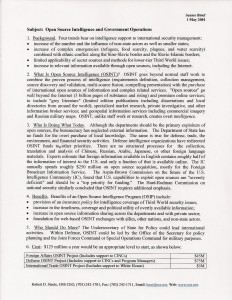
With help from Don Gessaman, Sean O'Keefe at Office of Management and Budget (OMB) was briefied on the need for a national Open Source Program, and agreed in principle to a $125 million first year start. Then he moved to the National and Aeronautics Administration, and the opportunity for a Presidential Initiative was lost.
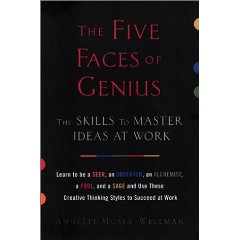
This book will be helpful to every knowledge worker–the title should not scare off the 99% of the population that does not qualify for “genius” status.
Certainly there will be those looking for some magical way to lift themselves from obscurity, or lethargy, or oppression, that that think they are unappreciated geniuses and are simply looking for the window-dressing they need to be recognized. This book is not for them.
What this book does, in a very nice way that reminds one of Drucker's belief that the best work is work as a “calling”–work as a beloved endeavor that brings out the best we have to offer–or of the 7 Habits book that emphasizes the urgency of protecting those activities that are important but not urgent (things like family time, exercise, and freedom from the telephone–or now, email)–is “review the bidding” on five different workstyles, and how to make them better.
In a nutshell, this book is what results when Myers-Briggs and 7 Habits have children, and the children grow up to be artists. It is a good read, and at a minimum it will help *anybody* bring more reflection and more peace back into their daily work routine.