. . . . . . . .The Central Intelligence Agency is deploying teams of spies, analysts and paramilitary operatives on top of the nearly 700 employees it already has in the war-torn country in parallel with a military expansion that will see 68,000 US troops in Afghanistan by year's end. . . . . . . . The incoming spies are receiving a broad range of assignments, including working in tandem with special forces units hunting high-value targets, tracking public sentiment in regions seen as shifting support toward the Taliban and gathering intelligence on corruption in the Afghan government, the Times said.
Chuck Spinney says: Even though OODA loops shaping nutty mass behaviour are becoming ever more disconnected from reality, Frank Rich shows this fact does not imply that the phenomenon of populist rage is not based on some real frustrations, grievances, anxieties, and fears. CS
The New York Times
OP-ED COLUMNIST
Even Glenn Beck Is Right Twice a Day
FRANK RICH
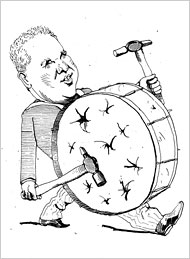
Cartoonist:Barry Blit
Time put Beck on its cover this week. Man of the Year may not be far behind. Beck is not, as many liberals assume, merely the latest incarnation of Rush Limbaugh. He is something different. That’s why he is gaining on his antecedents — and gaining traction in the country’s angrier precincts.
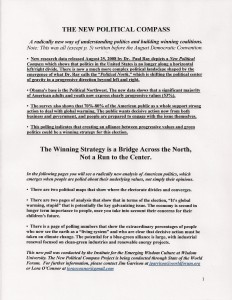
Not to be confused with Jerome Glenn's long-running State of the World endeavor, this conference has engaged the interest of Paul Ray, author of The New Political Compass and earlier, The Cultural Creatives.
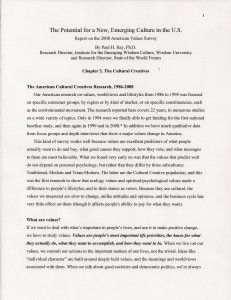
What we found very early on was that the values that predict well do not depend on personal psychology, but rather that they differ by three subcultures: Traditional, Modern and Trans-Modern. The latter are the Cultural Creative population, and this was the first research to show that ecology values and spiritual-psychological values made a difference to people’s lifestyles, and to their stance as voters. Because they are cultural, the values we measured are slow to change, unlike attitudes and opinions, and the business cycle has very little effect on them (though it affects people's ability to pay for what they want).
It’s the way cultures construe reality that matters. Thus, a financial materialism measure is part of what identifies the Modernist subculture, and an ecological measure is part of what identifies the emerging culture of the planet, and the Cultural Creatives. When we put them into a context of politics, they are at the opposite ends of a larger dimension, the tense opposition between a powerful, but recently wounded, business conservatism, versus a large and growing group of new ecological and planetary concerns, which grew out of all the new social movement values and beliefs. The surprise that then emerges across all cultural creatives studies is that this takes on the flavor of something very consequential.
New research data released August 25, 2008 by Dr. Paul Ray depicts a New Political Compass which shows that politics in the United States is no longer along a horizontal left/right divide. There is now a much more complex political landscape shaped by the emergence of what Dr. Ray calls the “Political North,” which is shifting the political center of gravity in a progressive direction beyond left and right.
This polling indicates that creating an alliance between progressive values and green politics could be a winning strategy for this [and future] election(s).
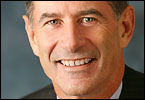
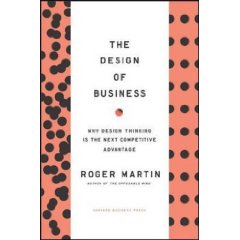
Roger Martin is Dean of the Rotman School of Management at the
University of Toronto
Amazon Page
Pre-order his forthcoming book
In response to the question: What does Wall Street have to change to produce better leaders, a different culture and a more long-term focus?
Forget about it. Don't even waste time thinking about it. The purpose
of Wall Street firms is to trade value for their own benefit not to
build value for the economy either short-term or long-term. While at
one point in its history, a non-trivial part of Wall Street's activity
involved financing the growth of American companies, that is now a
minor piece of its business. Wall Street is primarily engaged in
encouraging individuals and companies to trade value between one
another and tolling the parties for the service, and trading against
the outside economy for its own account.
Phi Beta Iota: This author not only gets it, he provides a solution. Wall Street, and the Fed, need to be creatively destroyed, and we need to restore bottom-up Human Scale locality-based business. Government “regulation” of financial crime is idiocy on top of illusion.