Nine of the ten largest hotels in the world are in Las Vegas. Four of them share one intersection: Las Vegas Boulevard (The Strip) and Tropicana Avenue. Together, these four corners comprise 12,953 rooms, most of which enjoy high occupancy year-round and are often full. Figure 25,000 people huddled on four corners.
The imagery is also appealing to terrorists: Occupying one corner is New York, New York, with a “skyline” that features the Empire State Building, the Chrysler Building, and the Statue of Liberty.
This thought: It is no longer necessary for al-Qaeda terrorists to hijack two Beechcraft C99 planes out of Vegas, as easy as this would be. Instead, why not drive (three-and-a-half hours from Vegas) to Grand Canyon West Airport with a few vans filled with ammonium nitrate (fertilizer) and diesel fuel? Armed with a few baseball bats, one could take command of the airstrip in less than a minute. Then wait for the Beechcrafts to arrive. Loaded with ammonium nitrate (or a low grade chemical or biological agent), these vector weapons could then be dispatched back at Las Vegas, a mere 15 minutes away at full throttle, or Hoover Dam, half the distance.
Phi Beta Iota: This posting was brought to our attention by a patriotic citizen who finds a great deal of common sense on this web site, and none at all within the so-called Department of Homeland Security (DHS). We recollect the period 1990-1994 when Peter Black, Winn Schwartau, and Robert Steele, among others, tried to warn Congress and the Executive about the cyber-threat, to include substantive correspondence to the top National Information Infrastructure security officer, Marty Harris, sounding the alarm. We vividly recollect testifying on behalf of Hackers and trying to tell the Secret Service it should hire them, not torment them. Now we have a government spending hundreds of billions of dollars in the wrong way, and failing to LISTEN to common sense solutions from its citizens.
Need the link for a new book. Review in a few days. Certain to be very favorable, this is precisely the kind of synthesis we need more of. Contrasts with the nine pillars of peace used within the UN which are more functional, will compare and contrast shortly.
East View Cartographic has been and remains our preferred provider of emergency geospatial services, but we like what we see here at MapAction, which appears to be popular in meeting United Nation (UN) needs, so we show them today as Worth a Look.
Sample Entry:
MapAction has published the first edition of its Field Guide to Humanitarian Mapping. The guide, which is downloadable free, will help aid organisations to use geospatial tools and methods in their work in emergencies. There are tutorials for Google Earth and open-source GIS software. Click here to access the guide.
The guide was written to meet the need for practical, step-by-step advice for aid workers who wish to use free and open-source resources to produce maps both at field and headquarters levels. The first edition contains an introduction to the topic of GIS, followed by chapters focused on the use of two recommended free software tools: Google Earth, and MapWindow. However much of the guidance is also relevant for users of other software. In addition there is a chapter on using GPS to collect data during humanitarian emergencies.
The principal author of the guide, MapAction team member Naomi Morris, commented: “We will be trialing the first edition during a three-month mission to Papua New Guinea in which we will show local organisations how to use these methods for disaster risk reduction mapping. More widely, we will welcome input from all our humanitarian organisations and a second edition of the guide will be issued later this year.”
The guide is available free as a PDF download (118 A5-sized pages) from our Resources page or by clicking here. In case of difficulty contactinfo@mapaction.orgThis e-mail address is being protected from spambots. You need JavaScript enabled to view itand a copy can be emailed. We also welcome user feedback and suggestions for content to be included in the next edition.
Production of the guide was funded by the Dulverton Trust.
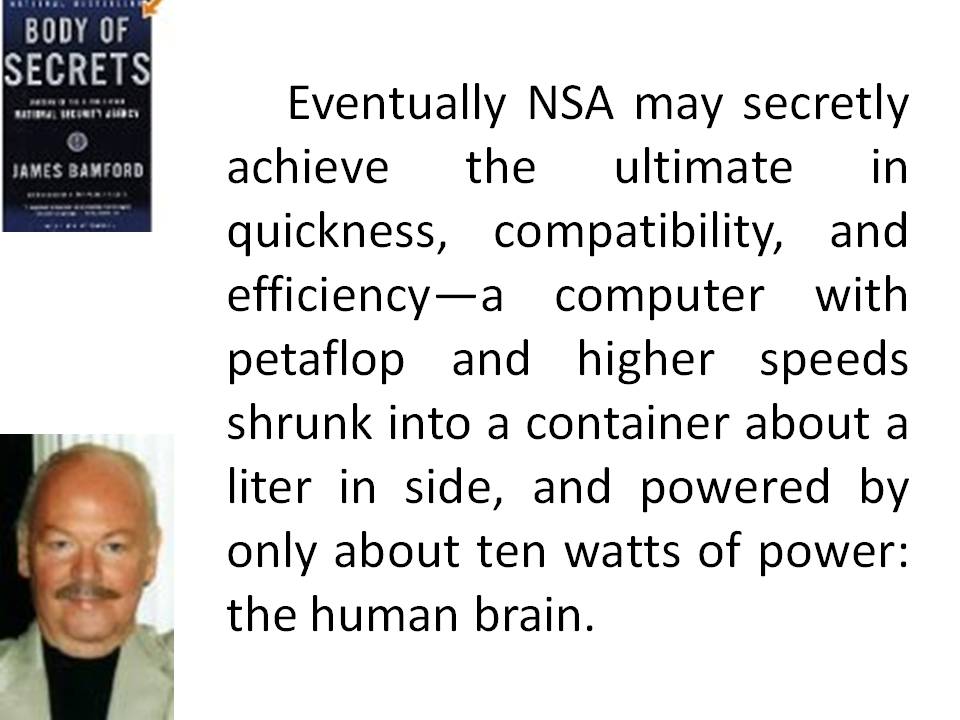
This is, in our humble opinion, the single most important sentence in the entire literature of intellience, from a practical stand-point. There are other sentences on ethics, on leadership, on focus, but in terms of the root nature of the intelligence discipline and all that is wrong with the USA approach to this discipline, this sentence is our favorite.
It is the last sentence on the last page of his second book, BODY OF SECRETS.
Computational Mathematics is the heart of both Google, and Wolfram Alpha. We understand that there are competing initiatives in China that have impressed Jim Fallows, now stationed there for Atlantic Monthly and in Russia. We imagine that both India and Iran have their own approaches underway as well, all emphasizing mathematics applied to bits and bytes.
This endeavor is funded by Stephen Wolfram, who made his fortune creating mathematical models and tools that are from a different planet. His book, A New Kind of Science, is a collector's item and could one day be considered the first step toward true cyber-biological integration.
Today WolframAlpha is highlighting updates and new capabilities in the following arenas:
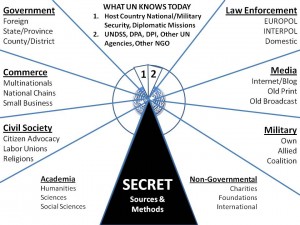
The original conceptual depictions of “competing influences” on individual decision-makers were first developed by Dr. Greg Treverton teaching the Intelligence Policy Seminar at JIF School of Government, and Jack Davis, dean of the U.S. Intelligence Community scholar-analysts. The “eight tribes” (previously seven) are original to Robert Steele. Steele's adaptation of Davis-Treverton first appeared as Figure 17 on page 53 of ON INTELLIGENCE: Spies and Secrecy in an Open World (AFCEA, 2000).



 Placeholder