NIGHTWATCH Extract: Our Friends, our Enemies

08 Wild Cards, Cultural Intelligence, Government, Military

Iraq: Insurgents conducted at least 34 coordinated attacks in 16 cities 0n 25 August. The bombings and other attacks killed 77 people and wounded nearly 400 more. Baghdad experienced five attacks.

NIGHTWATCH Comment: The attacks showed the breadth of the insurgents' operational area. They appear to be the work of a single group, apparently Sunni Arabs or secular Arabs.

The attacks also establish a baseline of the insurgents' ability to coordinate attacks over space and time. This was not a trivial display of the capability to coordinate attacks over long distances. They appear to be a test of the feasibility of taking the next escalation step in the insurgency.

Some outside entity is funding a new, most likely Sunni Arab, insurgency and has afforded its leadership the command and control capability for today's attacks.   Look to Kuwait and Saudi Arabia.

NIGHTWATCH KGS Home

Phi Beta Iota: Emphasis added above.  The US Government (not America the Beautiful or the big-hearted American public) is called a “useful idiot” in most of the world precisely because it mixes hubris and naivete with vast amounts of money spent without a strategy and without accountability.  It took too long to understand the Saudi funding behind the global spread of virulent Wahhabism, while the equivalent funding to the Bush family and others assured that at the political and policy level, our enemies the Saudis would remain conveniently and unethically our friends.

See Also:

Journal: Nuclear War Against Iran…Again
23 Worst Tyrants/Dictators (Yes, there’s more than 23) and Oops, there’s Saudi Arabia..
NIGHTWATCH Extract: Dictators vs Iran in Middle East
Review: Breaking the Real Axis of Evil–How to Oust the World’s Last Dictators by 2025
Review: The CIA in Iran–The 1953 Coup and the Origins of the US-Iran Divide
Review: The Health of Nations–Society and Law beyond the State
Review: Threshold–The Crisis of Western Culture
Review: Wars of Blood and Faith–The Conflicts That Will Shape the 21st Century
Worth a Look: Book Reviews on Empire as Cancer Including Betrayal & Deceit


Journal: Brains Beat Algorithms….Again

04 Education, Advanced Cyber/IO, Analysis, Citizen-Centered, Civil Society, Collective Intelligence, info-graphics/data-visualization, InfoOps (IO), IO Sense-Making, Methods & Process, Politics of Science & Science of Politics, Tools
Full Story Online

Today's issue of Nature contains a paper with a rather unusual author list. Read past the standard collection of academics, and the final author credited is… an online gaming community.

Scientists have turned to games for a variety of reasons, having studied virtual epidemics and tracked online communities and behavior, or simply used games to drum up excitement for the science. But this may be the first time that the gamers played an active role in producing the results, having solved problems in protein structure through the Foldit game. (Also related, TED talk on how gaming can make a better world).

See Also:

Graphic: Jim Bamford on the Human Brain

2010: Human Intelligence (HUMINT) Trilogy Updated

Review (DVD): 2012

5 Star, Complexity & Catastrophe, Culture, DVD - Light, Reviews (DVD Only)
Amazon Page

5.0 out of 5 stars Normally a Four, Seek to Balance Threes


August 25, 2010

John Cusack

This movie held the attention of my youngest son and myself, and that is a non-trivial accomplishment. Despite the usual and totally insipid tear-jerking moments, the movie is over-all startlingly effective with truly awesome creative graphics and augmented reality.

On multiple levels, I found this movie worthy, and while I would normally have made it a four, am kicking it up to a five. I like the comments of the top reviewers, but disagree with their three ratings.

Review: State of the World 2010–Transforming Cultures–From Consumerism to Sustainability

5 Star, America (Founders, Current Situation), Atlases & State of the World, Best Practices in Management, Complexity & Catastrophe, Culture, Research, Disaster Relief, Disease & Health, Economics, Education (General), Education (Universities), Environment (Problems), Environment (Solutions), True Cost & Toxicity, Values, Ethics, Sustainable Evolution, Voices Lost (Indigenous, Gender, Poor, Marginalized)
Amazon Page

5.0 out of 5 stars Top of the Fives, A Bold Departure Elegantly Executed

August 25, 2010

Erik Assadourian et al

I've become someone jaundiced about the State of the World series, while always respecting the persistence of Lester Brown (Peter Drucker called people like us “mono-maniacs” essential as change agents), but this one knocked me off my seat just with the table of contents. From there I went to the Notes and saw a number of books new to me. You can visit Phi Beta Iota the Public Intelligence Blog to see the 1,600+ that I have reviewed, sorted into 98 non-fiction categories.

My first note:

A triumph, the most interesting, diverse, and relevant of the series to date. A bold departure, “just in time.”

The book opens with a timeline over multiple pages with illustrations, and the notes are worthy. The timeline is compelling broad view that I found very helpful, and would like to see more of.

Continue reading “Review: State of the World 2010–Transforming Cultures–From Consumerism to Sustainability”

Journal: Newsweek on SecDef Departure

10 Security
Marcus Aurelius Recommends

Why Gates Seems Set on a 2011 Departure, by Jim Watson. So Robert Gates is set on retiring from government – for the second time. Or so he says. In an interview with ForeignPolicy.com, he has repeated more firmly than ever his desire to resign as secretary of defense sometime in 2011.

Why would he decide on 2011, and not 2010 or 2012? Strange but true: the arcane workings of the Pentagon budget process are one of the key factors behind his timing. Drawing up the annual defense budget – especially one now totaling $719 billion – is so complex that each exercise actually takes close to two years. Thus, the defense budget for 2012, the last year of President Obama's term in office, is already taking shape. Its unveiling in February of next year will place a capstone on Gates's extraordinary career.

Phi Beta Iota: The magazine appears poorly informed on several fronts, and most obviously, fails to recognize Senator Chuck Hagel as a possible successor to Gates.  Whoever it is, they are going to have to come in with a strategic analytic perspective that gives them a grip on reality, and an absolute non-negotiable mandate from Congress and the President to re-do Title 10 while also redirecting the CINCdoms into Whole of Government multinational information-sharing and sense-making networks.  Leon Panetta?  Why not Rahm Emanuel or David Axelrod?

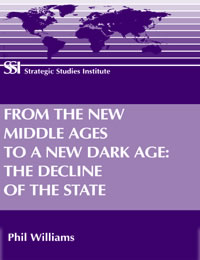
Reference: From the New Middle Ages to a New Dark Age–The Decline of the State and U.S. Strategy

Monographs

Full Monograph Online

Brief Synopsis

Security and stability in the 21st century have little to do with traditional power politics, military conflict between states, and issues of grand strategy. Instead they revolve around the disruptive consequences of globalization, declining governance, inequality, urbanization, and nonstate violent actors. The author explores the implications of these issues for the United States. He proposes a rejection of “stateocentric” assumptions and an embrace of the notion of the New Middle Ages characterized, among other things, by competing structures, fragmented authority, and the rise of “no-go” zones. He also suggests that the world could tip into a New Dark Age. He identifies three major options for the United States in responding to such a development. The author argues that for interventions to have any chance of success the United States will have to move to a trans-agency approach. But even this might not be sufficient to stanch the chaos and prevent the continuing decline of the Westphalian state.

20 Things Learned From Traveling Around the World for Three Years

Civil Society, Cultural Intelligence, Government, Media

Gary Arndt, Author of Everything-Everywhere.com
August 23, 2010

On March 13, 2007, I handed over the keys to my house, put my possessions in storage and headed out to travel around the world with nothing but a backpack, my laptop and a camera.

Three and a half years and 70 countries later, I've gotten the equivalent of a Ph.D in general knowledge about the people and places of Planet Earth.

Here are some of the things I've learned:

1) People are generally good

2) The media lies

3) The world is boring

4) People don't hate Americans

5) Americans aren't as ignorant as you might think

6) Americans don't travel

7) The rest of the world isn't full of germs

8 ) You don't need a lot stuff

9) Traveling doesn't have to be expensive

10) Culture matters

12) Everyone is proud of where they are from

13) America and Canada share a common culture

14) Most people have a deep desire to travel around the world

15) You can find the internet almost everywhere

16) In developing countries, government is usually the problem

17) English is becoming universal

18) Modernization is not Westernization

19) We view other nations by a different set of criteria than we view ourselves

20) Everyone should travel

Full article here to see elaborations for each of the twenty entries

noble gold