Who’s Who in Collective Intelligence: John N. Warfield

About the Idea, Alpha V-Z, Collective Intelligence

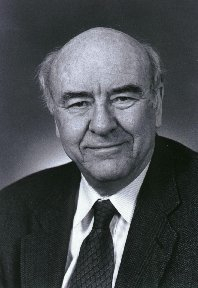
Dr. John N. Warfield (1925-2009) was emeritus professor and director of the Institute for Advanced Study in the Integrative Sciences (IASIS) at George Mason University.

He has been elected President of the Systems, Man, and Cybernetics Society of the Institute of Electrical and Electronics Engineers, and of the International Society for the Systems Sciences (formerly called the Society for General Systems Research). He served as Editor of the IEEE Transactions on Systems, Man, and Cybernetics from 1968 to 1971, and as founding Editor-in-Chief of the Pergamon journal Systems Research, during the period 1981-1990. Warfield is a member of the Academic Committee of the International Encyclopedia of Systems and Cybernetics.

He is a Life Fellow of the Institute of Electrical and Electronics Engineers, and holds that organization's Centennial Medal. He is a member of the Association for Integrative Studies.

In 2006 John N. Warfield was awarded the Joseph G. Wohl Award for Career Achievement at the 2006 annual meeting of the IEEE Systems, Man, and Cybernetics Society. This is the highest award given by the society, and is not awarded every year. He was awarded for his contributions to systems engineering concepts, methodology, design, education and management. Warfield was also awarded the IEEE Third Millennium Medal.

Wikipedia Biography & Links

His Most Relevant Online Work

GMU Digital Exhibit

GMU Special Collection (100 Boxes)

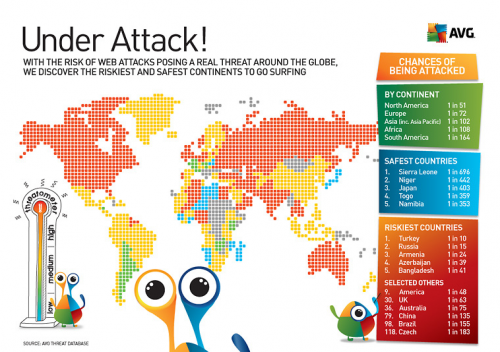
South America #1, Africa #2, Asia #3 Safest Continents for Web

08 Wild Cards, Computer/online security, Cyberscams, malware, spam, Technologies
Source article (WhiteAfrican.com)

Africa: The 2nd Safest Continent to Surf the Web

by HASH on August 23, 2010

Here’s an interesting study by AVG on internet security, asking “Where in the World are you most likely to be hit by a malicious computer attack or virus?”.

Apparently, and surprisingly to me, the answer is “not Africa” or South America.

“During the last week of July, AVG researchers compiled a list of virus and malware attacks by country picked up by AVG security software. This means we have compiled data from over 127 million computers in 144 countries to determine the incidence rates of virus attacks by country.”

Dirk Singer, of AVG sent over the list of African countries, here they are country-by-country. As you can see, sub-saharan Africa is compatively ‘safe’ compared to other areas of the World. Your chances of being attacked while surfing the web in each country are:

North Africa

  • Egypt 1 in 62.4
  • Algeria 1 in 86.9
  • Libya 1 in 87.7
  • Mauritania 1 in 92.4
  • Tunisia 1 in 110.7
  • Morocco 1 in 112.1

Continue reading “South America #1, Africa #2, Asia #3 Safest Continents for Web”

Searches (3): Golden Candle, OSINT, Platinum Awards

About the Idea, Awards 1992-2006, Historic Contributions
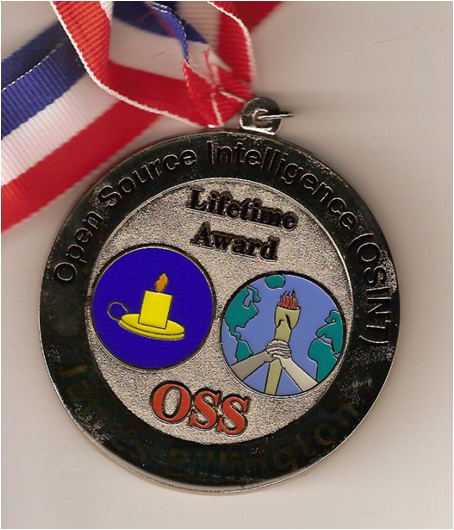
OSS Platinum Award

The PLATINUM Lifetime Awards of the Golden Candle Award were given out in 2006 to ten individuals and one couple (Alvin & Heidi Toffler).  A twelfth award was ultimately given in 2008 to Emmanuel Goldstein for Hackers on Planet Earth (HOPE).

OSS Golden Candle Award

Golden Candle Awards were given out from 1992 to 2006 to 122 individuals and 50 organizations (some overlap).

The two together comprise the only persistent global recognition endeavor with respect to Open Source Intelligence (OSINT).

OSS Golden Candle Awards Alphabetical Sort

OSS Golden Candle Awards Country/Organization Sort

Reference: Citation Analytics 201

About the Idea, Advanced Cyber/IO, Analysis, Analysis, Articles & Chapters, Augmented Reality, Balance, Budgets & Funding, Collaboration Zones, Collective Intelligence, Communities of Practice, History, ICT-IT, info-graphics/data-visualization, InfoOps (IO), Maps, Methods & Process, Multinational Plus, Policies, Policies-Harmonization, Policy, Political, Politics of Science & Science of Politics, Power Behind-the-Scenes/Special Interests, Processing, Real Time, Research resources, Secrecy & Politics of Secrecy, Strategy-Holistic Coherence, Threats, Tools, Tribes

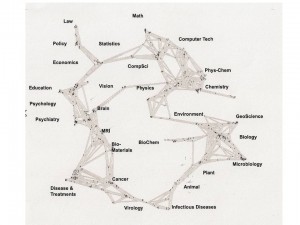
Phi Beta Iota: Most serious analysts now understand Citation Analytics 101.  It's time to move to Citation Analytics 202, and there is no better way to introduce the art of the possible than by pointing to Kevin W. Boyack, Katy Borner, and Richard Klavans (2007), “Mapping the Structure and Evolution of Chemistry Research (11th International Conference of Scientometrics and Infometrics, pp. 112-123.

Full Article with Color Graphics
Graphic as Printable Single Page PPT

There are several take-aways from this article, which is more or less the “coming out” of the Klavens-inspired infometrics field now that he has won his law-suit and has unchallenged access to all Institute of Scientific Information (ISI) access [this was one of the sources we used to win the Burundi Exercise before the Aspin-Brown Commission in 1995].

Continue reading “Reference: Citation Analytics 201”

Journal: DoD, WikiLeaks, JCS, Security Ad Naseum…

07 Other Atrocities, Civil Society, Corruption, Ethics, Government, InfoOps (IO), Intelligence (government), IO Impotency, Journalism/Free-Press/Censorship, Media, Methods & Process, Military, Officers Call, Secrecy & Politics of Secrecy

Defense News August 23, 2010

Experts: DoD Could Have Prevented WikiLeaks Leak

By William Matthews

While senior Pentagon officials resort to bluster in hopes of preventing the WikiLeaks website from posting any more secret Afghan war documents on the Internet, security experts say there is a lot the U.S. military could have done to prevent the classified documents from being leaked in the first place.

Steps range from the sophisticated — installing automated monitoring systems on classified networks — to the mundane — disabling CD burners and USB ports on network computers.

“The technology is available” to protect highly sensitive information, said Tom Conway, director of federal business development at computer security giant McAfee. “The Defense Department doesn’t have it, but it is commercially available. We’ve got some major commercial clients using it.”

Full Article Below the Line (Not Easily Available on Internet); Lengthy Comment Follows Article

Continue reading “Journal: DoD, WikiLeaks, JCS, Security Ad Naseum…”

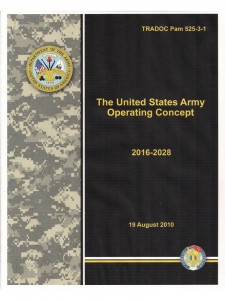
Reference: 2010 U.S. Army Operating Concept

DoD
Full Document Online

Marcus Aurelius Comments:

The Army Operating Concept, describes how future Army forces conduct operations as part of the joint force to deter conflict, prevail in war, and succeed in a wide range of contingencies in the future operational environment. It describes the employment of Army forces in the 2016-2028 timeframe with emphasis on the operational and tactical levels of war.  The Army Operating Concept (AOC) explains how the Army will comply with and execute guidance derived from the Army Capstone Concept (ACC) released in January 2009. The AOC will guide revisions in Army doctrine, organizations, training, materiel, leadership and education, personnel, and facilities (DOTMLPF). It also serves as a bridge between the ACC and war fighting functional concepts, and enhances integration of Army forces with a wide array of domestic and international partners.

A major theme in the ACC which the AOC seeks to implement is Operational Adaptability – defined as operating under conditions of uncertainty and complexity. Key to this concept is the Army's ability to simultaneously execute multiple variations of operations such as conducting combined arms maneuver and wide area security within the context of full spectrum operations.

Continue reading “Reference: 2010 U.S. Army Operating Concept”

noble gold