NIGHTWATCH Extracts: Koreas, Iran, Sudan

05 Iran, 08 Wild Cards, IO Sense-Making, Peace Intelligence

South Korea: For the first time in seven years, South Korea has lit a 100-foot tower in the shape of a Christmas triee with 100,000 Christmas lights and topped it with a cross, along the Demilitarized Zone. A choir sang Christmas carols. The tower and carols could be seen and heard in North Korea.

. . . . . . .

Afghanistan-Iran: Iran is blocking almost 2,000 fuel tankers from crossing the border into Afghanistan, saying the trucks would supply U.S.-led coalition troops, according to Afghan officials. The unannounced blockade is in its third week, and Afghan officials do not know when fuel imports will resume, Afghan Deputy Minister of Commerce Sharif Shairifi said.

. . . . . . .

Sudan: Update. Egyptian President Hosni Mubarak, Libyan leader Moammar Gadhafi and Mauritanian President Mohamed Ould Abdelaziz held talks with Sudanese President Omar al Bashir and Southern Sudanese leader Salva Kiir in Khartoum on 21 December in anticipation of the coming referendum on Southern Sudanese independence.

NIGHTWATCH KGS Home

Phi Beta Iota: All three pieces with the commentary are worth reading.  Even when wrong, the intellectual process and insights of the NIGHTWATCH leader are authentic, deep, and a real pleasure to consider.

1.  Wrong.  South Korea should not be provoking the North, and the US is long overdue from pulling out of South Korea.  This is a regional matter and like Germany, reunification is inevitable.  Meanwhile, the US military and the US taxpayer should not be burdened.

2.  Right.  Iran is Persia, and complicated.  The US supply lines to Afghanistan, and US cultural and doctrinal inadequacies in Afghanistan, combined with the FACT that it is costing the US taxpayer $50 million per Taliban body, the US is PAYING for the Taliban drug crop, and the US is blindly accepting of Karzai's deep deep corruption, all argue for a redirection of attention away from Afghanistan and toward respectful engagement with the Iran-Turkey axis of sensibility.

3.  Wrong.  Sudan is a bomb waiting to explode.  They may go through the motion of a vote, but the raw fact that the south has the wealth and the north has nothing means that strategic instability is inevitable.  Absent a regional plan to achieve tolerable prosperity for all, this is theater.  The US and the Arabs are settling for theater over thinking.

2011 Top 10 Cyber Predictions (and Then Some)

Collaboration Zones, Communities of Practice, Computer/online security, Cyberscams, malware, spam, InfoOps (IO), IO Multinational, IO Sense-Making, IO Technologies, Key Players, Methods & Process, Mobile, Officers Call, Policies, Real Time, Secrecy & Politics of Secrecy, Standards, Strategy, Technologies, Threats

2011 Top 10 Cyber Predictions

Posted by Anup Ghosh on December 16, 2010

Everybody is putting out their Top 10 lists of predictions for 2011. Not to be left out of the party, below is a list of what we expect to see in 2011 in Cyber Security.

1.  Malware.

2.  Blame the User.

3.  Reactive approaches to security will continue to fail.

4.  Major Breaches in Sectors with Intellectual Property.

5.  Hacktivists will bask in their new-found glory.

6.  Critical Infrastructure Attacks.

7.  Hello Android.

8.  Windows Kernel Exploits.

9.  Organized Crime rises.

10.  Congress will rear its head.

Read full paragraph that goes with each of the above….

Phi Beta Iota: Nothing wrong with any of the above, except that they are out of context.  As the still-valid cyber-threat slide created by Mitch Kabay in the 1990's shows, 70% of our losses have nothing to do with disgruntled or dishonest insiders, or external attacks including viruses.  Cyber has not been defined, in part because the Human Intelligence crowd does not compute circuits, and the circuit crowd do not computer human intelligence.  We are at the very beginning of a startling renaissance in cyber/Information Operations (IO) in which–we predict–existing and near-term hardware and software vulnerabilities will be less than 30% of the problem.  Getting analog Cold War leaders into new mind-sets, and educating all hands toward sharing rather than hoarding, toward multinational rather than unilateral, will be key aspects of our progress.  Cyber is life, life is cyber–it's all connected.  Stove-piped “solutions” make it worse.

See Also:

Graphic: OODA Loop (Observe, Orient, Decide, Act)

Journal: 1 in 4 Fail US Army Extrance Exam

Journal: Development at Gunpoint? Wasteful & Wrong

Undersea Cables: The Achilles Heel of our Economies

Journal: NSA Assumes It Has Been Compromised…Correct!

Reference: Frog 6 Guidance 2010-2020

Journal: 1 in 4 Fail US Army Extrance Exam

Collective Intelligence, Cultural Intelligence
DefDog Recommends...

APNewsBreak: Nearly 1 in 4 fails military exam

CHRISTINE ARMARIO and DORIE TURNER
AP News

Dec 21, 2010 19:05 EST

Nearly one-fourth of the students who try to join the U.S. Army fail its entrance exam, painting a grim picture of an education system that produces graduates who can't answer basic math, science and reading questions, according to a new study released Tuesday.

. . . . . .

The military exam results are also worrisome because the test is given to a limited pool of people: Pentagon data shows that 75 percent of those aged 17 to 24 don't even qualify to take the test because they are physically unfit, have a criminal record or didn't graduate high school.

Read rest of the article….

Phi Beta Iota: Information Operations (IO) starts in the public schoolhouse.  On the battlefield, the “strategic corporal” may have the fate of an entire division in their hands.  It's time to get back to basics.  Side note: corporations struggling with the failure of schools including colleges are now focusing on identifying “trainable” individuals who can be remediated toward full performance.  Restoring universal service and creating a common boot camp followed by branching into Home Service, Peace Corps, or Armed Forces would be one way to raise the over-all level.  Dumping the age requirements and creating both mid-career and retired categories of specialists is another solution.  IO is about human brains–collective intelligence–it more about humanity in action than it is about technology or the security of bits and bytes–the latter are support functions, not primary functions.

Event: 1100-1400 21 January McClean VA DNI Jim Clapper (1245) & EJ Kimball (1100) Speak

Uncategorized

REGISTRATION FOR AFIO NATIONAL WINTER LUNCHEON

FRIDAY, 21 January 2011

1 p.m. speaker

The Honorable
James R. Clapper, Jr.
Director of National Intelligence

Remarks are OFF THE RECORD

11 a.m. speaker

E. J. KIMBALL

Director, Government Relations Strategic Engagement Group, Jorge Scientific Corp., on this important, multi-author new book,
Shariah: The Threat to America

Check in for badge pickup at 10:30 a.m.
Lunch is served at noon
Event closes at 2 p.m.

Complete Form and Pay at This Link

Journal: NSA Assumes It Has Been Compromised…Correct!

Computer/online security, InfoOps (IO), Intelligence (government), Methods & Process, Open Government, Reform, Secrecy & Politics of Secrecy, Standards, Strategy, Technologies, Waste (materials, food, etc)

U.S. Code-Cracking Agency Works As If Compromised. The U.S. government's main code-making and code-cracking agency now works on the assumption that foes may have pierced even the most sensitive national security computer networks under its guard.

“There's no such thing as ‘secure' any more,” Debora Plunkett of the National Security Agency said on Thursday amid U.S. anger and embarrassment over disclosure of sensitive diplomatic cables by the website WikiLeaks.

“The most sophisticated adversaries are going to go unnoticed on our networks,” she said.

Plunkett heads the NSA's Information Assurance Directorate, which is responsible for protecting national security information and networks from the foxhole to the White House.

“We have to build our systems on the assumption that adversaries will get in,” she told a cyber security forum sponsored by the Atlantic and Government Executive media organizations.

The United States can't put its trust “in different components of the system that might have already been violated,” Plunkett added in a rare public airing of NSA's view on the issue. “We have to, again, assume that all the components of our system are not safe, and make sure we're adjusting accordingly.”

The NSA must constantly fine tune its approach, she said, adding that there was no such thing as a “static state of security.”

More than 100 foreign intelligence organizations are trying to break into U.S. networks, Deputy Defense Secretary William Lynn wrote in the September/October issue of the journal Foreign Affairs. Some already have the capacity to disrupt U.S. information infrastructure, he said. Plunkett declined to comment on WikiLeaks, which has started releasing a cache of 250,000 diplomatic cables, including details of overseas installations that officials regard as vital to U.S. security.

Official have focused publicly on Army Private Bradley Manning, who is being detained at a Marine Corps base in Quantico, Virginia, as the source of the leak.

NSA, a secretive Defense Department arm that also intercepts foreign communications, conceives of the problem as maintaining the availability and assuring the integrity of the systems it guards, rather than their “security,” she said.

NSA – which insiders jokingly used to say referred to “No Such Agency” – also focuses on standardization and auditing to hunt for any intrusions, Plunkett said. She referred to the development of sensors for eventual deployment “in appropriate places within our infrastructure” to detect threats and take action against them.

Mike McConnell, a retired Navy vice admiral who headed the NSA from 1992 to 1996, told the forum he believed no U.S. government network was safe from penetration.

A third-party inspection of major computer systems found there was none of consequence “that is not penetrated by some adversary that allows the adversary, the outsider, to bleed all the information at will,” said McConnell, director of national intelligence from 2007 to 2009 and now leader of the intelligence business for the Booz Allen Hamilton consultancy.[Wolf/Reuters/18December2010]

Phi Beta Iota: In 1992 NSA knew that shrink-wrapped hardware and software coming across its loading dock was pre-compromised with both hardware and software viruses, Trojan Horse backdoors, and so on.  In 1994 the National Information Infrastructure “leadership” refused to address the need for a $1 billion a year national cyber-security program.  Since then it has simply gotten worse, with the latest (in the last four years) being the ability of the Chinese to ride the electrical circuits into any computer (think of your Best Buy ethernet extender that uses the wiring as a pass through).  The good news is that 90% of what we have behind the green and black doors is not really secret or in such obscure minutia as to be immaterial to national security.  What we should be doing, in our view as the proponent for public intelligence, is this:

1.  Default both Whole of Government and Multinational Engagement to unclassified.  Civil Affairs can lead the way with the Joint Civil Affairs Information Management Sytem that feeds the high side everything, but keeps the open system open.

2.  Set a notional limit of 10% of what can be classified secret within any Embassy, roughly 8% for the spies and 2% for everyone else.

3.  Take the most sensitive stuff completely off the electrical grid (the real reason NSA wants its own power station at Fort Meade and in Utah).

4.  Invest one third of the cyber-war budget, whatever it ends up being (probably half), in education & research relevant to all stakeholders, not just the national security community.  It is not possible to have smart safe spies within a dumb unsafe nation.  It's all connected.

Turning away from secrecy is the single best thing we can do as a government, as a military, as a nation.  It will yield productivity and innovation and foreign relations dividends beyond our dreams.

Everybody who's a real practitioner, and I'm sure you're not all naïve in this regard, realizes that there are two uses to which security classification is put: the legitimate desire to protect secrets, and the protection of bureaucratic turf. As a practitioner of the real world, it's about 90 bureaucratic turf; 10 legitimate protection of secrets as far as I am concerned.

Rodney McDaniel, then Executive Secretary of the National Security Council, to a Harvard University seminar, as cited in Thomas P. Croakley (ed), C3I: Issues of Command and Control (National Defense University, 1991). Page 68.


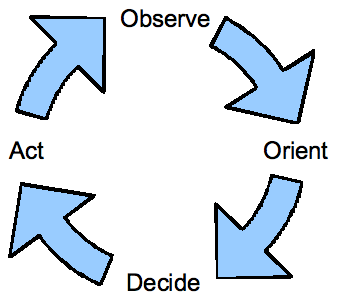
Graphic: OODA Loop (Observe, Orient, Decide, Act)

Advanced Cyber/IO, Analysis, Citizen-Centered, Innovation, Processing, Strategy-Holistic Coherence

Simplified:

Click to Enlarge

Nuanced:

Click to Enlarge

Credit Simplied

Credit Nuanced

See Also:

Journal: Spinney, Boyd, Green, Kuhn on “Can America Be Salvaged?–Public Intelligence Aspects”

Review: Boyd–The Fighter Pilot Who Changed the Art of War

Review (Guest): Science, Strategy and War–The Strategic Theory of John Boyd

Undersea Cables: The Achilles Heel of our Economies

03 Economy, 07 Other Atrocities, 11 Society, Computer/online security

Franz-Stefan Gady

Franz-Stefan Gady

Foreign policy analyst, EastWest Institute

Huffington Post, Posted: December 21, 2010 02:20 PM

In December 2008 within milliseconds, Egypt lost 70 percent of its connection to the outside Internet. In far away India, 50 to 60 percent of online connectivity similarly was lost. In Pakistan, 12 million people were knocked offline suddenly, and in Saudi Arabia, 4.7 million were unable to connect to the Internet. The economic costs of this 24-hour outage: approximately 64 million dollars.

The recent revelations by WikiLeaks of U.S. national security interests in critical infrastructure vulnerabilities mention the often neglected underpinning of the current connectivity revolution sweeping the planet–undersea cables. In December 2008, four undersea cables were cut simultaneously, affecting Internet users all over the world. While cable cuts happen from time to time nothing, the scope of the cuts illustrate the exposure of our economies to disruption once we lose connectivity.

Read full article….

Phi Beta Iota: In 1990 Peter Black published a “top ten” hit list for cyber-space in WIRED Magazine, and the conventionals went nuts.  Shortly thereafter Winn Schwartau testified to Congress on the possibilities of an electronic Pearl Harbor, and Robert Steele added to the conventional hysteria by pointing out that absent “action this day,” there would indeed be a day off reckoning in the future.  Now here's the key bit (not byte):  Information Operations (IO) is mostly about information access, assurance, and analysis. It's about ensuring that the OODA (Observe, Orient, Decide Act) Loop for all deciders, all action officers, all front-line mission specialists, is as good as it can get.  It's about culture, education, leadership, mentoring. A huge part of that lies in addressing human errors & omissions, fully 50% of the data or capability loss; and in the design of the over-all global, national, state, and local information architectures.  Redundancy, for example–but we still have companies putting BOTH cables in the same ditch where they can be cut by ONE swipe of a backhoe….  The underwater cables (not just in the ocean but in inland waters as well) have been pointed out as the Achilles heel since at least 1990, 20 years ago.  One wonders what it will take …..

See Also:

Journal: Weaponizing Web 2.0

Journal: Information Security Seven Guiding Principles

1994 Sounding the Alarm on Cyber-Security

Review: INFORMATION WARFARE–Chaos on the Electronic Superhighway

Review: Terminal Compromise

noble gold