Journal: When are Leaks Good for Society?

04 Inter-State Conflict, 05 Civil War, 07 Other Atrocities, 08 Wild Cards, 09 Justice, 10 Security, Civil Society, Collective Intelligence, Corruption, Ethics, Government, Law Enforcement, Military, Peace Intelligence

Marcus Aurelius Recommends

Charges for Soldier Accused of Leak

The New York Times

By STEVEN LEE MYERS
July 6, 2010
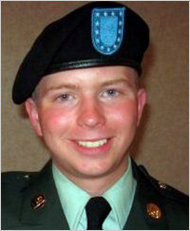
PFC Bradley E. Manning

BAGHDAD — An American soldier in Iraq who was arrested on charges of leaking a video of a deadly American helicopter attack here in 2007 has also been charged with downloading more than 150,000 highly classified diplomatic cables that could, if made public, reveal the inner workings of American embassies around the world, the military here announced Tuesday.

Army intelligence analyst charged in Wikileaks case
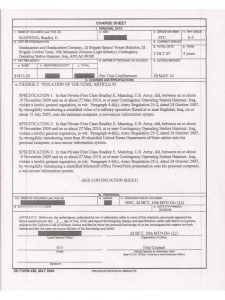
Four Page Charge Sheet

By Leila Fadel

Washington Post Foreign Service
Wednesday, July 7, 2010

BAGHDAD — The military said Tuesday that it has charged an Army intelligence analyst in connection with the leak of a controversial video and the downloading and transfer of classified State Department cables, in a case that is likely to further deter would-be whistleblowers.

Click on headlines to read each full story.

Phi Beta Iota: PFC Manning swore an oath to defend the Constitutions, not the chain of command and not the secrecy of immoral, illegal, and unaffordable policies that are funded by the U.S. taxpayer and done “in our name” but not at all in our interest.  Sunshine is the best disinfectant.

His charge sheet rests on “discrediting the Armed Forces” which is laughable–it is the behavior of our leaders that is a discredit to all of America; and on subverting “good order and discipline.”  His behavior in revealing the webs of deceit and incompetence that characterize our military, our “diplomats,” and our spies is precisely what America needs in order to re-establish good order and discipline in harmony with our Constitution.

America needs MORE leaks, MORE “misbehavior,” because we now suffer a “system” that is so far removed from the Founding Fathers' vision, and so deeply divorced from the principles enshrined in our Constitution, that we must, without question, consider PFC Manning to be a “just man” whose best place in a time of injustice is to be in jail as an example to us all.  BRAVO ZULU for courage and intelligence in the face of the enemy–he is us.  If the lawyer for the defense has any integrity at all, this will be a public jury trial and the PFC will walk free, as he should.  It's time to trash this pathological system and get back to the basics of freedom and a foreign policy of commerce and peace.

Wikipedia on Civil Disobedience

Civil Disobedience (Resistance to Civil Government) is an essay by Henry David Thoreau that was first published in 1849. It argues that people should not permit governments to overrule or atrophy their consciences, and that people have a duty to avoid allowing such acquiescence to enable the government to make them the agents of injustice. Thoreau was motivated in part by his disgust with slavery and the Mexican-American War.

Resistance also served as part of Thoreau's metaphor which compared the government to a machine, and said that when the machine was working injustice it was the duty of conscientious citizens to be “a counter friction” (i.e., a resistance) “to stop the machine”.
NIGHTWATCH Extract: China Wages Peace with Railroads Across Pakistan and Into Afghanistan

02 China, 03 India, 08 Wild Cards, Commercial Intelligence, Peace Intelligence

India: Minister of State for Defense M. M. Pallam Raju on 7 July said India is concerned about China's plans to build a rail link with Pakistan through the Karakoram mountain range, The Times of India reported. He said India is planning to take countermeasures against the proposed link.

Comment: This is one of four strategically significant rail projects in Asia. All are important in the UN master plan for Asian railroads, but several stand out.

The first is the Chinese project to build a railroad line in Afghanistan that runs southward from the Oxus River to China's Aynak Copper Mine in Logar Province. This is one of the largest, if not the largest, copper deposit in the world. Eventually it could become the leading edge of mineral extraction projects that could transform Afghanistan a generation from now, if security conditions permit.

The second project is the Iranian railroad to Herat, in western Afghanistan. This is moving ahead slowly, but follows a hard road already built by the Iranians. It will tie relatively quiet Herat and western Afghanistan to the economic market area of Mashhad, Iran's second largest city, when completed.

The third rail project with strategic significance is in North Korea, which has two sub-projects that can complete the link of Europe by rail to Japan. Completion of these long delayed spurs depend on whether whoever runs anything in North Korea ever gets a sound grip on their own economic best interests and permit upgrades to the Chinese and to the Russian spurs that run across the Demilitarized Zone and link to the South Korean rail systems that terminate at Pusan. A ferry ride across the Tsushima Strait links to Japan railroads and Tokyo. London to Tokyo by rail is in sight, if the North Koreans would only decide to become prosperous.

The latest project is that announced for Pakistan. In the 1971 general war with India, only Chinese truck convoys through the Karakoram Mountains via the Khunjerab Pass kept Pakistan in the war for the two weeks it actually fought before suing for peace and losing East Pakistan.

The Khunjerab Pass is the highest elevation paved international border at 15,400 ft above sea level. The railroad would presumably follow the Karakoram Highway, which is the highest paved road in the world.

A rail link through those mountains and that pass would link Xinjiang, China, to Karachi and Gwadar – the Chinese built port in southwestern Pakistan on the Indian Ocean — via the Pakistani rail system. The throughput capacity would be exponentially larger than that achievable by truck convoys.

This railroad will create a new market system. No wonder India is concerned, economically and militarily. Pakistan really would become an extension of the new Chinese economic empire. All China needs to do is to complete railroads through Burma and link the Afghanistan line to Iran and it will have an Asian rail empire, within a generation, all the way to the English Channel without using the Trans-Siberian.

NIGHTWATCH HOME

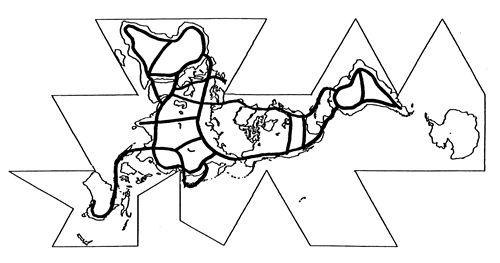
Phi Beta Iota: This is the kind of strategic analysis rooted in solid intellect that should characterize the entire US Intelligence Community, not one lone individual.  Three big things appear to be looming on the horizon:  free cellular around the planet, monetizing the transactions instead of the connections; low-cost rail (and eventually the Buckminster Fuller electrical grid) girding the globe; and finally, the up-ending of capitalism to focus on the needs–and wealth-creating capabilities–of the five billion poor.  No one in Washington, London, Paris, Bonn, or Toyko–or even New Delhi and Jakarta where they have the most to gain–is thinking about this.  That is a crime against humanity, a moral and intellectual atrocity so horrendous as to call into question the legitimacy of every government.

Event Report: 30 Jun-1 July, NYC – ICSR Peace and Security Summit

01 Poverty, 03 India, 04 Indonesia, 05 Civil War, 05 Iran, 08 Wild Cards, 09 Terrorism, 10 Security, 10 Transnational Crime, 12 Water, Academia, Civil Society, Collective Intelligence, Corruption, Cultural Intelligence, Government, History, Law Enforcement, Methods & Process, Military, Non-Governmental, Peace Intelligence, Policy, Strategy, Technologies
Event link

Peace and Security Summit Event Report/Notes

+ Host: London-based International Centre for the Study of Radicalization and Political Violence

+ Partners, Affiliates, Financial Support: National Defense Univ, Rena & Sami David, The Rockefeller Foundation, Public Safety Canada, Center on Global Counterterrorism Cooperation, Centre for Policy Research, New Dehli, Dept of War Studies , King's College London, Inst for Strategic Threat Analysis & Response, Univ of Penn, International Inst for Counter-Terrorism, Interdisciplinary Center Herzliya, Pakistan Inst for Peace Studies, Regional Centre on Conflict Prevention, Jordan Inst of Diplomacy

> Overall, disappointing but reviewing these notes shows there are some good nuggets to take + connect.

BIGGEST SURPRISE = NOT ONE MENTION ABOUT FINANCING OF TERRORISM

Continue reading “Event Report: 30 Jun-1 July, NYC – ICSR Peace and Security Summit”

Where We Are Winning – Where We Are Losing: Futurologists Publish Annual Report on Major World Problems and Opportunities

01 Poverty, 03 Economy, 03 Environmental Degradation, 04 Education, 05 Energy, 06 Family, 11 Society, 12 Water, Academia, Civil Society, Collective Intelligence, Commerce, Corruption, Government, Key Players, Non-Governmental, Peace Intelligence

Millennium Project / State of the Future web portal

Where We Are Winning – Where We Are Losing:

Futurologists Publish Annual Report on Major World Problems and Opportunities

Berlin 7th July 2010 – Can civilization implement solutions fast enough to keep ahead of the looming challenges? The Millennium Project, a global independent think tank of futurologists, and thought leaders, today published its 14th report on global perspectives in Germany and around the world. Until two years ago the report showed a positive trend in the so-called “State of the Future Index” (SOFI). Triggered by the financial and economic crises and the failure of the climate conference in Copenhagen, the current SOFI shows that the prospects of success in solving some major global challenges have become somewhat clouded.

What the authors see as lacking the most, according to Jerome Glenn,
Director of the Millennium Project, are a serried of serious global
strategies to be implemented by governments, companies, NGOs, UN
institutions and other international bodies.” The world is in a race between
implementing ever-increasing ways to improve the human condition and the
seemingly ever-increasing complexity and scale of global problems. After 14
years of research into the future within the framework of the Millennium
Project it is increasingly clear that the world has the necessary capacity
to cope with its problems. However, it remains unclear whether humankind
will make the right decisions on the scale necessary to meet the global
challenges appropriately”, said Glenn.

Among the regular sections in the ninety page ‘State of the Future' report
are the annually updated analyses of the fifteen key global challenges, as
well as the publication of the State of the Future Index (SOFI). The index
identifies areas in which there has been either an improvement or
deterioration during the past 20 years and creates projections for these
scenarios over the coming decade. All relevant and recognised studies by the
UN or World Bank are distilled as part of these projections.

On individual results of the State of the Future Index:

Where We Are Winning
Continue reading “Where We Are Winning – Where We Are Losing: Futurologists Publish Annual Report on Major World Problems and Opportunities”

Journal: PSYOP Dies, Renamed, Still Dead

Augmented Reality, Cultural Intelligence, info-graphics/data-visualization, InfoOps (IO), Military, Officers Call, Peace Intelligence

Marcus Aurelius Recommends

PSYOP has long had problems being PSYOP.  Overseas they often work as “Military Information Support Teams” (MISTs).  If you want to get them significantly spun up, try to discuss with them “perception management” or “deception.”  Try that and they tend to go to ground very quickly.  As for nefarious, spooky, and master manipulators, US PSYOP has always been dwarfed by the British; e.g., “Soldatensender Calais,” documented in Sefton Delmer's “Black Boomerang.”  Personally, I just don't think the current Executive Branch of the USG has the will to play a full-up, full-spectrum game in the national security/foreign policy arena.  Now, soon, or later, we will pay for that in needless loss of life.  Remember always John Stewart Mill:  “War is an ugly thing but not the ugliest of things. …”

“Psychological Operations” Are Now “Military Information Support Operations”

3 July 2010

By Kevin Maurer
Associated Press
July 2, 2010

The Army has dropped the Vietnam-era name “psychological operations” for its branch in charge of trying to change minds behind enemy lines, acknowledging the term can sound ominous.

The Defense Department picked a more neutral moniker: “Military Information Support Operations,” or MISO.

U.S. Special Operations Command spokesman Ken McGraw said Thursday the new name, adopted last month, more accurately reflects the unit’s job of producing leaflets, radio broadcasts and loudspeaker messages to influence enemy soldiers and civilians.

One of the catalysts for the transition is foreign and domestic sensitivities to the term ‘psychological operations’ that often lead to a misunderstanding of the mission,” McGraw said.

Fort Bragg is home to the 4th Psychological Operations Group, the Army’s only active duty psychological operations unit. Psychological operations soldiers are trained at the post.

The name change is expected to extend to all military services, a senior defense official said in Washington. The official, who has direct knowledge of the change, spoke on condition of anonymity because not all services have announced how they will revamp or rename their psychological operations offices.

The change was driven from the top, by Pentagon policymakers working for Defense Secretary Robert Gates. It reflects unease with the Cold War echoes of the old terminology, and the implication that the work involved subterfuge.

The change, however, left some current practitioners of psychological operations cold. Gone is the cool factor, posters to online military blogs said. With a name like MISO, one wrote, you might as well join the supply command.

Alfred H. Paddock, Jr., a retired colonel who was Director for Psychological Operations in the Office of the Secretary of Defense from 1986 to 1988, said the term has always had some baggage and been difficult to explain.

“Somehow it gives a nefarious connotation, but I think that this baggage can be overcome,” said Paddock, who also served three combat tours with Special Forces in Laos and Vietnam.

He said the military was giving in to political correctness by changing the name.

Psychological operations have been cast as spooky in movies and books over the years portraying the soldiers as master manipulators. The 2009 movie “The Men Who Stare at Goats,” staring George Clooney, was about an army unit that trains psychic spies, based on Jon Ronson’s nonfiction account of the U.S. military’s hush-hush research into psychic warfare and espionage.

But the real mission is far more mundane. During the 2003 invasion of Iraq, psychological operations units dropped leaflets urging Iraqis to surrender.

In Vietnam, a psychological operations effort called the Open Arms Program bombarded Viet Cong units with surrender appeals written by former members. The program got approximately 200,000 Viet Cong fighters to defect.

McGraw said the name change was approved by Defense Secretary Robert Gates and Adm. Eric Olson, the Special Operations commander, in mid-June.

Many in the psychological operations community, including Paddock, dislike the new name.

“Military Information Support Operations, or MISO, is not something that rolls off the tip of your tongue,” Paddock said. “It makes it even more difficult for psychological operations personnel to explain what they do. That they still have the capability to employ programs and themes designed to influence the behavior of foreign target audiences.”

Original Source

Phi Beta Iota: PSYOP is 80% fraud, waste, and abuse, and that percentage is kind.  They are still teaching enlisted people at Fort Bragg how to load aircraft propaganda cannisters to deliver leaflets to people who by and large cannot read.  80% of PSYOP billets, dollars, and facilities should be immediately transferred to the Civil Affairs Corps, and used to transition to the regional brigades that include a single multinational Civil Affairs Brigade for each region, along with direct support multinational battalions for military police, combat engineers, medical, and organic land, sea, and air units, all built around a US C4I hub with both regional and donor country (e.g. Nordics) participation.

Journal: Continuity of Gerbil Operations

08 Wild Cards, Cultural Intelligence, Government, Law Enforcement, Military, Peace Intelligence
Marcus Aurelius Recommends

COMMENTS:

1.  The “fact of” PDB distribution is well known; Administrations influence who is on the distro list.

2.  Of the principals showcased here, some are (at least sort of) competent patriotic and some…well…

3.  This article is, perhaps unknowingly, deceptive in that it creates an impression that USG is postured to continue mission 24/7 from wherever necessary.  Not necessarily so.  There is a long established and openly acknowledged “Continuity of Operations” (COOP) program and a related personnel program, “telework,” that are essentially broken — misunderstood and pitifully under-resourced.  At least within DoD, the COOP programs are inextricably trapped in Cold War mentalities where the principal threat was nuclear strikes on key command and control nodes.  The concept was that a very small and elite segment of the workforce evacuated to predesignated facilities to sustain a very small set of “mission essential functions” for a relatively short period (say less than 30 days) after which the survivors emerge from their smoking holes and restart the world.  That mindset endures.  COOP and the people running it have not been able to transition to the idea that contingencies now exist that require USG to sustain a much greater fraction (say; 90%) of normal day to day functions for much longer periods (say 270 cumulative days over an 18-24 month period) and do it from distributed locations in order to intentionally avoid concentrating the workforce.  Inflexible security policies retard achievement of that standard as does misconstruction of “telework,” which is cast as a personnel benefit program, intended as a reward for a picked set of supposed high performing employees, and hampered by traditional information security strictures, computer security strictures, and pervasive management concerns about how to intensively manage and supervise teleworkers in order to ensure that they do not defraud the government.  Some of the policy documents governing telework are mind-boggling garbage.  Further, the overriding intent is that the teleworking employee financially support telework, particularly internet access back to the employing agency and in many cases basic hardware and software.)

President Obama's nighthawks: Top officials charged with guarding the nation's safety

By Laura Blumenfeld Washington Post Staff Writer

Sunday, July 4, 2010; A01

Headlights approach on an empty road. A government agent steps out of an armored SUV, carrying a locked, black satchel.

“Here's the bag,” the agent says, to the intelligence official. “Here's the key.”

The key turns, and out slides a brown leather binder, gold-stamped TOP SECRET. The President's Daily Brief, perhaps the most secret book on Earth.

The PDB handoff happens in the dead of every night. The book distills the nation's greatest threats, intelligence trends and concerns, and is written by a team at CIA headquarters.

FULL STORY ONLINE

Phi  Beta Iota: The President's Daily Brief (PDB) costs $75 billion a year to produce, and provides the President and senior commanders with “at best” 4% of what he  needs to know.  The US Intelligence Community lacks a strategic analytic model and does nothing of consequence for Cabinet Secretaries, regional and functional Assistant Secretaries, or individual action officers (e.g. the one deep Energy officer responsible for proliferation).  Madeline Albright it right when she described herself and others as “gerbils on a wheel.”

See also:

Continue reading “Journal: Continuity of Gerbil Operations”

Journal: William Polk on Afghanistan Non-Strategy Plus Consolidated Journal, Review, and Reference Links for Afghanistan

08 Wild Cards, Cultural Intelligence, Government, Law Enforcement, Military, Peace Intelligence
Chuck Spinney Recommends

William R. Polk recently sent out the attached letter to his distribution list.  It is a very comprehensive and I believe important review of Afghanistan.  I urge you to take the time to read it.  Appended to the end are a series of notes he used in the construction of his letter.   Polk know of which he speaks: his book Violent Politics (Harper Collins, 2007) is one of the very best books on guerrilla warfare, insurrection, and terrorism I have ever read.  You can learn more about Polk and his writings by visiting his website http://www.williampolk.com/

Chuck Spinney, Kalamata, Greece

William R. Polk [personal web site]
669 Chemin de la Sine, 06140 Vence, France
williamrpolk@post.harvard.edu
(33) 493581627

June 27, 2010

Dear Colleagues and Friends,

On June 24, the International Herald Tribune published an editorial from its parent, The New York Times, entitled “Obama’s Decision.”  Both the attribution –  printing in the two newspapers which ensures that the editorial will reach both directly and through subsidiary reprinting almost every “decision maker” in the world – and the date – just before the appointment of David Petraeus to succeed Stanley McChrystal – are significant.  They could have suggested a momentary lull in which basic questions on the Afghan war might have been reconsidered.

That did not happen.  The President made clear his belief that the strategy of the war was sound and his commitment to continue it even if the general responsible for it had to be changed.

The editorial sounded a  different note arising from the events surrounding the fall of General McChrystal:   Mr. Obama, said The Times, “must order all of his top advisers to stop their sniping and maneuvering” and come up with a coherent political and military plan for driving back the Taliban and building a minimally effective Afghan government.”

In short, Mr. Obama must get his team together and evolve a plan.

Unfortunately, the task he faces is not that simple.

Continue reading “Journal: William Polk on Afghanistan Non-Strategy Plus Consolidated Journal, Review, and Reference Links for Afghanistan”

noble gold