Reference: Psychological Roots of Over-Consumption

About the Idea, Advanced Cyber/IO, Communities of Practice, Cultural Intelligence, Earth Intelligence, Ethics, Key Players

Click on Image to Expand

The psychological roots of resource over-consumption

Nate Hagens, 11 May 2011

Chapter from Fleeing Vesuvius

Humans have an innate need for status and for novelty in their lives. Unfortunately, the modern world has adopted very energy- and resource-intensive ways of meeting those needs. Other ways are going to have to be found as part of the move to a more sustainable world.

Phi Beta Iota: Buckminster Fuller understood the centrality of time/energy, but he did not grasp the psychological roots of collective self-destruction.  This is an extraordinary article in every possible way.  Strategic Analytics & Smart Nations are a solution.

See Also:

YouTube: Steele to Scowcroft at WW Center

Graphic: Meeting in Middle–End Subsidized Wealth

Analysis, Balance, Budgets & Funding, Citizen-Centered, Earth Orientation, History, Innovation, Leadership-Integrity, Multinational Plus, Policies-Harmonization, Political, Reform, Strategy-Holistic Coherence, Threats, Tribes
Click on Image to Enlarge

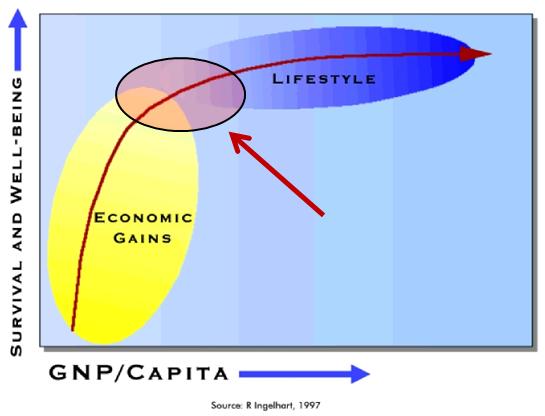
Meeting in the middle? The arrowed circle on this Inglehart Curve represents the highest level of well-being/survival consistent with a low level of resource use. It is therefore a target at which a society should aim. (Source: N. Hagens and R. Inglehart 1997)

Source

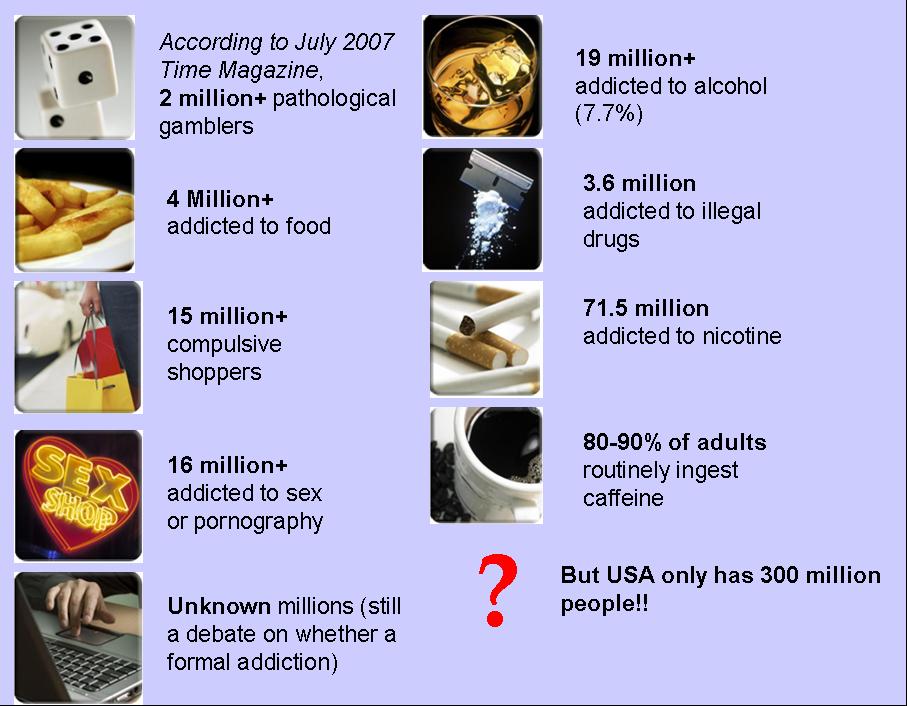
Graphic: American Addiction & Cultural Anhedonia

Analysis, Citizen-Centered, Definitions, Earth Orientation, Threats
Click on Image to Enlarge

Source

Wikipedia on Anhedonia:

In psychology and psychiatry, anhedonia (< Greek ἀν- an-, “without” + ἡδονή hēdonē, “pleasure”) is defined as the inability to experience pleasure from activities formerly found enjoyable, e.g. hobbies, exercise, social interaction or sexual activity.

Anhedonia can be a characteristic of mental disorders including mood disorders, schizoaffective disorder, schizoid personality disorder and schizophrenia. Affected schizophrenic patients describe themselves as feeling emotionally empty.[1]

Mood disturbances are commonly observed in many psychiatric disorders. Disturbing mood changes may occur resultant to stressful life events and they are not uncommon during times of physical illness. [2] While anhedonia can be a feature of such mood changes, they are not mutually inclusive.

Psychology of Human Incompetence: New Metrics

Advanced Cyber/IO, Analysis, Budgets & Funding, Commercial Intelligence, Communities of Practice, Cultural Intelligence, Earth Intelligence, Ethics, History, InfoOps (IO), Intelligence (government), International Aid, IO Sense-Making, Key Players, Methods & Process, Policies, Policy, Politics of Science & Science of Politics, Strategy, Technologies, Threats, Waste (materials, food, etc)
John Steiner

“Any coward can fight a battle when he's sure of winning, but give me the man who has pluck to fight when he's sure of losing. That's my way, sir; and there are many victories worse than a defeat.”

—George Eliot
We're losing!  Here's a playbook, see especially the focus on new metrics that have more meaning.

Posted by nate hagens on May 11, 2011 – 10:50am
Topic: Demand/Consumption
Tags: evolutionary psychology, human psychology, overconsumption [list all tags]

The essay below is an updated and edited version of a post I wrote here a few years ago, I'm Human, I'm American and I'm Addicted to Oil. Richard Douthwaite, Irish economist and activist, (and a fellow at the Post Carbon Institute), invited me to contribute it as a chapter in the just released book Fleeing Vesuvius, which is a collection of articles generally addressing “how can we bring the world out of the mess it finds itself in”? My article dealt with the evolutionary underpinnings of our aggregate behavior – neural habituation to increasingly available stimuli, and our evolved penchant to compete for status given the environmental cues of our day. And how, after we make it through the likely upcoming currency/claims bottleneck, we would be wise to adhere to an evolutionary perspective in considering a future (more) sustainable society.

Click here for the table of contents from Fleeing Vesuvius, followed by my article.

Phi Beta Iota: Will and Ariel Durant, in Lessons of History, state that the only real revolution is in the mind of man.  We strongly believe that strategic analytics is the next revolution, and that strategic analytics will make possible transparency, truth, and truth leading to compassionate non-zero evolution–a world that works for all.
See Also:

Engineers of India-Afghanistan vs China-Pakistan

02 China, 03 India, 04 Inter-State Conflict, 08 Wild Cards, 12 Water, Advanced Cyber/IO, Cultural Intelligence, Earth Intelligence, Government, IO Mapping, IO Multinational, IO Sense-Making, Methods & Process, Military, Peace Intelligence, Strategy

India-China-Pakistan: Indian intelligence agencies say they have credible evidence that several hundred Chinese working in Pakistan-occupied Kashmir are People's Liberation Army engineers, the Times of India reported 12 May.

According to the report, Indian intelligence agencies are verifying that the engineers are engaged with military construction projects, such as bunkers, and said the presence of military engineers in civilian construction activities carried out by China in other countries is “unusual,” an intelligence source said. The information about the engineers was part of an assessment presented by the Indian Army to the Indian prime minister, defense minister and other senior officials weeks ago.

Comment: This is the first press report of Chinese military engineers in Pakistan's portion of Kashmir. Chinese engineers are working on road construction in far northern Pakistan which borders China, but no engineering agreements are known that cover Pakistani Kashmir.

India-Afghanistan:
India has committed about $1.5 billion to Afghanistan for developmental assistance and plans to commit another $500 million over the next five years, Indian Prime Minister Manmohan Singh said on 12 May. Priority areas for the aid will be social programs, agriculture and infrastructure, according to Singh

India strongly supports Afghanistan's peace and reconciliation efforts with the Taliban, Indian Prime Minister Manmohan Singh told Afghan President Hamid Karzai during Singh's two-day visit to Kabul. Singh told Karzai and senior Afghan officials that New Delhi is Kabul's “neighbor and partner in development.” He expressed support for Afghanistan's “unity, integrity and prosperity

Comment: The two news stores above help explain Pakistan's dogged support for the Taliban and other anti-Kabul movements and its anxiety about India. India supported the Northern Alliance of Uzbek and Tajik tribes against the Pashtun Taliban when Karzai still was working for the Taliban, before he switched sides.

The presence of Indian advisors and influence west of Pakistan confronts Pakistani strategists with the prospect of fighting on two fronts in a putative future war, with no strategic depth because Pakistan is so narrow. More importantly, the Indian Border Roads Organization (BRO) has thousands of workers and Indian Army engineers working on the “infrastructure” projects in Afghanistan about which Prime Minister Singh spoke. BRO seems to concentrate on improving the roads in Afghan provinces that border Pakistan.

Indian motives in helping Afghanistan are far from altruistic, just as are those of Iran. Both states have provided aid to the Northern Alliance and the Afghan government, based on their strategic calculations to restrain Pakistan and especially prevent it from annexing the Pashtun regions of Afghanistan.

NIGHTWATCH KGS Home

Continue reading “Engineers of India-Afghanistan vs China-Pakistan”

noble gold